


Role Of Coaching In Resilience: Building Strength For Everyday Life
- Tom Ryder Wellbeing

- Dec 5, 2025
- 6 min read

Resilience coaching is gaining traction across British workplaces and communities, helping people reframe setbacks into opportunities for growth. Research shows that nearly 40 percent of adults in the United Kingdom report struggling to adapt to stress, highlighting the real need for strategies that foster mental strength. By exploring how coaching sparks resilience and empowers individuals to thrive, this article offers guidance on practical tools and mindsets that make a lasting difference.
Table of Contents
Key Takeaways
Point | Details |
Coaching Empowers Growth | Coaching is a collaborative process that helps individuals identify barriers and create actionable plans for personal and professional objectives. |
Resilience is Essential | Building resilience involves developing mental strength to cope with challenges, focusing on learning from setbacks rather than avoiding them. |
Diverse Coaching Approaches | Various coaching methods, such as cognitive-behavioural and solution-focused coaching, provide strategies to enhance emotional strength and adaptive skills. |
Application Across Domains | Coaching techniques can improve personal development and professional performance, supporting individuals in managing relationships and workplace challenges effectively. |
Defining coaching and resilience clearly
Coaching represents a collaborative, goal-oriented process designed to support individuals in unlocking their potential and navigating personal challenges. Unlike traditional therapy, coaching focuses on forward movement, helping people transition from where they are to where they want to be.
At its core, coaching psychology explores systematic approaches to personal development. The practice involves working with clients to identify barriers, develop strategies, and create actionable plans for achieving specific life or professional objectives. Coaches act as skilled guides, offering structured support without judgement, enabling individuals to discover their own solutions and build confidence.
Resilience sits at the heart of effective coaching. Resilience is not about avoiding difficulties but developing the mental and emotional strength to bounce back from setbacks. It involves cultivating adaptive coping mechanisms that help individuals transform challenges into opportunities for growth. Through targeted coaching interventions, people learn to:
Recognise negative thought patterns
Develop emotional regulation skills
Build robust support networks
Create personalised stress management techniques
Reframe obstacles as learning experiences
By integrating coaching principles with resilience-building strategies, individuals can develop a more flexible and robust approach to life’s complex challenges. The goal is not perfection but progressive personal development, where setbacks become stepping stones rather than roadblocks.
Coaching approaches that build resilience
Resilience coaching offers a diverse toolkit of evidence-based strategies designed to help individuals develop psychological flexibility and emotional strength. Researchers have identified several key approaches that effectively support personal growth and psychological adaptation.
Cognitive-behavioural coaching represents a powerful method for building resilience. This approach focuses on identifying and challenging unhelpful thought patterns that undermine an individual’s ability to respond constructively to challenges. By examining the relationship between thoughts, emotions, and behaviours, coaches help clients develop more adaptive mental strategies that promote emotional regulation and problem-solving skills.
Multiple resilience-building coaching approaches exist, each with unique strengths:
Solution-focused coaching: Concentrates on future possibilities and client strengths
Strengths-based coaching: Identifies and leverages individual capabilities
Acceptance and commitment coaching: Encourages psychological flexibility and value-aligned actions
Narrative coaching: Helps clients reframe personal stories and perspectives
These approaches share a common goal: empowering individuals to develop robust mental strategies that transform challenges into opportunities for personal growth. By working collaboratively with a skilled coach, people can learn to navigate life’s complexities with greater confidence and emotional intelligence.
How coaching develops resilient mindsets
Resilient mindsets emerge through deliberate psychological training that transforms how individuals perceive and respond to challenges. Coaching provides a structured pathway for developing mental flexibility, enabling people to reframe obstacles as opportunities for personal growth and learning.

The development of a resilient mindset involves multiple interconnected strategies. Coaches work closely with clients to identify deep-seated thought patterns that limit personal potential, helping them cultivate more adaptive and constructive mental frameworks. This process includes recognising automatic negative thinking, challenging self-limiting beliefs, and developing more balanced perspectives that support emotional regulation and personal effectiveness.
Key mechanisms for building resilient mindsets include:
Self-awareness: Developing deeper understanding of personal triggers and emotional responses
Cognitive reframing: Learning to interpret challenges as temporary and manageable
Emotional regulation: Building skills to manage stress and maintain composure
Growth orientation: Cultivating a perspective that views setbacks as learning opportunities
Self-compassion: Developing kinder, more supportive internal dialogue
Through targeted coaching interventions, individuals gradually build psychological muscles that enable them to navigate life’s complexities with greater confidence and emotional agility. The goal is not to eliminate difficulties but to develop a robust internal mechanism that transforms challenges into catalysts for personal development and continuous improvement.
Practical coaching mechanisms explained
Coaching psychology offers a range of systematic mechanisms designed to help individuals transform their approach to personal and professional challenges. These practical strategies go beyond traditional advice, providing structured interventions that enable clients to develop more adaptive thinking and behavioural patterns.
Cognitive-behavioural mechanisms form a cornerstone of effective coaching, focusing on the intricate relationship between thoughts, emotions, and actions. Coaches utilise techniques that help clients identify and challenge unhelpful thought patterns, replacing them with more constructive and empowering perspectives that support personal growth and resilience.
Key practical coaching mechanisms include:
Socratic questioning: Encouraging deeper self-reflection through strategic, probing questions
Cognitive mapping: Visualising thought patterns and identifying potential barriers to progress
Behaviour tracking: Monitoring and analysing personal responses to different situations
Scenario planning: Developing flexible strategies for anticipated challenges
Strengths identification: Uncovering and leveraging individual capabilities and resources
These mechanisms work collaboratively to help individuals develop a more nuanced understanding of their internal processes. By providing structured support and practical tools, coaching enables people to build psychological flexibility, transform limiting beliefs, and create more effective approaches to navigating life’s complexities.
Applications across personal and workplace life
Coaching strategies offer transformative approaches to building resilience that seamlessly integrate across personal and professional domains. These techniques provide individuals with versatile tools to navigate complex challenges, helping them develop adaptive skills that enhance performance and emotional well-being in multiple life contexts.
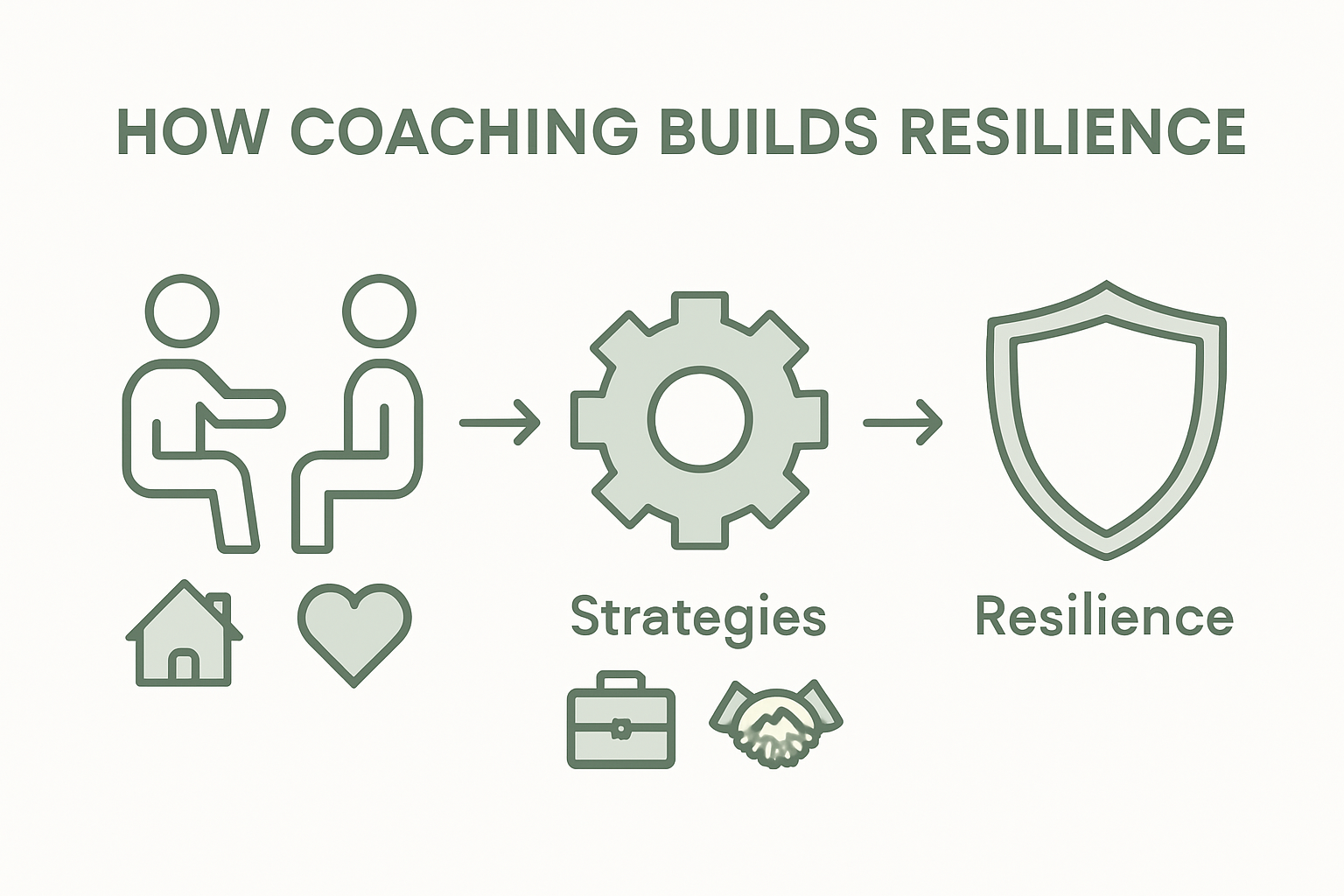
In personal life, coaching supports individuals in managing relationships, personal development, and emotional regulation. People learn to recognise unhelpful patterns, develop more effective communication strategies, and build stronger interpersonal connections. Workplace applications focus on professional growth, stress management, and leadership development, enabling employees to build psychological resilience that supports career progression and organisational effectiveness.
Key application areas include:
Personal growth: Managing life transitions, building self-confidence, and developing emotional intelligence
Career development: Improving professional skills, navigating workplace challenges, and setting strategic career goals
Relationship management: Enhancing communication, resolving conflicts, and building stronger personal and professional networks
Stress reduction: Developing coping mechanisms for both personal and professional pressures
Performance optimization: Creating strategies for continuous personal and professional improvement
The versatility of coaching lies in its ability to provide targeted support across different life domains. By offering personalised strategies that address individual needs, coaching helps people develop a holistic approach to resilience that supports growth, well-being, and personal effectiveness in every aspect of life.
Strengthen Your Resilience with Practical Coaching Support
The article highlights the importance of building resilience through coaching techniques that help you manage stress and reframe challenges as growth opportunities. If you feel overwhelmed by constant stress, anxiety, or a sense of being stuck in your personal or work life, Tom Ryder Wellbeing offers a practical, grounded approach designed just for these situations. Using concepts like emotional regulation, cognitive reframing, and the SCALES Model, we support you in creating small, effective changes to improve your mental and physical wellbeing.
Take the next step towards building your resilient mindset by exploring 1:1 Health and Wellbeing Coaching that focuses on developing clarity and personalised action plans. Discover how our Mindset Coaching can help you break free from self-doubt and build lasting confidence. Visit Tom Ryder Wellbeing now to start your journey towards emotional strength and everyday balance with coaching designed to turn setbacks into progress.
Frequently Asked Questions
What is the role of coaching in developing resilience?
Coaching plays a vital role in developing resilience by providing structured support and strategies that help individuals identify barriers, develop coping mechanisms, and create actionable plans for personal growth. It empowers individuals to navigate challenges more effectively.
How does cognitive-behavioural coaching enhance resilience?
Cognitive-behavioural coaching enhances resilience by focusing on identifying and challenging unhelpful thought patterns. This approach helps individuals develop more adaptive mental strategies, promoting emotional regulation and effective problem-solving skills.
What are some practical mechanisms used in resilience coaching?
Practical mechanisms in resilience coaching include Socratic questioning, cognitive mapping, behaviour tracking, scenario planning, and strengths identification. These techniques help individuals gain insights into their thought patterns and develop more effective responses to challenges.
How can coaching strategies be applied in everyday life?
Coaching strategies can be applied in everyday life by helping individuals manage personal relationships, professional challenges, and emotional regulation. They provide tools for improved communication, stress management, and overall personal and professional growth.
Recommended
Comments