


Role of Mindset in Mental Health – Practical Impact


Most advice about mental health focuses on quick fixes and ignores the role of mindset, yet over 70 percent of British adults say their everyday thoughts directly affect their well-being. Understanding the link between thinking patterns and resilience matters more than ever as mental health concerns rise across Britain. This guide reveals how shifting your mindset can help you build emotional strength, overcome challenges, and create lasting positive change.
Table of Contents
Key Takeaways
Point | Details |
Mindset Shapes Mental Health | Our mindset influences how we interpret challenges, affecting emotional regulation and resilience. A growth mindset fosters improved well-being and lower self-stigma. |
Barriers to Change | Psychological barriers such as negative self-talk and fear of failure can hinder the development of a positive mindset. Recognising these barriers is essential for personal transformation. |
Strategies for Mindset Shift | Intentional practices like cognitive reframing, reflective journaling, and mindfulness can effectively support the transformation of one’s mindset towards a more resilient perspective. |
Holistic Approaches | The SCALES Model emphasises the interconnectedness of various life dimensions like sleep, creativity, and social interactions in supporting mental health and facilitating personal growth. |
What Mindset Means for Mental Health
At its core, mindset represents the fundamental lens through which individuals interpret and respond to life’s challenges. Our internal narrative shapes not just our perception of events, but directly impacts our mental health resilience. Understanding this connection allows us to consciously reframe our thinking patterns and develop healthier psychological responses.
Research highlights the profound relationship between mindset and mental wellbeing. A compelling study examined how adopting growth mindsets regarding mental health correlates with decreased self-stigma and increased personal well-being among individuals managing mental health conditions. This suggests our mental attitude is not a fixed state, but a dynamic process we can actively cultivate and improve.
Practically speaking, mindset influences mental health through several key mechanisms:
Interpretation of challenges: Whether you view difficulties as insurmountable obstacles or opportunities for growth
Emotional regulation: How quickly you can reframe negative experiences and maintain psychological equilibrium
Stress response: Your ability to maintain composure and constructive thinking under pressure
Self-perception: The internal dialogue that either supports or undermines your confidence and resilience
Transforming mindset requires deliberate practice. It involves recognising unhelpful thought patterns, challenging negative self-talk, and developing a more compassionate, growth-oriented perspective. This isn’t about toxic positivity, but about building genuine psychological flexibility that allows you to navigate life’s complexities with greater ease and self-understanding.
Types of Mindset and Their Effects
Understanding mindset involves recognising two primary psychological frameworks: fixed mindset and growth mindset. These contrasting approaches fundamentally shape how individuals perceive challenges, interpret setbacks, and navigate personal development. Your mindset acts as an internal operating system that determines resilience, learning potential, and emotional responses.

A pivotal definition highlights that in a growth mindset, people believe their fundamental abilities can be developed through dedicated effort, understanding that talent represents merely a starting point. This perspective stands in stark contrast to a fixed mindset, where individuals perceive their capabilities as unchangeable and predetermined.
Let’s explore the distinctive characteristics of each mindset:
Fixed Mindset Characteristics:
Believes intelligence and talents are static traits
Avoids challenges to prevent potential failure
Views effort as fruitless if natural talent is lacking
Feels threatened by others’ success
Tends to give up quickly when encountering obstacles
Growth Mindset Characteristics:
Views challenges as opportunities for learning
Understands that effort is the pathway to mastery
Embraces criticism as constructive feedback
Finds inspiration in others’ achievements
Demonstrates persistent resilience during difficulties
The profound impact of mindset extends far beyond theoretical concepts. It directly influences mental health, professional progression, and personal relationships. By consciously cultivating a growth-oriented perspective, individuals can transform their psychological landscape, turning potential limitations into pathways for continuous self-improvement and emotional well-being.
How Mindset Influences Coping and Resilience
Coping and resilience are not predetermined traits, but dynamic psychological skills deeply influenced by our underlying mindset. The way we interpret challenges, setbacks, and emotional experiences fundamentally shapes our ability to navigate life’s complexities with strength and adaptability. Each response to difficulty represents a choice point where our mental framework determines whether we will be overwhelmed or empowered.
Research provides compelling evidence of this connection. Path analyses revealed that growth mindsets were directly linked to lower self-stigma and subsequently improved well-being, demonstrated through higher levels of positive emotions, meaningful engagement, quality relationships, sense of purpose, and personal accomplishment. This suggests that our internal narrative plays a crucial role in psychological resilience, transforming potential obstacles into opportunities for personal development.
Key mechanisms through which mindset impacts coping and resilience include:
Emotional Reframing: Ability to view challenges as learning experiences rather than threats
Stress Interpretation: Perceiving stress as a normal, manageable part of growth
Self-Talk Patterns: Developing constructive internal dialogue during difficult moments
Adaptive Problem-Solving: Approaching problems with curiosity and flexibility
Ultimately, cultivating a resilient mindset is about developing psychological agility. It involves consciously training yourself to respond to challenges with curiosity, compassion, and a belief in your capacity for growth. This doesn’t mean avoiding negative emotions, but rather learning to move through them with greater ease, understanding that each difficulty carries potential for personal transformation and deeper self-understanding.
Barriers to Positive Mindset Change
Psychological barriers represent invisible yet powerful obstacles that can prevent individuals from developing a more adaptive and growth-oriented mindset. These deeply ingrained mental patterns function like invisible walls, blocking personal transformation and maintaining status quo thinking, even when such thinking no longer serves our best interests.
The most prevalent barriers to positive mindset change emerge from complex psychological mechanisms deeply rooted in personal history, learned behaviours, and protective psychological strategies. These barriers often manifest through specific cognitive and emotional defence mechanisms that unconsciously resist change, creating a self-perpetuating cycle of limited thinking and restricted personal potential.
Key barriers that impede mindset transformation include:
Negative Self-Talk: Persistent internal criticism that undermines confidence
Fear of Failure: Overwhelming anxiety about potential mistakes or rejection
Comfort Zone Attachment: Resistance to stepping outside familiar psychological boundaries
Past Trauma Conditioning: Unresolved emotional experiences that create protective psychological shields
Limiting Belief Systems: Deeply embedded narratives about personal capabilities and worth
Overcoming these barriers requires deliberate, compassionate self-reflection and a willingness to challenge long-established thought patterns. The journey involves recognising these mental blocks not as permanent fixtures, but as malleable constructs that can be gradually reshaped through consistent practice, self-awareness, and a commitment to personal growth. Each small step towards understanding these barriers becomes a powerful act of psychological liberation, opening pathways to more flexible, resilient ways of thinking and being.
Proven Strategies for Shifting Mindset
Mindset transformation is an intentional process that requires structured approaches and consistent practice. Like tuning a musical instrument, shifting our psychological perspective demands precision, patience, and deliberate technique. Understanding that our mental frameworks are not fixed but malleable provides the fundamental foundation for meaningful personal change.
Educational approaches have highlighted the significance of strategic mindset development. Practical toolkits designed to help individuals develop helpful mindsets demonstrate that systematic interventions can effectively support psychological growth. These strategies are not about magical thinking, but about implementing concrete, evidence-based techniques that gradually reshape our internal narrative and response patterns.
Key strategies for mindset shift include:
Cognitive Reframing: Consciously challenging and reconstructing negative thought patterns
Reflective Journaling: Documenting thoughts to identify recurring mental barriers
Intentional Learning: Embracing challenges as opportunities for skill development
Positive Affirmation Practice: Developing constructive self-dialogue
Mindfulness Meditation: Cultivating awareness of thought processes
Successful mindset transformation requires understanding that change is a gradual, non-linear journey. Each small adjustment represents a meaningful step towards psychological flexibility. By approaching personal development with curiosity, compassion, and consistent effort, individuals can systematically dismantle limiting beliefs and construct more empowering, resilient mental frameworks that support genuine personal growth and emotional well-being.
Using the SCALES Model to Support Change
The SCALES Model represents a holistic framework for understanding and supporting mental health transformation. Like an intricate musical instrument with six interconnected strings, this approach recognises that psychological well-being depends on the careful tuning of multiple life dimensions. When one area becomes imbalanced, the entire system’s harmony can be disrupted.
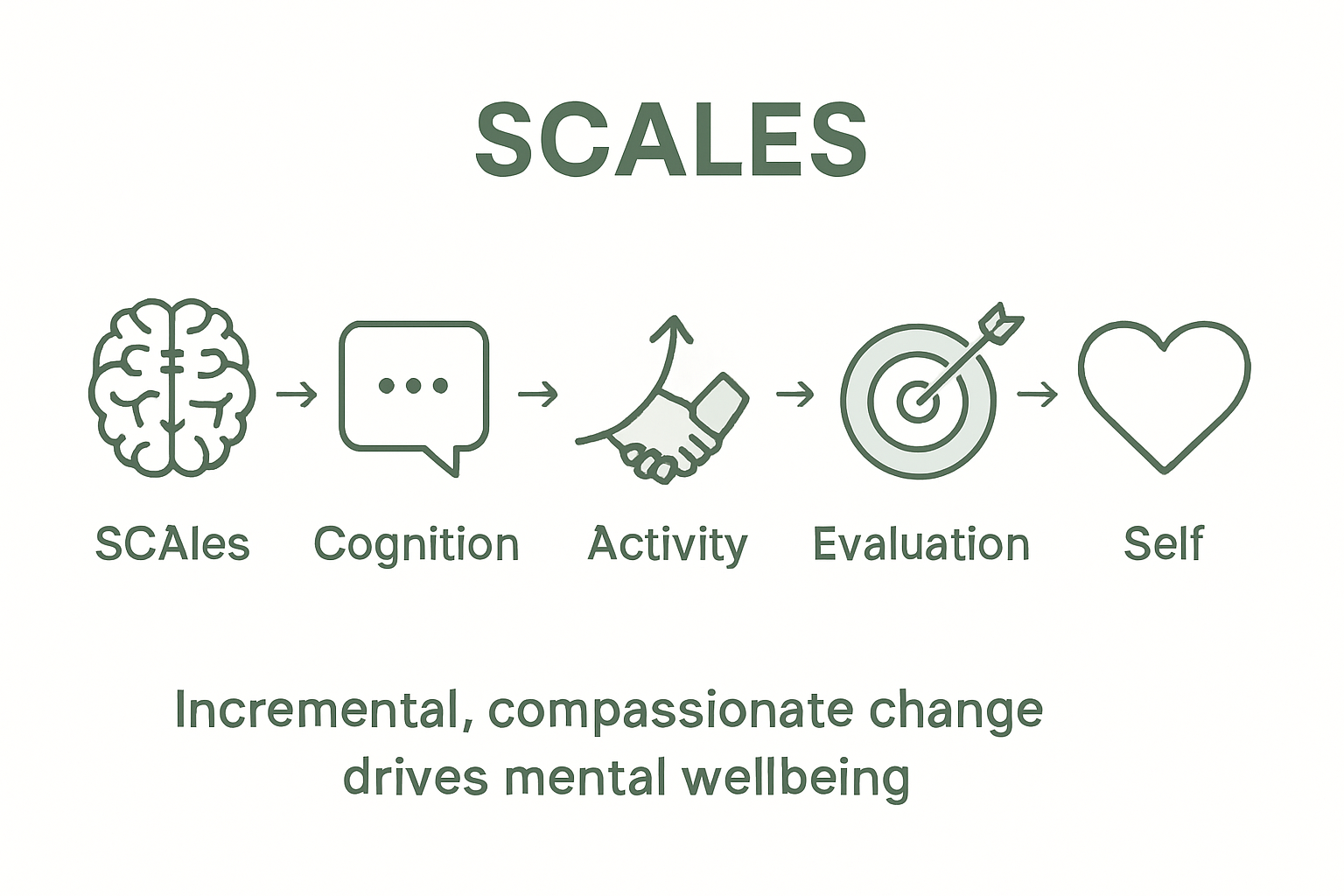
Educational approaches have long recognised the fundamental role of systematic frameworks in creating reflective, well-adjusted individuals capable of driving positive personal change. The SCALES Model provides precisely such a structured approach, offering a comprehensive toolkit for understanding and improving mental health through six key interconnected dimensions.
Each dimension of the SCALES Model offers specific strategies for psychological growth:
Sleep: Establishing consistent rest patterns and understanding sleep’s role in emotional regulation
Creative: Developing outlets for emotional expression and personal exploration
Active: Integrating physical movement as a cornerstone of mental well-being
Listen: Cultivating self-awareness and emotional intelligence
Earth: Connecting with natural environments and grounding techniques
Social: Building supportive relationships and community connections
Implementing the SCALES Model isn’t about perfection, but about incremental, compassionate adjustment. By recognising these six dimensions as interconnected elements of our psychological ecosystem, individuals can develop more nuanced, flexible approaches to personal growth. The model transforms mental health support from a rigid, prescriptive process into a dynamic, personalised journey of self-discovery and continuous improvement.
Embrace a Growth Mindset to Transform Your Mental Wellbeing
Understanding how mindset shapes your mental health is the first step towards lasting change. If you often feel overwhelmed by self-doubt, stuck in negative self-talk, or challenged by stress and low mood, there is a practical way forward. By recognising the power of mindset and using tools like the SCALES Model, you can build resilience and find balance across sleep, creative expression, activity, listening to yourself, connecting with nature, and social support.
At Tom Ryder Wellbeing, we specialise in coaching that helps you move beyond fixed thinking to a growth mindset. Our tailored 1:1 Health and Wellbeing Coaching and Mindset Coaching equip you with clear yet simple steps to reframe setbacks and develop routines that nurture your mental, emotional, and physical health. Why wait to feel more grounded and capable now? Start your journey to practical, sustainable change today with a free consultation and see how the SCALES Model can support you in tuning all six pillars of your wellbeing.
Frequently Asked Questions
What is the relationship between mindset and mental health?
Mindset acts as a lens through which we perceive challenges and respond to them. A positive mindset can enhance mental resilience, while a negative mindset may hinder emotional well-being.
How can I develop a growth mindset for better mental health?
Developing a growth mindset involves recognising unhelpful thought patterns, challenging negative self-talk, and reframing challenges as opportunities for learning. Regular reflection and intentional practice can aid this transformation.
What are the barriers to shifting my mindset?
Common barriers include negative self-talk, fear of failure, attachment to comfort zones, past trauma conditioning, and limiting belief systems. Overcoming these requires self-reflection and a commitment to challenge established thought patterns.
What strategies can help me shift my mindset towards a more positive outlook?
Effective strategies include cognitive reframing, reflective journaling, embracing challenges for learning, practising positive affirmations, and engaging in mindfulness meditation. These techniques help reshape your internal narrative and response patterns.
Recommended
How Cognitive Restructuring Helps Reframe Unhealthy Eating Habits? - LeanAndFit
Mindful Living Tips: The Essential Guide for Homes – BLUSHBEES USA
Comments