


What Is Resilience? Practical Meaning for Daily Life
- Tom Ryder Wellbeing

- Dec 8, 2025
- 8 min read

Most advice about resilience oversimplifies what it means to thrive after adversity. While the traditional view focuses on simply rebounding, British researchers highlight a more complex journey marked by ongoing adaptation and growth. Studies show true resilience weaves together emotional, physical, and social strengths, allowing people to transform through their toughest moments. This fresh perspective uncovers how resilience develops, the misconceptions that hold us back, and practical ways anyone can build lasting inner strength.
Table of Contents
Key Takeaways
Point | Details |
Resilience is Multifaceted | Resilience involves not just bouncing back, but growing and transforming through adversity across emotional, physical, and social domains. |
Core Traits of Resilient Individuals | Commitment, control, and challenge are key traits that enable resilient individuals to adapt effectively to life’s challenges. |
Misconceptions About Resilience | A common myth is that resilient people do not feel stress; true resilience involves processing emotions and often requires support. |
Building Resilience | Strengthening resilience involves setting achievable goals, nurturing relationships, and developing effective coping mechanisms. |
Defining Resilience Beyond Simple Bouncing Back
Resilience is far more complex than the simplistic notion of just “bouncing back” after difficulties. Recent interdisciplinary research challenges this traditional understanding, revealing resilience as a sophisticated, multilayered psychological process that involves dynamic adaptation and personal growth.
Scholars have critiqued the linear “bounce back” model, arguing instead that resilience represents a nuanced expansion and contraction dynamic across multiple personal domains. This means resilience isn’t about returning to a previous state, but about transforming and evolving through challenging experiences. Think of it less like a rubber band snapping back and more like a muscle that grows stronger through consistent stress and recovery.
Understanding resilience requires recognizing its multidimensional nature. Psychological resilience involves cognitive, emotional, and behavioural adaptations that help individuals navigate stress effectively. Comprehensive research analysis suggests that resilient individuals don’t just survive challenges but develop enhanced capabilities through them. They learn, adjust their perspectives, and cultivate new strategies for managing future difficulties.
Resilient people aren’t superhuman or immune to stress. Instead, they’ve developed flexible mental frameworks that allow them to process setbacks constructively. This might mean reframing negative experiences, maintaining supportive social connections, practising self-compassion, or developing problem-solving skills that help them navigate uncertainty with greater ease.
Types of Resilience: Emotional, Physical, Social
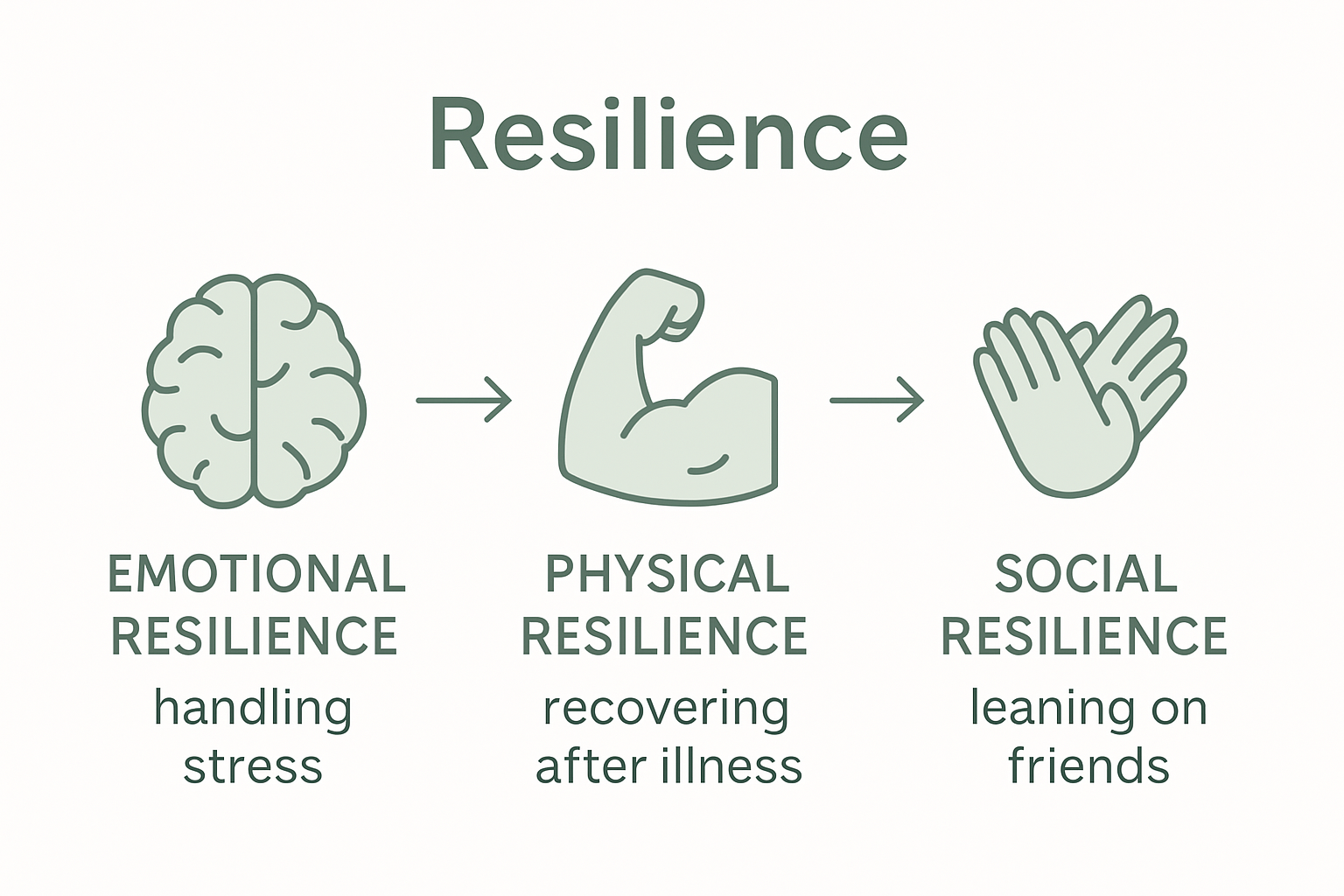
Resilience isn’t a singular concept but a complex spectrum of adaptive capabilities that manifest differently across various life domains. Comprehensive research suggests that individuals develop unique resilience types to navigate challenges effectively, each playing a crucial role in overall wellbeing and personal growth.
Emotional resilience represents our capacity to process and manage intense feelings without becoming overwhelmed. This involves recognising emotional triggers, developing healthy coping mechanisms, and maintaining psychological equilibrium during stressful situations. People with strong emotional resilience can experience difficult emotions without being consumed by them, bouncing back with greater psychological flexibility. Insights from mental health research indicate that emotional resilience helps individuals maintain a balanced perspective, preventing negative experiences from derailing their overall mental health.
Physical resilience relates to the body’s ability to recover from strain, illness, or injury. This type of resilience involves maintaining robust physiological systems through proper nutrition, regular exercise, adequate sleep, and stress management techniques. Physical resilience isn’t just about muscular strength, but about creating a responsive, adaptive biological system that can withstand and recover from environmental and internal challenges.
Social resilience emerges through our ability to build and maintain supportive relationships that provide emotional scaffolding during difficult times. This involves developing communication skills, establishing healthy boundaries, cultivating empathy, and creating networks of mutual support. Socially resilient individuals can navigate interpersonal challenges, seek help when needed, and contribute positively to their community’s collective wellbeing.
Core Traits and Behaviours of Resilient People
Resilient individuals possess a distinctive set of psychological characteristics that enable them to navigate life’s challenges with remarkable adaptability. Psychological hardiness research reveals three fundamental traits that distinguish these individuals: commitment, control, and challenge.
Commitment represents the ability to remain engaged and purposeful, even when circumstances become difficult. Resilient people maintain a deep sense of meaning in their experiences, viewing challenges as opportunities for personal growth rather than insurmountable obstacles. They stay connected to their core values and long-term goals, which provides an internal compass during turbulent times. This trait allows them to transform potential setbacks into meaningful learning experiences, maintaining their motivation and sense of direction.
The second critical trait is control, which involves believing in one’s capacity to influence outcomes rather than feeling powerless. Resilient individuals understand that while they cannot control every external circumstance, they can always control their response. They take proactive steps to address challenges, make strategic decisions, and adapt their approach when needed. This sense of personal agency helps them maintain psychological equilibrium, reducing feelings of helplessness and increasing their problem-solving capabilities.
Lastly, challenge represents the ability to view change and uncertainty as natural, potentially exciting aspects of life rather than threats. Resilient people approach difficulties with curiosity and openness, seeing them as chances for personal development and skill enhancement. They remain flexible in their thinking, willing to experiment with new strategies and learn from both successes and failures. This perspective transforms potential stressors into opportunities for growth, enabling them to develop increasingly sophisticated coping mechanisms over time.
How Resilience Develops Over Time and Experience
Resilience is not an innate, fixed trait but a dynamic skill that grows through continuous learning and adaptation. Academic research on resilience development demonstrates that individuals progressively build psychological strength by navigating successive challenges and reflecting on their experiences.
The initial stages of resilience development typically involve experiencing setbacks and learning fundamental coping strategies. During these early phases, individuals begin to recognise patterns in their emotional responses and develop initial problem-solving techniques. Young people, in particular, start building resilience by encountering manageable academic and social challenges that stretch their comfort zones without overwhelming them. Studies exploring professional development reveal that structured exposure to challenging environments helps individuals incrementally develop more sophisticated resilience mechanisms.
As individuals mature, their resilience becomes more nuanced and context-specific. They learn to distinguish between situations requiring direct intervention and those demanding emotional regulation or strategic acceptance. This sophisticated approach involves developing a repertoire of adaptive responses rather than relying on a single coping mechanism. Critically, resilience development is not linear but cyclical, with each challenging experience providing an opportunity to refine emotional intelligence, self-awareness, and psychological flexibility.
Ultimately, resilience emerges from a combination of accumulated experiences, intentional learning, and conscious reflection. Individuals who actively seek to understand their emotional responses, learn from both successes and failures, and remain open to personal growth tend to develop more robust resilience over time. This process involves cultivating self-compassion, maintaining a growth mindset, and recognising that vulnerability is not weakness but a fundamental aspect of human adaptability.
Common Barriers and Misconceptions About Resilience
Resilience has become a widely discussed concept, yet it remains frequently misunderstood. Critical research examines the problematic narratives surrounding resilience, revealing several pervasive misconceptions that can actually hinder genuine psychological growth and adaptive coping.
One of the most damaging myths is the belief that resilience means never experiencing negative emotions or completely eliminating stress. Contemporary psychological perspectives challenge this notion, emphasising that resilience is not about suppressing emotions but about experiencing and processing them effectively. Resilient individuals do not magically avoid difficult feelings; instead, they develop sophisticated strategies for acknowledging, understanding, and moving through challenging emotional landscapes without becoming permanently overwhelmed.
Another significant barrier is the societal expectation that resilient people should instantly ‘bounce back’ from adversity without requiring support or recovery time. This misconception places an unrealistic burden on individuals, suggesting that psychological strength means immediate and complete recovery. In reality, resilience is a nuanced, non-linear process that involves vulnerability, learning, and gradual adaptation. It requires compassionate self-understanding and often necessitates external support, professional guidance, or structured mental health interventions.
Furthermore, many people mistakenly view resilience as an innate personality trait rather than a skill that can be developed and refined. This fixed mindset prevents individuals from recognising their capacity for growth and learning. True resilience is not about being superhuman or immune to stress, but about cultivating the flexibility, self-awareness, and emotional intelligence to navigate life’s challenges with increasing competence and grace.
Practical Steps to Strengthen Personal Resilience
Building personal resilience requires intentional practice and a strategic approach to developing psychological strength. Research exploring resilience enhancement suggests a comprehensive framework for systematically improving one’s ability to navigate life’s challenges.
Developing competence and confidence forms the foundation of resilience. This involves setting achievable goals, acquiring new skills, and celebrating incremental progress. Break larger objectives into smaller, manageable tasks that provide regular opportunities for success. By consistently challenging yourself and reflecting on your capabilities, you gradually build a more robust sense of self-efficacy. This approach helps counteract self-doubt and creates a positive feedback loop where small achievements generate momentum and increased belief in your own potential.
The next crucial dimension involves cultivating strong connections and character. Resilient individuals invest in supportive relationships that provide emotional scaffolding during difficult times. This means actively nurturing meaningful social connections, practising vulnerability, and surrounding yourself with people who encourage personal growth. Simultaneously, developing character involves clarifying your core values, maintaining ethical integrity, and creating a sense of purpose that transcends immediate challenges. By understanding what truly matters to you, you create an internal compass that helps navigate uncertainty with greater clarity and resolve.
Ultimately, strengthening resilience requires mastering effective coping mechanisms and maintaining a sense of personal control. This involves developing a toolkit of stress management techniques, such as mindfulness practices, regular physical exercise, creative expression, and structured reflection. Learn to distinguish between aspects of life you can influence and those beyond your control, directing your energy strategically. Embrace a growth mindset that views challenges as opportunities for learning rather than insurmountable obstacles. By consistently practising these approaches, you transform resilience from an abstract concept into a lived, dynamic experience of personal empowerment.
Build True Resilience with Practical Support from Tom Ryder Wellbeing
The article reveals that resilience is not just about “bouncing back” but is a dynamic, ongoing process involving emotional flexibility, personal growth, and effective coping strategies. If you often find yourself feeling overwhelmed by stress, stuck in cycles of negative thinking, or unsure how to move forward after setbacks, this complexity can feel daunting. Building resilience means developing clear, manageable skills and routines that support mental, emotional, and physical wellbeing rather than expecting to instantly recover from every challenge.
At Tom Ryder Wellbeing, we specialise in turning these psychological insights into practical, personalised coaching grounded in the proven SCALES Model. You will gain:
Clarity on what better balance means for you across Sleep, Creative outlets, Activity, Listening to your needs, Earth grounding, and Social support
Step-by-step guidance breaking down big life changes into achievable daily actions
Tools and accountability to build emotional resilience so that setbacks do less damage and confidence grows
Discover how to transform resilience from an abstract idea into real change by exploring our 1:1 Health and Wellbeing Coaching and SCALES Programme. Take the first step today with a free consultation to find out how coaching tailored to your needs can empower you to handle life’s challenges with greater ease and create lasting wellbeing.
Frequently Asked Questions
What is the true meaning of resilience?
Resilience is a complex psychological process involving dynamic adaptation and personal growth in response to challenges. It’s not merely about bouncing back but about transforming and evolving through experiences.
What are the different types of resilience?
The main types of resilience are emotional, physical, and social. Emotional resilience involves managing intense feelings; physical resilience relates to recovery from physical challenges; and social resilience focuses on maintaining supportive relationships during tough times.
How can I develop resilience over time?
You can develop resilience by experiencing setbacks, learning coping strategies, and reflecting on your experiences. Engaging in gradual challenges, maintaining social connections, and practising self-awareness contribute to your resilience growth.
What are some common misconceptions about resilience?
Some misconceptions include the belief that resilient individuals never experience negative emotions, that they must ‘bounce back’ instantly from adversity, and that resilience is an innate personality trait rather than a skill that can be developed.
Comments