


Why Mindset Coaching Matters for Life Balance


Most people do not realize that over 80 percent of British adults report struggling with persistent negative thinking at some point in their lives. The way you think shapes every decision, from daily habits to long-term goals, sometimes holding you back more than you know. Mindset coaching offers a fresh path for anyone ready to challenge limiting beliefs and build more resilient, productive thought patterns. Here you will discover what makes mindset coaching unique and who gains the most from its practical, results-focused approach.
Table of Contents
Key Takeaways
Point | Details |
Mindset Coaching Focuses on Future Potential | Unlike traditional therapy, mindset coaching helps individuals reshape their thought patterns and overcome limiting beliefs to unlock personal growth. |
Broad Beneficiary Spectrum | Professionals, creatives, students, and anyone dealing with stress or uncertainty can benefit from mindset coaching to enhance emotional resilience and clarity. |
Complementary to Traditional Therapy | Mindset coaching is not a replacement for therapy but offers a proactive approach to personal development and self-improvement. |
Awareness of Limits is Crucial | Although mindset coaching can be effective, it is essential to manage expectations and recognise when professional mental health treatment is necessary. |
What Is Mindset Coaching and Who Needs It
Mindset coaching represents a transformative approach to personal development that focuses on reshaping thought patterns and belief systems to unlock individual potential. Unlike traditional therapy, which often explores past experiences, mindset coaching is forward-looking and action-oriented, helping people understand how their current thinking impacts their life outcomes.
At its core, mindset coaching works by identifying and challenging limiting beliefs that prevent personal growth. These beliefs might stem from past experiences, societal conditioning, or ingrained psychological patterns that create invisible barriers to success. A mindset coach helps individuals recognise these mental roadblocks and develop strategies to reframe negative thought processes, enabling more constructive and empowering perspectives.
Who can benefit from mindset coaching? The answer is broad. Professionals experiencing career stagnation, creatives struggling with self-doubt, students navigating complex transitions, and individuals wrestling with persistent stress or anxiety are prime candidates. Specifically, mindset coaching serves people who:
Feel consistently stuck in negative thought patterns
Struggle to achieve personal or professional goals
Experience recurring self-sabotaging behaviours
Want to develop greater emotional resilience
Seek clarity about personal direction and purpose
Need support in managing workplace or life transitions
The SCALES Model developed by Tom Ryder provides an excellent framework for understanding how mindset coaching intersects with holistic wellbeing. By addressing sleep, creativity, activity, listening, earthing, and social connections, this approach ensures that mindset work is not conducted in isolation but as part of a comprehensive personal development strategy. Mindset coaching, therefore, is not about quick fixes but sustainable, meaningful transformation.
Key Benefits: Mental Health and Resilience
Mental health resilience is a critical skill that mindset coaching helps individuals develop, enabling them to navigate life’s challenges with greater emotional strength and adaptability. Research demonstrates that targeted interventions can significantly enhance an individual’s capacity to manage stress and maintain psychological wellbeing. In fact, systematic reviews of resilience interventions have shown promising results in reducing perceived stress and improving overall mental health outcomes.
Mindset coaching specifically targets psychological mechanisms that underpin emotional resilience. By helping individuals reframe negative thought patterns and develop more constructive perspectives, these coaching approaches create fundamental shifts in how people perceive and respond to challenges. Clinical research in educational environments has highlighted the profound impact of growth mindset interventions, demonstrating that individuals who learn to view challenges as opportunities for development experience enhanced psychological flexibility.
The key benefits of mindset coaching for mental health and resilience include:
Improved emotional regulation skills
Enhanced ability to manage workplace and personal stress
Increased self-awareness and psychological insight
Development of proactive coping strategies
Reduced anxiety and negative thought spirals
Greater capacity for personal and professional adaptation
Through structured coaching techniques, individuals learn to build psychological capital that transforms their approach to challenges. Rather than feeling overwhelmed by difficulties, coached individuals develop a robust toolkit for emotional management, enabling them to maintain equilibrium during turbulent periods. The ultimate goal is not just surviving challenging circumstances, but developing the inner resources to thrive and grow through them.
Mindset Coaching Versus Traditional Therapy
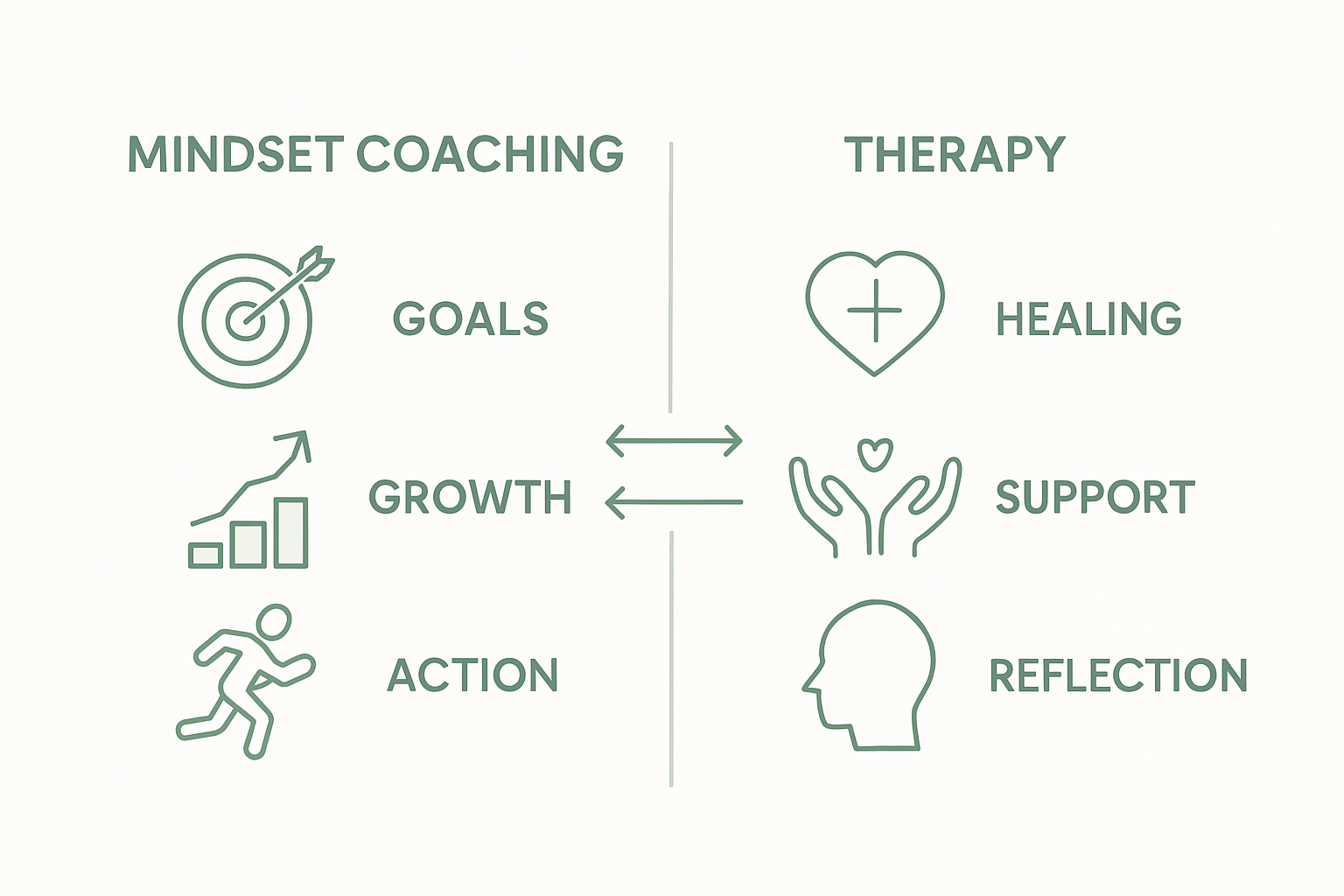
While traditional therapy and mindset coaching share the fundamental goal of supporting mental wellbeing, they differ significantly in approach, methodology, and desired outcomes. Traditional therapy typically focuses on exploring past experiences, processing emotional wounds, and diagnosing potential mental health conditions. In contrast, virtual professional coaching has demonstrated promising results in actively improving psychological well-being, emphasising a forward-looking, action-oriented strategy.
Mindset coaching distinguishes itself through its proactive and solution-focused methodology. Where traditional therapy might spend considerable time understanding the origins of psychological challenges, mindset coaching concentrates on developing practical strategies for personal transformation. Contemporary research on cognitive restructuring techniques suggests that both approaches can facilitate mental health improvements, but coaching tends to be more immediate and pragmatic in its interventions.
Key differences between mindset coaching and traditional therapy include:
Timeframe of intervention
Therapy: Often long-term and open-ended
Coaching: Typically short-term and goal-specific
Primary focus
Therapy: Healing past traumas and managing diagnosed conditions
Coaching: Developing future potential and creating actionable change
Interaction style
Therapy: Patient-led, exploring emotional landscapes
Coaching: Collaborative, with clear objectives and measurable outcomes
Ultimately, mindset coaching is not a replacement for therapy, particularly for individuals dealing with complex mental health conditions. Instead, it offers a complementary approach that empowers individuals to take active control of their personal development, build resilience, and create meaningful life transformations through structured, goal-oriented strategies.
How Mindset Coaching Works in Practice
Mindset coaching operates through a structured yet personalised approach that transforms individual thinking patterns and behavioural responses. Imperial College London describes coaching as a process involving both mindset and skillset development, where individuals are guided to recognize their inner strengths and restructure their thinking to discover innovative solutions. This approach typically begins with a comprehensive assessment of current thought patterns, identifying potential psychological barriers that prevent personal growth and optimal performance.

The practical implementation of mindset coaching involves several key stages. Initially, coaches work closely with clients to establish clear, measurable objectives that align with their personal and professional aspirations. Through a series of targeted conversations and reflective exercises, individuals learn to challenge existing belief systems and develop more constructive mental frameworks. Practical applications, such as the MINDFIT programme in the UK, demonstrate how structured interventions can effectively build confidence, reduce anxiety, and improve overall achievement across various life domains.
Typical mindset coaching techniques include:
Cognitive reframing
Transforming negative thought patterns
Developing alternative perspectives on challenges
Goal-setting strategies
Creating specific, measurable objectives
Breaking down complex goals into manageable steps
Reflection and self-awareness exercises
Journaling techniques
Mindfulness practices
Personal values alignment
The SCALES Model provides a comprehensive framework for this approach, ensuring that mindset coaching addresses multiple dimensions of personal development. Coaches help clients understand how sleep, creativity, activity, listening, earthing, and social connections interplay to create holistic psychological wellbeing. Ultimately, mindset coaching is about empowering individuals to become their own most effective change agents, equipped with practical tools to navigate life’s challenges with greater resilience and clarity.
Risks, Limitations, and What to Avoid
While mindset coaching offers significant potential for personal development, it is not a universal solution applicable to every individual or situation. Research on school-based growth mindset programmes in Scotland highlights the nuanced nature of such interventions, demonstrating that not all programmes yield consistent or positive outcomes. This underscores the importance of understanding the potential limitations and risks associated with mindset coaching.
Studies examining mindset interventions among college students reveal that while these approaches can reduce stress and improve psychological perspectives, their effectiveness varies significantly. Potential risks and limitations include unrealistic expectations, potential oversimplification of complex psychological challenges, and the danger of individuals viewing coaching as a substitute for professional mental health treatment when more intensive support is required.
Key risks and potential pitfalls to be aware of include:
Expectations management
Avoiding promises of instant transformation
Understanding that progress is gradual
Professional boundaries
Not replacing clinical mental health treatment
Recognising when specialist intervention is necessary
Individual variability
Acknowledging that approaches work differently for each person
Being prepared to adapt strategies
Crucial warning signs that mindset coaching might not be suitable include experiencing severe mental health conditions, having unmanaged trauma, or seeking a quick fix for deeply rooted psychological challenges. Ethical mindset coaches will always prioritise the client’s wellbeing, maintaining clear professional boundaries and recommending alternative support when appropriate. The most effective coaching occurs when both coach and client understand the approach’s potential and limitations, creating realistic expectations for personal growth and development.
Discover How Mindset Coaching Creates Lasting Life Balance
Many people feel overwhelmed by stress, self-doubt, and constant pressure, making it hard to find balance in work, relationships, and health. This article highlights how mindset coaching helps break negative thought cycles and builds resilience by reshaping beliefs and managing emotional challenges. If you often struggle with feeling “off balance” or stuck in unhelpful patterns, the SCALES Model can guide you towards restoring harmony across key life areas like sleep, creativity, activity, listening, earth, and social connection.
At Tom Ryder Wellbeing, we offer tailored mindset coaching rooted in real lived experience and professional training. Our approach breaks down your goals into manageable steps and builds emotional strength through practical habits aligned with the SCALES framework. Whether you want to overcome self-doubt, reduce stress, or gain clearer direction in life, our coaching supports you with honesty and achievable change. Ready to tune your life back into balance? Start with a free consultation and explore coaching options designed for your unique needs at Tom Ryder Wellbeing. Learn more about how we use the SCALES Model to bring greater wellbeing and resilience into your everyday life.
Frequently Asked Questions
What is mindset coaching?
Mindset coaching is a personal development approach that focuses on reshaping thought patterns and belief systems to unlock individual potential and enhance future growth.
Who can benefit from mindset coaching?
Mindset coaching can benefit a wide range of individuals, including professionals facing career stagnation, creatives grappling with self-doubt, students in transition, and anyone dealing with stress or anxiety.
How does mindset coaching differ from traditional therapy?
Mindset coaching is proactive and solution-focused, concentrating on developing practical strategies for personal transformation, while traditional therapy often explores past experiences and emotional wounds.
What are the key techniques used in mindset coaching?
Key techniques in mindset coaching include cognitive reframing, goal-setting strategies, and self-awareness exercises, which together help individuals develop more constructive thought patterns and practical coping strategies.
Comments