


Why Promote Wellbeing in Schools – Real Impacts on Learning


Over half of British students report that their mental health directly affects their academic success. Wellbeing is no longer just a buzzword in British schools—families, teachers, and policymakers are all facing rising concerns about student stress, emotional health, and personal growth. Understanding how schools promote wellbeing reveals what really drives happier, more resilient learners and where meaningful change starts within the educational system.
Table of Contents
Key Takeaways
Point | Details |
Holistic Development | Wellbeing promotion in schools focuses on nurturing students’ physical, mental, and emotional health beyond academic performance. |
Whole-School Approach | Successful wellbeing programmes require comprehensive, integrated strategies that involve all stakeholders in creating supportive environments. |
Impact on Academic Success | There is a strong link between student wellbeing and academic performance, with proactive mental health support enhancing engagement and achievement. |
Risks of Neglect | Failing to address pupil wellbeing can lead to severe consequences, including increased anxiety and disengagement from education. |
Defining Wellbeing Promotion in Schools
Wellbeing promotion in schools represents a holistic approach to supporting students’ comprehensive development beyond traditional academic learning. It encompasses a strategic framework designed to nurture students’ physical, mental, and emotional health through intentional educational practices. European Education Area research highlights this approach as fundamentally about creating supportive environments that foster positive relationships and personal growth.
At its core, school wellbeing promotion involves developing students’ social and emotional competencies while establishing environments conducive to individual potential. Cambridge University Press defines this as a dynamic state where learners can realise their potential, effectively manage daily stresses, and function productively. This means schools must move beyond purely academic metrics to understand and support students’ comprehensive psychological and physiological needs.
Key elements of effective wellbeing promotion include:
Developing emotional intelligence and resilience
Creating safe, inclusive learning environments
Supporting mental health through proactive strategies
Encouraging positive interpersonal relationships
Teaching stress management techniques
By integrating wellbeing strategies across curriculum and school culture, educational institutions can transform traditional learning spaces into nurturing environments that support holistic student development. This approach recognises that academic success is intrinsically linked to students’ overall emotional and psychological welfare.
Key Elements of School Wellbeing Programmes
School wellbeing programmes represent a comprehensive strategy for supporting students’ holistic development, focusing on creating environments that nurture mental, emotional, and social health. UK Department for Education research emphasises a whole-school approach that integrates multiple dimensions of student support and institutional practice.
Whole-school wellbeing requires a strategic framework that extends beyond isolated interventions. T4 Education highlights the importance of building a culture that systematically prioritises student welfare. This involves developing clear organisational vision, establishing strong leadership commitment, and creating structures that consistently support student mental health.
Key components of effective school wellbeing programmes include:
Comprehensive leadership engagement
Consistent staff training and development
Integrated curriculum approaches
Proactive mental health support
Collaborative partnerships with parents and carers
Regular emotional intelligence training
Personalised support mechanisms
Transparent communication strategies
Continuous programme evaluation
Successful implementation requires a multifaceted approach that recognises wellbeing as a dynamic, interconnected process. Schools must move beyond reactive models to create preventative, supportive environments that empower students to develop resilience, emotional understanding, and self-management skills. By embedding wellbeing into institutional culture, educational settings can transform traditional learning spaces into nurturing ecosystems that support comprehensive student growth.
Impact on Mental Health and Academic Success
The connection between student wellbeing and academic performance represents a critical area of educational research, revealing profound links between mental health and learning outcomes. UK Department for Education research demonstrates that comprehensive mental health interventions can significantly enhance both psychological resilience and educational achievement.

Academic success is intrinsically tied to students’ emotional and psychological state. Parliamentary research highlights that schools implementing robust wellbeing programmes consistently observe improvements in student attendance, engagement, and overall academic performance. This suggests that mental health support is not a peripheral educational activity, but a fundamental component of effective learning environments.
Key impacts of wellbeing programmes on student outcomes include:
Reduced anxiety and stress levels
Improved emotional regulation skills
Enhanced classroom participation
Better interpersonal relationship development
Increased academic motivation
Higher resilience during challenging academic periods
More effective study and learning strategies
Improved self-confidence and self-perception
By recognising mental health as a core educational priority, schools can create transformative learning experiences that support students’ holistic development. These programmes do more than mitigate psychological challenges; they actively cultivate the emotional intelligence, self-awareness, and psychological skills necessary for sustained academic and personal success. The investment in student wellbeing represents a powerful strategy for nurturing future-ready, emotionally intelligent learners who can navigate complex academic and personal landscapes with confidence and resilience.
Whole-School Approaches and Practical Strategies
A whole-school approach to wellbeing represents a comprehensive, systemic strategy that integrates mental health support across all aspects of school life. Schools Wellbeing Partnership research, developed by Professor Katherine Weare, emphasises the importance of creating an integrated framework that goes beyond isolated interventions, embedding wellbeing into the fundamental culture and practice of educational institutions.
Worth-it’s guide advocates for a preventative model that actively involves all school stakeholders in cultivating a supportive environment. This approach recognises that effective wellbeing strategies cannot be implemented through top-down directives, but require genuine engagement from leadership, staff, students, and broader school communities.
Practical strategies for implementing a whole-school wellbeing approach include:
Comprehensive staff mental health training
Developing clear wellbeing policies and protocols
Creating dedicated wellbeing leadership roles
Integrating emotional intelligence into curriculum
Establishing peer support networks
Regular mental health awareness programmes
Developing transparent communication channels
Implementing flexible support mechanisms
Continuous programme evaluation and adaptation
Successful whole-school wellbeing requires a dynamic, responsive approach that recognises the unique ecosystem of each educational institution. By creating environments that prioritise psychological safety, emotional learning, and holistic support, schools can transform traditional educational models into nurturing spaces that genuinely support students’ comprehensive development. This approach does more than address immediate mental health challenges; it builds foundational skills for lifelong emotional resilience and personal growth.
Risks of Neglecting Pupil Wellbeing
Mental health neglect in educational settings carries profound and long-lasting consequences for students’ personal and academic development. UK Parliamentary research reveals that schools failing to address pupil wellbeing systematically expose students to significant psychological and educational risks, potentially undermining their entire developmental trajectory.
The ‘Education for Wellbeing’ programme highlights the critical interconnection between emotional support and academic performance, demonstrating that neglecting student mental health can trigger cascading negative outcomes. When schools do not proactively support psychological welfare, students become increasingly vulnerable to complex challenges that extend far beyond immediate academic environments.
Potential risks of neglecting pupil wellbeing include:
Increased rates of anxiety and depression
Higher likelihood of academic disengagement
Reduced emotional resilience
Compromised social skill development
Elevated school absenteeism
Long-term mental health complications
Diminished self-confidence
Potential development of negative coping mechanisms
Increased vulnerability to bullying and social isolation
Ultimately, neglecting student wellbeing represents more than an educational oversight; it constitutes a significant developmental risk that can fundamentally alter a young person’s life trajectory. By understanding these potential consequences, educational institutions can recognise the critical importance of proactive, compassionate mental health support as an integral component of holistic student care and development.
Comparing Wellbeing Models for UK Schools
UK Department for Education guidance reveals multiple approaches to school wellbeing, emphasising the need for flexible, comprehensive models that can adapt to diverse educational environments. Wellbeing models represent strategic frameworks designed to support students’ holistic development, each with unique strengths and implementation strategies.
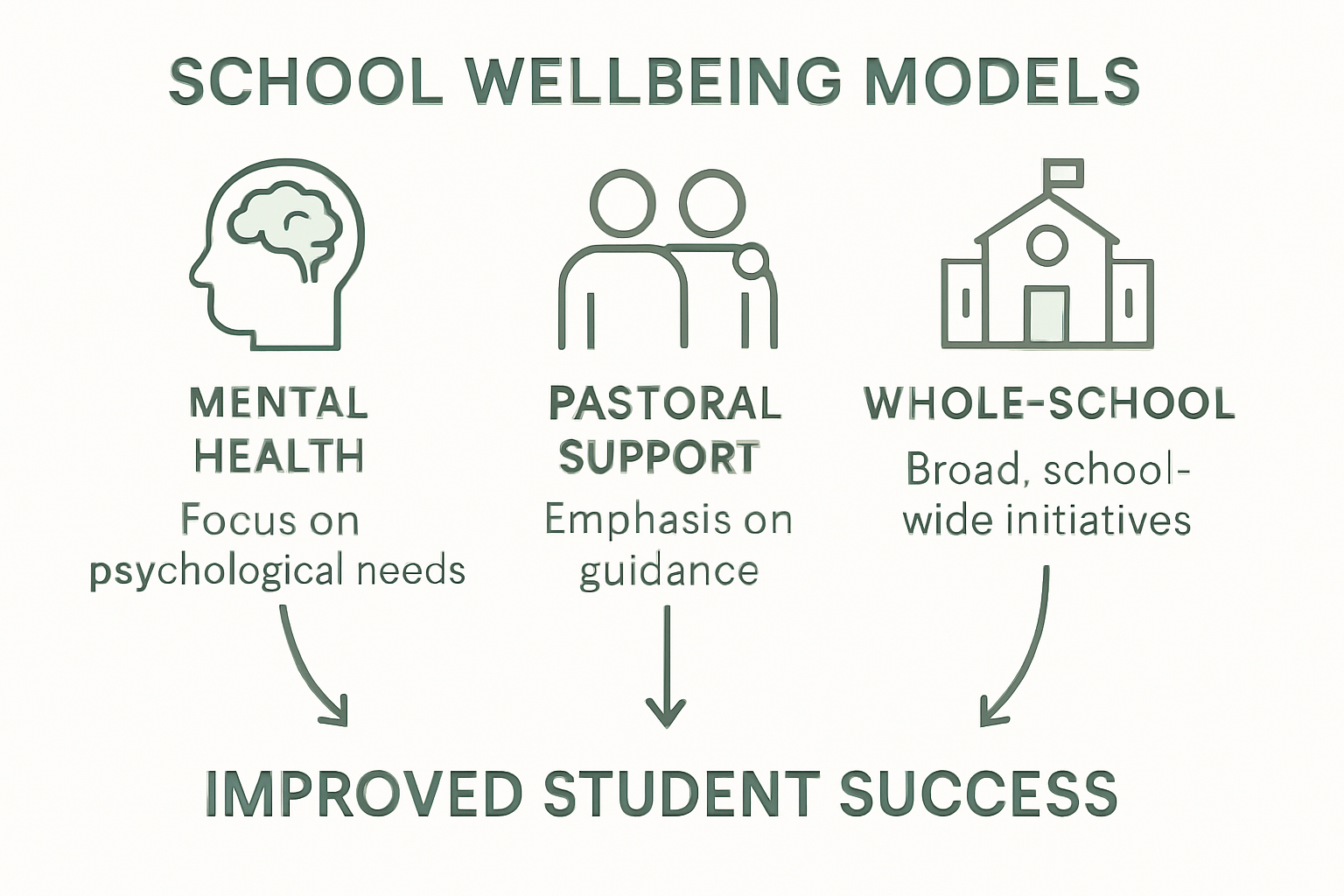
Research from Routledge’s comprehensive publication highlights the complexity of health promotion in educational settings, demonstrating that effective models must balance systematic intervention with personalised support mechanisms. The most successful approaches integrate multiple perspectives, recognising that student wellbeing cannot be addressed through a one-size-fits-all methodology.
Key comparative aspects of wellbeing models include:
Comprehensive leadership involvement
Integrated mental health support
External agency collaboration
Personalised intervention strategies
Whole-school cultural transformation
Proactive prevention mechanisms
Continuous evaluation processes
Flexible implementation frameworks
Staff and student engagement levels
Successful wellbeing models transcend theoretical frameworks, becoming living systems that respond dynamically to students’ evolving psychological and emotional needs. By understanding the nuanced differences between approaches, schools can develop sophisticated, adaptive strategies that genuinely support student mental health and personal development.
Unlock True Wellbeing in Schools with Practical Coaching Support
The article highlights how promoting wellbeing in schools is essential for reducing stress, enhancing emotional resilience, and improving academic success. Many students, educators, and families face challenges such as anxiety, low motivation, and difficulty managing everyday pressures. Concepts like emotional intelligence, whole-school approaches, and proactive mental health strategies call for practical, personalized support that goes beyond theory.
At Tom Ryder Wellbeing, we understand these challenges deeply. Drawing on over a decade of experience supporting young people across the UK, our coaching focuses on sustainable change using the proven SCALES Model, addressing Sleep, Creativity, Activity, Listening, Earth, and Social connections. Our tailored coaching helps individuals and schools break down overwhelming challenges into clear, manageable steps that build lasting resilience and balance.
Discover how our 1:1 Health and Wellbeing Coaching and Workshops and Group Sessions can complement whole-school wellbeing strategies by providing hands-on tools and emotional support. If you want to turn wellbeing insights into real-life improvements for young people or staff, start your journey today at Tom Ryder Wellbeing. Take the first step towards healthier, happier learning environments now.
Frequently Asked Questions
What is wellbeing promotion in schools?
Wellbeing promotion in schools encompasses a holistic approach aimed at supporting students’ physical, mental, and emotional health through strategic educational practices and supportive environments.
How does promoting wellbeing impact academic success?
Promoting wellbeing is intrinsically linked to academic success, as it can lead to improved emotional regulation, reduced anxiety, enhanced classroom participation, and increased academic motivation among students.
What are key elements of effective wellbeing programmes in schools?
Key elements include comprehensive leadership engagement, consistent staff training, integrated curriculum approaches, proactive mental health support, and transparent communication strategies.
What are the risks of neglecting pupil wellbeing?
Neglecting pupil wellbeing can lead to increased rates of anxiety and depression, higher academic disengagement, reduced emotional resilience, and long-term mental health complications, ultimately undermining a student’s entire developmental trajectory.
Recommended
Complete Guide to School Staff Health Policies Canada - Probe IT
Comments