


Role of Group Coaching in Wellbeing Transformation

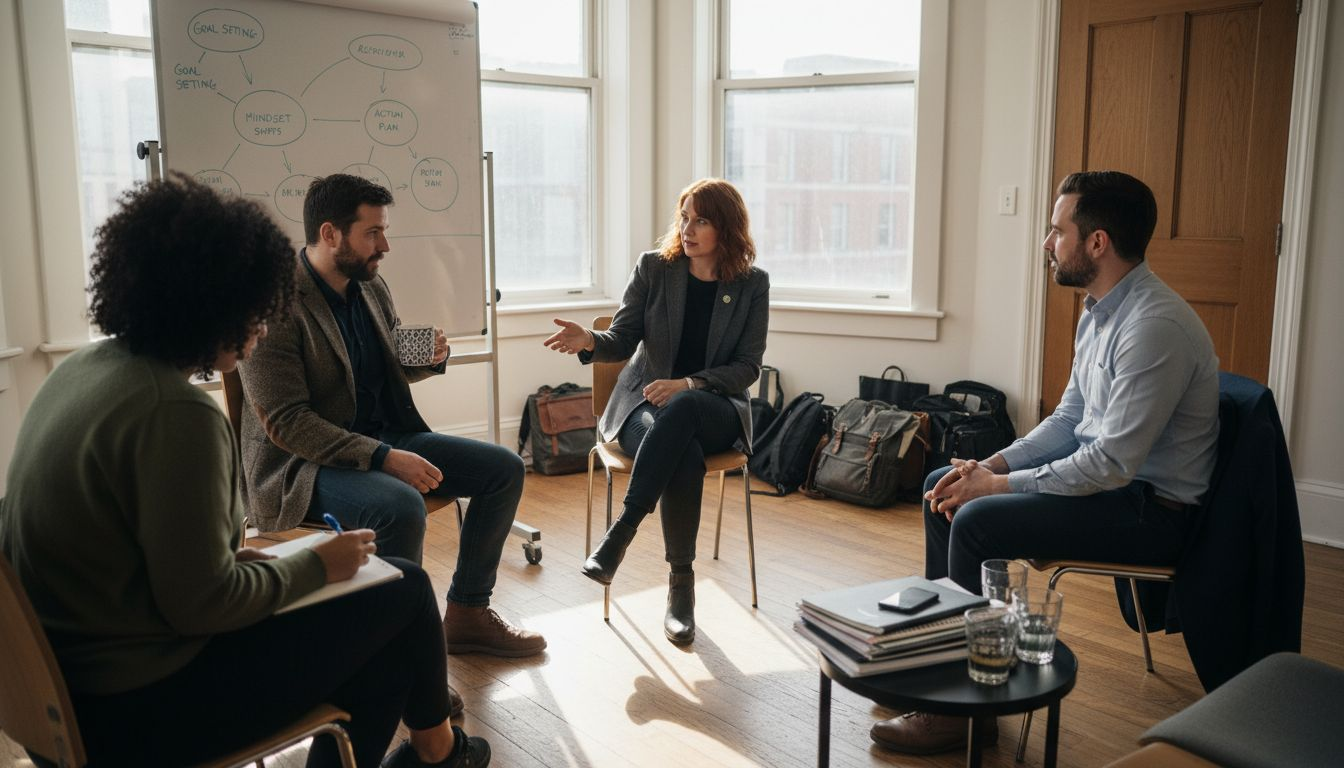
Feeling burnt out at work is all too common for professionals and creatives across Essex, where long hours and high expectations leave little room for real recovery. When exhaustion creeps in, finding support that genuinely helps can seem impossible. Group coaching offers a unique blend of expert facilitation and peer learning that goes beyond traditional advice, helping you reconnect with yourself and others who understand exactly what you are facing day to day.
Table of Contents
Key Takeaways
Point | Details |
Group Coaching Facilitation | Group coaching fosters shared learning and accountability through peer support and collaboration, making it particularly beneficial for those experiencing similar challenges. |
Key Principles | The process relies on psychological safety, clear boundaries, and confidentiality to enable vulnerability and open dialogue within the group. |
Types of Group Coaching | Various formats such as peer group coaching and themed workshops cater to different needs, focusing on stress management, resilience, and skill-building. |
Mental Health Benefits | Participating in group coaching can alleviate feelings of isolation, build social capital, and promote lasting mental health transformation through community support. |
Group coaching explained and key principles
Group coaching sits somewhere between traditional one-to-one coaching and classroom learning, but it’s not simply coaching delivered to multiple people in a room. It’s a distinct method that harnesses the power of shared experience and collective problem-solving. Rather than a coach working with individuals separately, group coaching creates an environment where professionals and creatives learn from each other’s challenges, solutions, and perspectives. This approach is particularly valuable for people in Essex dealing with burnout, as you’re not just receiving guidance from a coach—you’re also drawing strength and insight from others facing similar pressures in their careers.
At its core, group coaching rests on several key principles that make it work. Coaching is fundamentally a process that helps individuals unlock potential to perform and develop by increasing awareness and self-responsibility. In a group setting, this principle multiplies. When one person shares a struggle with work-life balance, others recognise themselves in that story. When someone discovers a small routine that actually sticks, the whole group benefits from that learning. The coach’s role shifts slightly—you’re still facilitating discovery and building self-responsibility, but you’re doing it within a container where peers become part of the support system. Psychological safety matters enormously here. People need to feel genuinely safe being honest about their struggles, which is why clear boundaries, confidentiality agreements, and skilled group facilitation are non-negotiable.
What makes group coaching distinct is its subtle yet profound nature, enabling deeper connection and shared learning. You discover you’re not alone in your anxiety about deadlines or your difficulty switching off after work. You hear how someone else reframed their perfectionism and what small shifts they made first. The group becomes a mirror—and sometimes a mirror is more powerful than any individual advice. Within this space, themes like boundaries, sleep routines, creative outlets, movement, connection, and grounding naturally emerge. These map directly onto the SCALES framework used in wellbeing coaching, where each pillar (Sleep, Creative, Active, Listen, Earth, Social) plays a role in how balanced your life feels. The coach holds this structure whilst the group members do the real work of recognising their own patterns and experimenting with change.
Pro tip: When joining a group coaching programme, come prepared to be both vulnerable and curious. The most transformative moments often happen when someone speaks their truth, and the group collectively recognises something they all experience.
Types of group coaching for wellbeing
Group coaching comes in several distinct formats, each designed to address different wellbeing challenges and learning styles. The type of group coaching you choose depends on what you’re trying to tackle. If you’re struggling with burnout and work-life balance, you might benefit from a stress management group that focuses on practical routines and boundary-setting. If you’re looking to rebuild confidence after a career setback, a resilience-focused group creates space for that collective healing. Some groups centre on creative expression as a route to better mental health, whilst others focus on practical skill-building like time management or communication. The key is that group coaching combines expert facilitation with peer learning to support your specific developmental needs, whether that’s personal growth, skill enhancement, or finding your footing again after a difficult period.
One particularly valuable format is peer group coaching, where members actively learn from one another in a structured, supportive environment. This works brilliantly for professionals and creatives in Essex who want to tackle shared challenges together. Rather than simply receiving advice from a coach, you and your peers engage in reflective conversations, ask each other clarifying questions, and build accountability naturally. Peer group coaching encourages self-awareness, confidence, and collaborative learning through shared experience and mutual support. The coach holds the space and asks the questions, but your peers become part of your thinking process. This format works particularly well for people dealing with similar pressures in their roles, such as managers feeling overwhelmed, freelancers struggling with consistency, or creatives battling perfectionism.
Another common format is the themed group workshop series, where sessions build on each other over a set number of weeks. These typically explore topics like Sleep and Recovery, Building Boundaries, Creative Outlets for Stress, or Movement and Energy. Each session combines group discussion with practical take-aways you can implement immediately. Some groups operate in a hybrid model, mixing in-person and online sessions to accommodate different schedules and locations. What matters across all these types is that they create a safe, confidential container where you feel free to be honest about where you’re struggling. That safety is what allows real transformation to happen.
Here’s a structured comparison of common group coaching formats and their benefits for wellbeing:
Format | Main Focus | Unique Benefit | Best Suited For |
Peer group coaching | Collaborative insight | Builds accountability | Managers, freelancers, creatives |
Themed workshop series | Topic exploration | Practical take-away skills | Those seeking routine change |
Hybrid in-person/online | Flexibility | Suitable for varied schedules | Busy professionals |
Resilience-focused groups | Recovery and confidence | Promotes collective healing | People after career setbacks |
Pro tip: When exploring group coaching options, ask potential programmes how they handle confidentiality and what happens if someone shares something sensitive. A well-run group will have clear agreements in place that help everyone feel genuinely safe.
How group coaching supports mental health
Group coaching works on mental health in ways that individual coaching or self-help alone cannot replicate. When you sit with others facing similar struggles—anxiety about performance, difficulty switching off after work, imposter syndrome, or simply feeling disconnected from yourself—something shifts. You realise that the voice in your head telling you that you should cope better, that you’re somehow failing, is not unique to you. That realisation alone can ease the pressure. Beyond that initial relief, group coaching creates a structured space where you can explore what’s actually driving your stress and low mood. Rather than quick fixes or surface-level advice, you work alongside others to understand the patterns underneath. Why does burnout keep happening? What does your body actually need when anxiety peaks? What would it feel like to truly prioritise your own wellbeing instead of everyone else’s?

One of the most powerful mental health benefits comes from what research calls building social capital. Group coaching improves self-awareness, acceptance of self and others, and strengthens social connection, which acts as a foundation for lasting wellbeing. When you hear someone else name a struggle you thought was only yours, you feel less alone. When someone shares how they finally set a boundary with their manager and what happened next, you see a real possibility for yourself. The sense of belonging that emerges from this shared experience is protective for your mental health. It buffers against the isolation that often comes with burnout and stress. This is especially valuable for professionals and creatives in Essex who might spend much of their working life feeling unseen or misunderstood in their roles.
The group also provides ongoing accountability and support between sessions. You’re not just thinking about your wellbeing once a week in a coaching room; you’re living it out with people who know your situation and genuinely care about your progress. When someone in your group tries a new sleep routine and reports back that they slept better, you feel motivated to try it yourself. When someone admits they struggled with a goal but learned something useful from the failure, you feel permission to be imperfect too. This normalisation of difficulty, combined with consistent support, creates conditions where real mental health transformation becomes possible. The group becomes less like a coaching programme and more like a community built around wellbeing.
Pro tip: Choose a group where the coach actively creates space for quieter voices and doesn’t let one or two people dominate. The groups where everyone feels heard are the ones where people actually change.
Typical group coaching processes and models
Most group coaching programmes follow a structured process that helps the coach manage group dynamics whilst allowing space for genuine transformation. The process typically begins with contracting, where the coach and group members agree on how the group will work together. This might sound formal, but it’s actually protective. You establish together what confidentiality means, how conflict will be handled, what happens if someone misses sessions, and what the group’s shared purpose is. This foundation matters because it creates safety. When everyone knows the boundaries and has agreed to them, people can be more vulnerable. From there, the group moves into its working phase, where the actual coaching conversations happen. Some sessions focus on individual members bringing their challenges whilst others listen and ask questions. Other sessions might explore a theme together, such as managing perfectionism or building better sleep habits. The coach’s job is to hold the space, ask clarifying questions, and help the group extract learning that applies to everyone.
Typical group coaching processes include managing boundaries, maintaining psychological safety, and navigating group dynamics to create conditions where real change becomes possible. What this means in practice is that a skilled coach watches not just what people are saying, but how the group is functioning. If one person is dominating, the coach gently redirects. If someone has gone quiet, the coach might check in. If tension emerges between two members, the coach helps the group work through it rather than avoiding it. This active facilitation is what separates group coaching from simply putting people in a room together. The coach is also drawing on reflective practice, noticing patterns that emerge across the group and naming them. When three different people mention struggling to set boundaries with their manager, the coach might invite the group to explore what that’s about together.
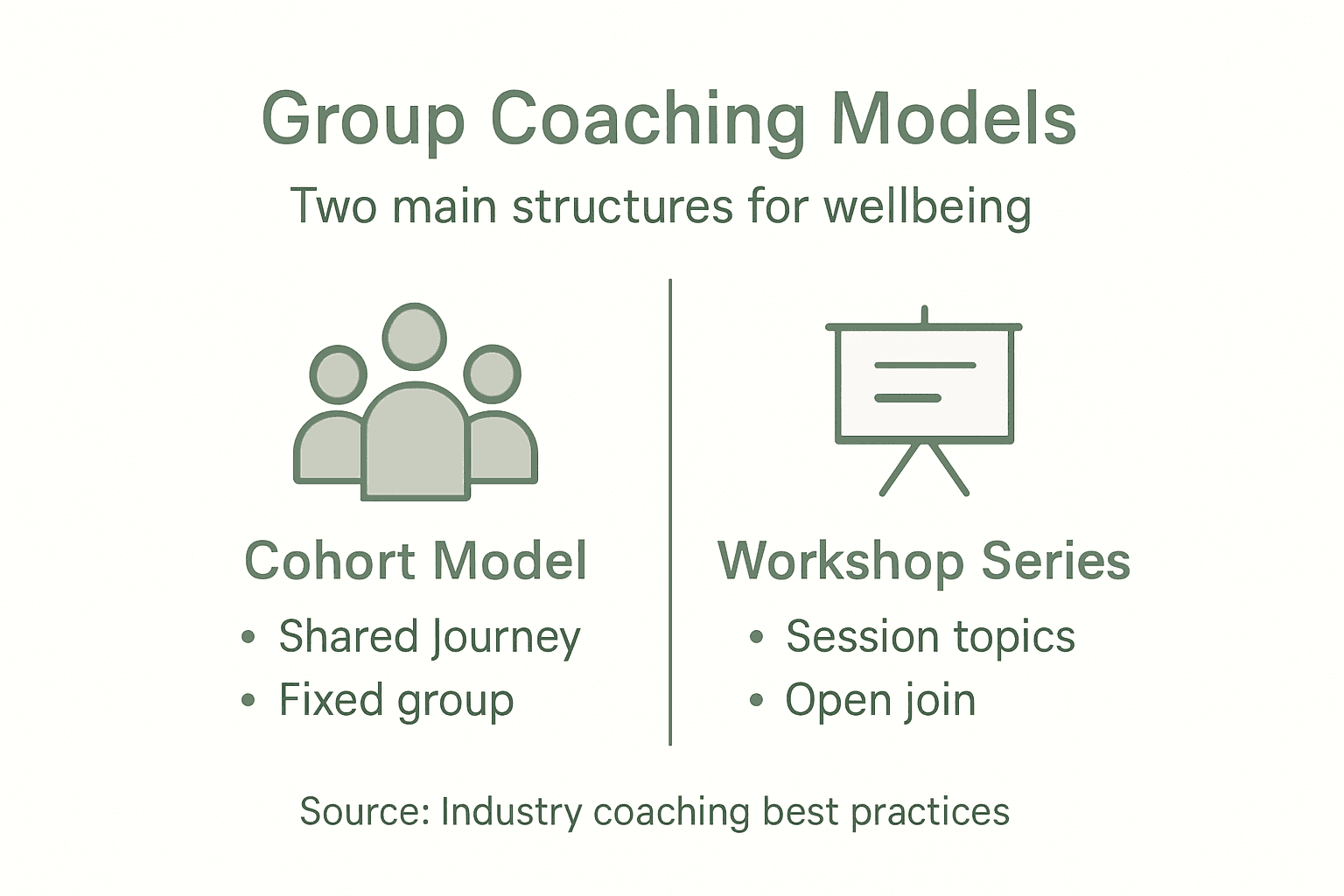
Common group coaching models include the cohort model, where the same group meets across a set number of weeks, creating continuity and deepening relationships. There’s also the rolling model, where people join and leave at different points, which works well for ongoing group coaching. Some organisations run hybrid models, combining in-person sessions with online check-ins, which suits professionals with unpredictable schedules. Within Tom Ryder Wellbeing’s approach, group work often centres on the SCALES framework, exploring how Sleep, Creative, Active, Listen, Earth, and Social practices are showing up for each member. Each model has strengths. The cohort creates tighter bonds but requires commitment. The rolling model offers flexibility but needs careful management of group dynamics as people join. The key is choosing a model and structure that fits both the goals and the lives of the people joining.
Pro tip: Before joining a group, ask about the group size and how long people typically stay. Groups of between six and ten people tend to work best—large enough for diverse perspectives, small enough that everyone gets genuine airtime.
Risks, limitations and ethical safeguards
Group coaching is powerful, but it’s not a substitute for therapy or medical care, and it’s crucial to understand its boundaries. One of the main risks in group settings is that confidentiality can be harder to maintain than in one-to-one coaching. When multiple people are in the room, you’re trusting each of them to keep what’s shared private. A skilled coach will establish clear agreements about this at the start, but ultimately you’re placing faith in relative strangers. This is worth thinking carefully about before joining. Another significant risk is boundary confusion. In a group, people can become close quite quickly, and relationships might extend beyond the coaching space in ways that complicate the dynamic. Someone might feel pressured to socialise with the group outside sessions, or a member might develop an unhelpful dependency on another group member rather than building their own resilience. The coach needs to actively manage these dynamics, but it requires awareness from participants too.
There’s also the question of appropriateness. Ethical coaching requires clear distinctions between coaching and therapy, with appropriate referral when deeper psychological issues are present. Group coaching works brilliantly for stress, work-life balance, and building practical wellbeing habits. It’s less appropriate if you’re dealing with trauma, active suicidal thoughts, severe anxiety disorders, or other mental health conditions that require specialist treatment. A responsible coach will screen for this before accepting someone into the group and will know how to make appropriate referrals if something emerges during the coaching that’s beyond the scope of coaching support. This is a key safeguard. Tom Ryder Wellbeing, for instance, is transparent about what coaching can and cannot do, and operates alongside rather than instead of medical or therapeutic support.
To protect participants, ethical group coaching programmes include several safeguards. Maintaining confidentiality, managing conflicts of interest, and safeguarding psychological safety are non-negotiable. Coaches should have formal training in group facilitation, ongoing supervision where they can discuss challenging situations, and clear professional standards they operate within. Before joining any group, you should ask about the coach’s qualifications, how they handle disclosures that might need reporting (such as safeguarding concerns), and what happens if someone in the group shares something that suggests they’re at risk. A good programme will have answers to all of these questions and will welcome them being asked. Red flags include coaches who are vague about qualifications, confidentiality terms, or their own supervision arrangements.
Pro tip: In the first session of any group coaching programme, notice how the coach handles the contracting discussion. If they rush through it or seem dismissive of questions about confidentiality and boundaries, that’s worth considering carefully before committing.
Comparing group coaching and one-to-one
Both group and one-to-one coaching can support your wellbeing, but they work quite differently and suit different situations. With one-to-one coaching, the focus is entirely on you. Your coach learns your specific story, understands your particular pressures, and tailors every conversation to your unique circumstances. There’s no one else in the room, so confidentiality is absolute. You can go as deep as you need without worrying about how your struggles might affect someone else or whether they’ll judge you. This format works brilliantly if you’re dealing with something highly personal, if you need intensive support over a shorter period, or if you prefer not to be part of a group. One-to-one coaching also allows your coach to track nuances in your progress session to session and adjust their approach based on what’s emerging for you specifically.
Group coaching operates from a different premise entirely. Group coaching harnesses peer learning, collective insight, and collaborative problem-solving, which can accelerate growth and motivation. You’re still receiving coaching, but you’re also learning from and with others facing similar challenges. This creates several distinct advantages. First, there’s the realisation that you’re not alone. Hearing someone else describe the exact anxiety you feel about work-life balance lifts an enormous burden. Second, solutions often emerge from the group itself. Someone in your group tries something different and it works, and suddenly you have a real example to learn from. Third, there’s relational accountability. You’re more likely to actually try the sleep routine you committed to when you know you’ll be reporting back to people you’ve grown to care about. The trade-off is less personalisation and less privacy.
How do you choose? Consider your situation. If you’re experiencing specific, acute stress around a work project or life transition, one-to-one coaching often works faster. If you’re dealing with ongoing burnout and want to build sustainable habits alongside others doing the same, group coaching creates momentum and community. Group coaching involves managing complex group dynamics and facilitating shared learning, whereas individual coaching allows for focused, individualised attention. Some people actually benefit from both. Starting with a group programme to address work-life balance and stress, then moving into one-to-one coaching if something more personal emerges, is a perfectly reasonable approach. What matters most is that you’re choosing based on what you actually need right now, not just what feels easier or what you think you should do.
For clarity, the key differences between group coaching and one-to-one coaching are summarised below:
Aspect | Group Coaching | One-to-One Coaching |
Focus | Shared learning and support | Individualised attention |
Accountability | Peer-driven | Coach-led |
Confidentiality | Relies on group agreements | Absolute privacy |
Best for | Habit-building, community | Deep personal processing |
Pro tip: Many people find that group coaching works best for building sustainable wellbeing habits, whilst one-to-one coaching works best for processing specific, emotionally difficult situations. Consider what your current priority actually is before deciding.
Unlock Your Wellbeing Potential Through Group Coaching with Tom Ryder Wellbeing
Feeling overwhelmed by stress, burnout, or struggling to find balance in your daily life is a common but deeply personal challenge. This article highlights the unique power of group coaching in creating shared learning, accountability, and a supportive community. At Tom Ryder Wellbeing, we understand that real transformation happens when practical steps meet emotional connection. Our group coaching sessions, grounded in the trusted SCALES Model, help you build sustainable routines around Sleep, Creativity, Activity, Listening, Earth, and Social connection.
If you are ready to move beyond feeling stuck and want to experience the collective strength of peer-supported wellbeing work, explore our Stress Management Coaching and Wellbeing Coaching UK services. Whether you prefer the ongoing support of a group or need tailored Mindset Coaching UK, Tom Ryder Wellbeing offers expert facilitation to create a safe, transformative space. Don’t wait to start your journey towards greater mental health and balance — visit Tom Ryder Wellbeing today and discover how group coaching can help you unlock the resilience and clarity you seek.
Frequently Asked Questions
What is group coaching and how does it differ from one-to-one coaching?
Group coaching is a collaborative process where a coach facilitates discussions among multiple individuals, allowing them to learn from shared experiences and insights. Unlike one-to-one coaching, which focuses solely on the individual’s needs, group coaching leverages peer support and collective problem-solving.
How can group coaching support my mental health?
Group coaching offers a unique environment for individuals facing similar challenges to connect and share their experiences, which can reduce feelings of isolation and promote self-acceptance. It also enhances social connections and provides ongoing accountability, leading to improved wellbeing.
What are the key benefits of participating in a peer group coaching session?
Peer group coaching fosters collaborative learning, where participants share insights and support each other in overcoming challenges. This format creates a sense of community, accountability, and motivation, helping individuals implement changes more effectively.
What should I expect in a typical group coaching session?
In a typical group coaching session, participants engage in discussions around shared themes or challenges, facilitated by a coach. The coach helps manage group dynamics and encourages meaningful conversations, ensuring that everyone contributes while maintaining psychological safety.
Recommended
Comments