


Mindset and Resilience – Unlocking Balance at Work


Work stress and creative deadlines in Essex can test even the most seasoned professionals. The daily pressures often leave talented individuals feeling depleted and questioning their own resilience. It is your mindset, shaped by beliefs and emotional responses, that determines whether setbacks become stumbling blocks or stepping stones. Understanding the difference between a fixed and growth mindset offers powerful tools to buffer the impact of adversity and build lasting resilience for your wellbeing and success.
Table of Contents
Key Takeaways
Point | Details |
Mindset Shapes Resilience | Your mindset fundamentally influences how you interpret and respond to challenges, shaping your growth and ability to handle stress. |
Growth vs Fixed Mindset | Embracing a growth mindset leads to greater motivation and resilience by viewing setbacks as opportunities for learning rather than signs of inadequacy. |
Types of Workplace Resilience | Recognising the types of resilience—engineering, robustness, and adaptive—can help you identify strengths and areas for improvement in managing workplace stress. |
Importance of Awareness and Support | Developing personal resilience is crucial, but it must be complemented by collective support from teams and organisations for sustainable wellbeing. |
What Is Mindset in Resilience?
Mindset sits at the heart of resilience. It is not simply about bouncing back from difficulty, though that matters. Rather, your mindset shapes how you interpret challenges, respond to them, and ultimately grow through them. When we talk about resilience in the context of work stress or personal wellbeing, we are really talking about the mental frameworks and beliefs you hold about yourself and your ability to handle what comes your way.
Research describes mindset as the mental capacity to rebound from adversity while potentially transforming or overcoming challenges. Think of it like this: two people face the same workplace setback. One sees it as evidence they are not good enough and spirals into self-doubt. The other sees it as information, a puzzle to solve, feedback to learn from. Same event. Completely different mindsets. The difference is not luck or talent. It is the set of beliefs and cognitive patterns they bring to the situation.
In practical terms, a resilient mindset involves three interconnected elements:
Your beliefs about whether challenges are temporary or permanent, changeable or fixed
Your emotional responses, and crucially, your ability to notice and work with them rather than be overwhelmed by them
Your sense of agency - the conviction that your actions actually matter and can influence outcomes
This is where things get interesting for professionals and creatives in Essex juggling multiple pressures. A resilient mindset does not mean you never feel stressed or anxious. It means you have cognitive and emotional frameworks that buffer the impact of adversity. You can feel the pressure, acknowledge it, and still move forward with intentionality. You know which thoughts are facts and which are just your nervous system reacting. You can distinguish between “I made a mistake” and “I am a failure.” That distinction changes everything.
One critical aspect often overlooked is that a resilient mindset is not something you are born with or without. It develops. It shifts. You build it through small, repeated practices. When you work with why resilience matters for your wellbeing and success, you begin to notice patterns in how you think and respond. Over time, with intention and support, those patterns can change.
In the context of work, this matters enormously. If your mindset tells you that stress means you are weak, or that needing boundaries means you are not committed enough, you will push harder and burn out faster. If your mindset tells you that difficulty is temporary, that it contains something to learn, and that you have some agency in how you respond, you build something quite different. You build the capacity to sustain effort without sacrificing yourself.
Pro tip: Pay attention this week to how you talk about difficulties. Notice whether your internal language frames challenges as temporary setbacks you can influence, or as permanent proof of your limitations. Your mindset is often visible in your self-talk before it shows up in your resilience.
Growth Mindset Versus Fixed Mindset
The distinction between growth mindset and fixed mindset is one of the most practical frameworks you can apply to your work life and resilience. It shapes whether you see challenges as threats or opportunities, whether you persist through difficulty, and ultimately whether you build the kind of sustainable success that does not come at the expense of your wellbeing.
At its core, a fixed mindset assumes your abilities are static. You believe you are either good at something or you are not. If you struggle with a presentation, it means you are not a natural communicator. If you make a mistake in a project, it reflects on your fundamental capability. This mindset creates a defensive posture. When things get difficult, you tend to withdraw, make excuses, or avoid the challenge altogether because failure feels like proof of your limitations. In a workplace setting, this often shows up as perfectionism, procrastination, or reluctance to try new things.
A growth mindset, by contrast, rests on the belief that abilities can be developed through effort and learning. You see your skills as starting points, not endpoints. When you struggle, you do not interpret it as evidence of inadequacy. Instead, you see it as information. You think, “I cannot do this yet. What do I need to learn?” This shifts your relationship to failure entirely. Failure becomes data, not disaster. It becomes fuel for improvement rather than confirmation of your fears.

The real power of understanding this distinction lies in what happens next. Research shows that growth mindset individuals demonstrate higher motivation and persistence, particularly when facing challenges. They engage differently with setbacks. They ask different questions. When a project does not go as planned, a fixed mindset person asks, “Why am I so bad at this?” A growth mindset person asks, “What went wrong, and what can I do differently next time?”
For professionals and creatives dealing with work stress and anxiety, this matters enormously. A fixed mindset tells you that your current stress level, your anxieties, your struggle to maintain boundaries at work - these are just who you are. You are an anxious person. You are not good at saying no. You do not have the discipline to stick to a routine. Fixed. Unchangeable. Growth mindset tells a different story. Your anxiety patterns developed for reasons. You learned to over-give at work because it felt safer than asserting your needs. You struggle with routine because the systems you have tried have not been built around how you actually work. These are not character flaws. They are learned patterns that can be unlearned.
Here is the practical reality: you probably do not sit at one end of this spectrum. Most people operate across both mindsets depending on the context. You might have a growth mindset about learning new software at work but a fixed mindset about your ability to manage stress. You might believe you can develop professionally but assume your anxiety is just hardwired. The work, then, is noticing where you hold fixed beliefs and consciously shifting them.
The three key areas where this shift matters most:
How you interpret difficulty - as a sign of inadequacy or as feedback to learn from
How you respond to failure - by withdrawing or by adjusting and trying again
How you approach your own development - as optional or as ongoing and possible
When you shift from fixed to growth mindset, you stop seeing resilience as something you either have or you do not. You start seeing it as something you can build, week by week, through small practices and adjusted thinking.
Pro tip: This week, catch yourself when you think or say “I am just not good at…” or “I cannot…” and pause. Add one word: “yet.” “I am not good at saying no yet.” “I cannot maintain a sleep routine yet.” That single word shifts you from fixed to growth, from resignation to possibility.
Types of Workplace Resilience
When we talk about workplace resilience, we are actually talking about several different things operating at once. Resilience is not a single skill or mindset. It is a collection of approaches, both personal and organisational, that determine how you and your workplace handle pressure, disruption, and change. Understanding the different types helps you recognise where your strengths lie and where you might need more support.
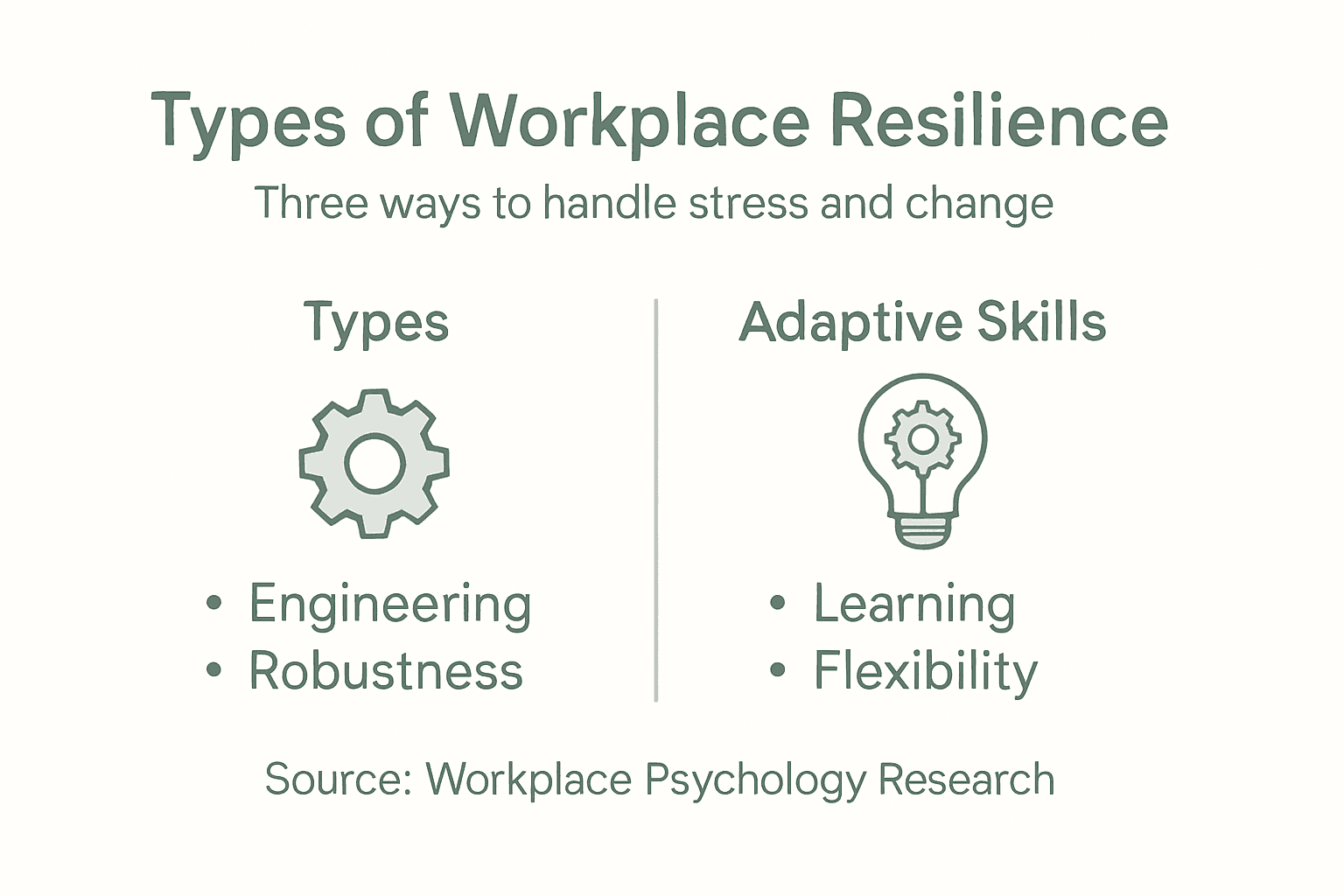
There are three main frameworks for thinking about workplace resilience, each reflecting a different approach to managing difficulty. Engineering resilience is about returning to normal as quickly as possible after a disruption. Think of a project that went off track - engineering resilience means getting back on schedule, restoring the status quo. This works well for temporary setbacks with clear solutions. However, it assumes the original state was working, which is not always true. If you are constantly stressed at work, simply “bouncing back” to that stressed state is not actually resilience. It is just accepting the problem.
Robustness takes a different approach. It means building systems and practices strong enough to withstand shock without falling apart. In your work life, this might mean creating boundaries that protect your time and energy, establishing routines that stabilise your mood, or developing skills that make you less vulnerable to redundancy. Robustness is about preparation. It is saying, “I know difficulty will come, so I am going to build something solid now.” For professionals and creatives juggling multiple demands, robustness matters enormously. When you have solid sleep routines, clear communication with your manager about workload, and practices that ground you emotionally, you can weather the storms that will inevitably arrive.
The third type is adaptive resilience, which goes further. This is not about returning to normal or simply withstanding pressure. It is about transforming under stress. When a creative professional faces a complete career shift, or when workplace demands fundamentally change, adaptive resilience means you can learn, adjust, and even grow through the transformation. You do not just survive the change; you become different in ways that serve you better. This is perhaps the most powerful form of resilience, but it also requires the most from you. It requires willingness to question your assumptions, to learn new approaches, and to let go of what no longer works.
Here’s a structured comparison of different workplace resilience types:
Resilience Type | Main Focus | Strengths | Limitations |
Engineering Resilience | Quick recovery after disruption | Rapid restoration of status quo | May restore flawed systems |
Robustness | Withstanding future setbacks | Strong protective foundations | Can resist healthy change |
Adaptive Resilience | Transforming under pressure | Continuous learning and growth | Requires high adaptability |
There is a crucial point that often gets missed: workplace resilience is not just about individual capacity to cope with demands. Your organisation, your team, your manager, the policies in place, the culture you work within - these all shape your resilience dramatically. You can have excellent coping strategies, strong boundaries, and a growth mindset, but if you are working in a culture of chronic overload with no support, you will burn out. Conversely, you can develop your personal resilience alongside an organisation that genuinely supports wellbeing, and something shifts. The burden becomes shared. The expectation becomes sustainable.
Here is what this looks like in practice:
To clarify how different support levels interact in workplace resilience, see this overview:
Level of Resilience | Example Factors | Unique Contributions |
Personal | Mindset, stress management | Drives individual coping capability |
Team | Communication, safety, support | Facilitates shared problem-solving |
Organisational | Policies, culture, leadership | Shapes overall resilience capacity |
Personal resilience involves your mindset, your coping strategies, your ability to notice stress and respond to it, and your commitment to practices that sustain you
Team resilience involves psychological safety, clear communication, shared understanding of capacity, and mutual support
Organisational resilience involves policies, culture, leadership behaviour, and systemic support for wellbeing alongside performance
The research is clear: resilience at work requires both your personal effort and systemic support. You cannot will your way out of a poorly designed system. At the same time, a supportive system cannot sustain you if you have not built your own practices and mindset.
When you think about your own workplace resilience, consider which type you are currently leaning on. Are you trying to engineer quick bounces back to stress? Are you building robustness through solid foundations? Are you open to adaptive changes that might serve you better? The answer is probably different across different areas of your work life. The goal is not to achieve all three at once, but to recognise where each applies and where you have room to develop.
Pro tip: This week, identify one area of your work life where you are relying solely on engineering resilience (hoping things get back to normal) and ask yourself what one robust system you could build instead. That might be a consistent morning routine, a weekly boundaries conversation with your manager, or a creative practice that stabilises your mood. One small robust system beats endless bouncing back.
How Mindset Coaching Builds Resilience
Mindset coaching is not about positive thinking or pretending difficulties do not exist. It is a structured process that helps you examine the beliefs and thought patterns that either support or undermine your resilience. When you work with a coach on your mindset, you are essentially building the mental architecture that allows you to handle pressure, setbacks, and change without falling apart.
The process starts with awareness. Most of us operate on autopilot with our thinking. You face a work challenge and your mind immediately tells you a story about what it means. That story shapes how you feel and what you do next. Mindset coaching makes those stories visible. A coach helps you notice what you are actually thinking, especially in moments of stress. Are you thinking, “I can handle this, and I will learn from it”? Or are you thinking, “This proves I cannot cope”? Once you see the pattern, you can work with it. You cannot change what you do not notice.
From there, coaching helps you reframe challenges and develop adaptive coping strategies that build genuine resilience. This is not about replacing negative thoughts with forced positivity. It is about examining whether your thoughts are actually true, whether they serve you, and what alternative perspectives might be more accurate or useful. When you face a difficult conversation at work, a mindset coach might help you move from “I will fail at this” to “I have never done this before, and that is exactly why I need to try. I can prepare, I can be honest, and I can handle whatever happens.” That shift is not fake. It is grounded in reality and in your actual capacity.
One of the most powerful aspects of mindset coaching is that it builds what researchers call emotional regulation and self-awareness. You learn to notice when stress is rising, when you are slipping into unhelpful thought patterns, and what your early warning signs are. A coach helps you develop the practical skills to manage those moments. That might mean breathing techniques, breaking down overwhelming tasks into smaller steps, or simply pausing before responding when you are triggered. With practice, these become automatic. You develop agency. You stop feeling like things happen to you and start feeling like you have choices in how you respond.
Mindset coaching also addresses the beliefs you hold about your own capacity for change. If you believe you are “just an anxious person” or “naturally bad at boundaries,” that belief will keep you stuck. Coaching methodologies help you reframe challenges, persist through setbacks, and adopt proactive behaviours that directly counter those limiting beliefs. Over time, as you experience small wins through coaching, your beliefs about yourself shift. You start to see evidence that you can change, that you can develop, that you are not fixed.
For professionals and creatives dealing with work stress, this matters profoundly. Burnout does not happen because you are weak. It happens because your mindset has accepted an unsustainable situation as normal or necessary. Mindset coaching helps you recognise that pattern and choose differently. It is not about forcing yourself to be tougher. It is about examining what beliefs are driving your choices and building new ones that serve your wellbeing and your work.
The key is that mindset coaching works best alongside concrete changes. You develop a new belief that you can set boundaries, and then you actually practise setting one. You shift your mindset about failure, and then you try something that scares you. The coaching happens in the thinking, but the resilience gets built in the doing. The two together create lasting change.
Here is what good mindset coaching typically involves:
Noticing your current patterns of thought and belief
Examining whether those patterns serve you or hold you back
Experimenting with new ways of thinking and responding
Building evidence through small, repeated practices
Integrating new patterns until they become your default
Pro tip: Start noticing one specific moment in your work week when stress hits. What do you think in that moment? Write it down. That single piece of awareness is where mindset coaching begins, and you can start it yourself right now.
Key Mistakes That Undermine Resilience
Building resilience is not just about doing the right things. It is equally about stopping the patterns that actively work against you. Many people sabotage their own resilience without realising it. They are trying hard, putting in effort, yet somehow they still feel exhausted, overwhelmed, and stuck. Often the issue is not effort. It is the mistakes they are making along the way. Understanding these patterns is the first step to changing them.
The first major mistake is avoiding or ignoring setbacks rather than learning from them. When something goes wrong at work, your instinct might be to move past it quickly, forget about it, or blame external circumstances. This feels easier in the moment. You do not have to sit with the discomfort of failure. But this approach guarantees you will face the same difficulty again. Recognising setbacks as learning opportunities rather than proof of inadequacy is fundamental to building real resilience. When you actually pause and ask “What went wrong? What can I learn?” something shifts. You stop being a victim of circumstances and become someone actively building capability.
The second mistake is trying to build resilience alone. There is a cultural narrative that resilience means toughing it out, managing everything yourself, not bothering anyone else with your struggles. This is backwards. Research is absolutely clear: people with strong support networks have better resilience outcomes. Asking for help is not weakness. It is wisdom. When you isolate, when you assume you should manage everything yourself, you drain your resources. When you build a team around you, when you have people who understand what you are going through, you multiply your capacity. For professionals in Essex dealing with work stress, this might mean having a trusted friend you can vent to, a manager you can be honest with about your limits, or a coach who helps you work through patterns. The specific form does not matter. What matters is that you are not shouldering everything alone.
The third mistake is ignoring early warning signs of burnout or overwhelm. Your body and mind give you signals long before you hit a wall. You stop sleeping well. Your mood shifts. You lose interest in things you normally enjoy. You get more irritable. You feel a constant low-level anxiety. Many people notice these signs and push harder, assuming they need more discipline or willpower. Actually, these are messages. They are telling you something needs to change. When you ignore them, you are essentially ignoring the speedometer in your car until the engine overheats. By then, the damage is done. Resilience means paying attention early and adjusting before you break. This might mean reducing commitments, building in more rest, seeking support, or making changes to how you work.
The fourth mistake is holding onto unhelpful beliefs about what resilience looks like. Many people equate resilience with never struggling, never needing help, always bouncing back instantly. That is not resilience. That is performance. Real resilience includes the difficult emotions, the moments of doubt, the times you need support. It includes feeling the full range of human experience and still moving forward. When you judge yourself for struggling, when you feel ashamed of needing help, when you believe you should just be fine all the time, you add a second layer of suffering on top of the original difficulty. You feel bad, and then you feel bad about feeling bad.
The fifth mistake is failing to invest in the foundations that support resilience. You cannot build resilience on quicksand. If your sleep is chaotic, your nutrition is poor, you never move your body, and you have no time for anything that brings you joy, your resilience will be fragile. These foundations matter. When you prioritise sleep, when you eat reasonably well, when you move in ways that feel good, when you protect space for creativity or rest or connection, you are not being indulgent. You are building the platform on which everything else rests. This is not luxury. This is infrastructure.
Here is what undermines resilience most consistently:
Avoiding or rationalising away failures instead of learning from them
Trying to manage everything alone without asking for or accepting support
Ignoring early warning signs of stress or overwhelm
Holding perfectionist standards about what resilience should look like
Neglecting sleep, movement, nutrition, and joy
Blaming yourself for struggling instead of examining the actual circumstances
Operating constantly in crisis mode without planning or preparation
Pro tip: Pick one mistake from this list that resonates with you. This week, do one small thing that directly counters it. If you are avoiding learning from setbacks, write down one thing that went wrong and one thing you learned. If you are isolating, text one person and be honest about something you are struggling with. One small action against one pattern is where change begins.
Build a Resilient Mindset to Unlock Balance at Work
The article emphasises that developing a resilient mindset is key to managing workplace stress and transforming challenges into growth. If you find yourself caught in cycles of self-doubt, overwhelm, or burnout, it is not because you are weak but because your mental frameworks need strengthening. Concepts such as growth mindset, emotional regulation, and adaptive resilience are vital for creating lasting change rather than quick fixes. This aligns perfectly with the coaching approach at Tom Ryder Wellbeing, where practical strategies help you reframe setbacks and build emotional resilience.
If you want to shift from feeling stuck or drained to feeling balanced and empowered, explore our Mindset Coaching UK and Emotional Resilience Coaching. Our SCALES model supports you in building simple habits across sleep, creativity, activity, listening, earth, and social connection — all crucial foundations highlighted in the article. Start your journey with a free consultation on Tom Ryder Wellbeing today and take the first step towards a mindset that sustains you through work pressures and beyond.
Frequently Asked Questions
What is the relationship between mindset and resilience?
Mindset plays a crucial role in resilience as it determines how we interpret and respond to challenges. A resilient mindset views setbacks as opportunities for growth rather than proof of inadequacy.
How can I develop a growth mindset to enhance my resilience?
To develop a growth mindset, start by recognising and reframing negative thoughts. Focus on learning from challenges, viewing failures as opportunities for improvement, and practising self-compassion.
What are the key components of building resilience in the workplace?
The key components of building resilience in the workplace include developing a positive mindset, emotional awareness, establishing supportive networks, and creating robust systems to handle stress effectively.
How does mindset coaching contribute to resilience?
Mindset coaching helps individuals identify and change limiting beliefs, develop adaptive coping strategies, and enhance emotional regulation, which collectively strengthen resilience in the face of workplace challenges.
Recommended
Comments