


Practical Coaching: How It Transforms Wellbeing


Feeling overwhelmed by constant deadlines and creative pressures is a daily reality for many in Essex. Stress and burnout can cloud judgement and sap motivation, leaving even the most skilled professionals searching for effective ways to regain control. Structured coaching offers a clear, action-oriented process grounded in psychology and adult learning theory, giving you practical tools to improve mental wellbeing and reshape your work-life balance with true autonomy.
Table of Contents
Key Takeaways
Point | Details |
Practical Coaching Defined | It is a structured process focused on achieving real life changes through action-oriented dialogue with a trained coach. |
Core Principles | The approach is action-focused, grounded in learning, collaborative, and ensures confidentiality and support. |
Types of Coaching | Different types cater to various needs, such as Wellbeing, Mindset, Work-Life Balance, and Life Coaching, each addressing specific challenges. |
Common Pitfalls | Key issues include expecting instant results, unclear expectations, and insufficient trust, which can derail the coaching process. |
Defining Practical Coaching and Its Core Principles
Practical coaching is fundamentally different from what many people imagine. It is not therapy, counselling, or consulting. Instead, it is a structured process designed to help you achieve real change in your life through action-oriented dialogue with a trained coach. The focus sits entirely on what you want to accomplish and how you will actually do it.
At its heart, coaching is a professional helping relationship that places you at the centre. Your coach does not tell you what to do. Instead, they ask powerful questions, listen carefully, and help you discover your own solutions. This collaborative approach works because it recognises that you already have the answers within you; you simply need support to access them.
The core principles of practical coaching rest on several key foundations:
Action-focused: Every session ends with concrete steps you will take before the next meeting. Ideas without implementation lead nowhere
Grounded in learning: Coaching draws on psychology and adult learning theory to create sustainable change, not quick fixes
Collaborative: You and your coach work as a team. Your motivation drives the process
Confidential and supportive: What you share stays private. Your coach creates a safe space to be honest about where you struggle
For professionals and creatives in Essex dealing with stress or burnout, this approach offers something tangible. Rather than exploring why you feel overwhelmed, practical coaching asks: “What small change could you make this week to feel even slightly better?” That distinction matters. Why practical coaching works for stress and burnout lies precisely in this focus on doable steps over endless analysis.
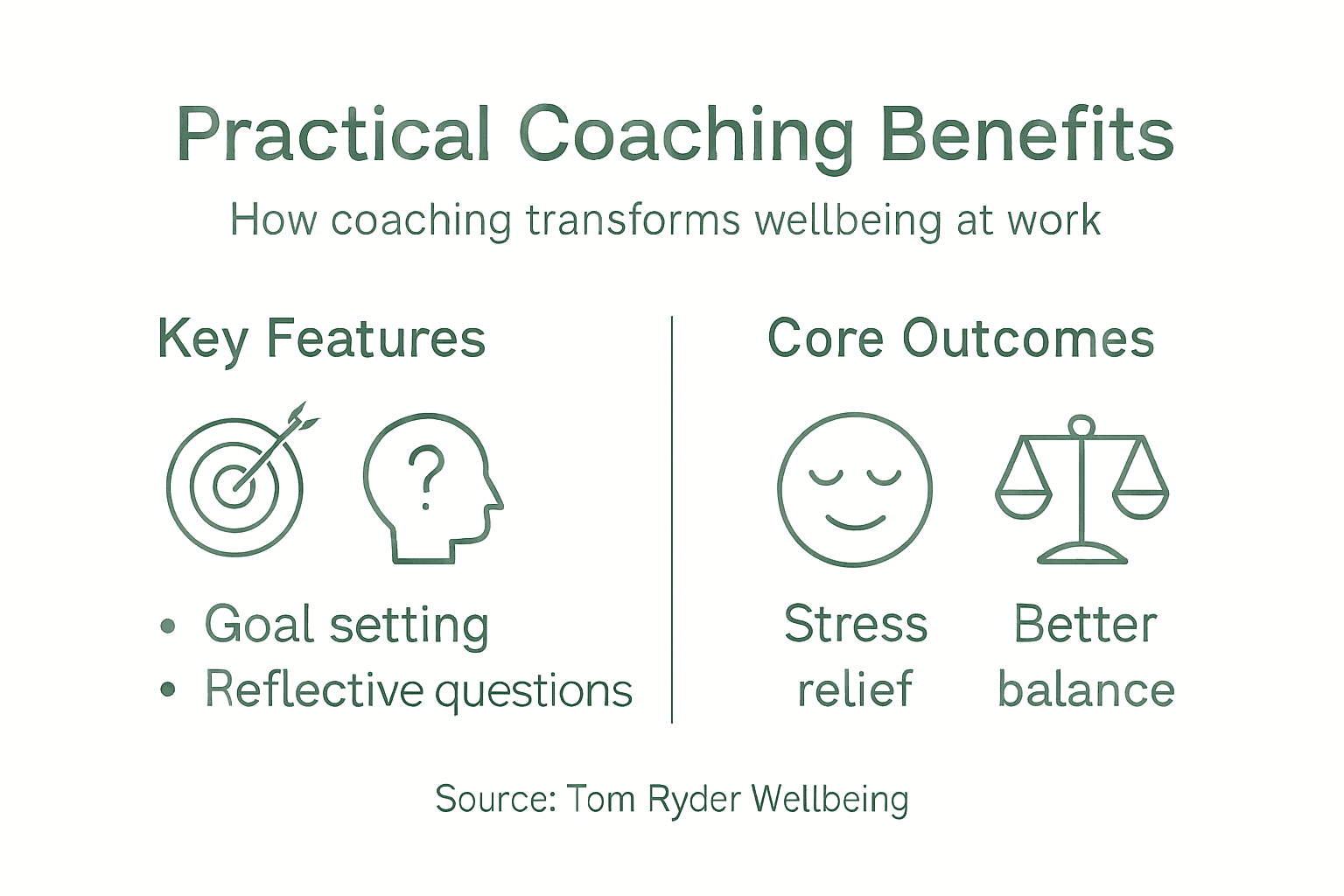
The coaching process typically follows a clear structure. Discovery happens first, where you name what matters to you. Clarity comes next, defining your actual goal. Then comes planning and practice—testing changes in real life. Finally, progress tracking ensures you know what is working.
What separates practical coaching from other support is its commitment to you leaving with real tools. You do not depend on your coach forever. Instead, you build capability you can use long after coaching ends.
Compare core elements of practical coaching with common approaches to support:
Aspect | Practical Coaching | Therapy/Counselling | Consulting |
Focus | Forward action and change | Reflection and healing | Expert solutions |
Role of Client | Active participant | Client explores feelings | Receives guidance |
Outcome | Self-driven progress | Emotional resolution | Implement advice |
Duration of Support | Time-limited, builds autonomy | Often ongoing | Defined per project |
Pro tip: When considering whether coaching fits your needs, ask yourself this: do I know what I want to change, but struggle with how to actually do it? If yes, practical coaching is likely your answer.
Types of Coaching: From Wellbeing to Mindset
Coaching is not a one-size-fits-all service. Different types address different challenges depending on where you feel stuck. Understanding which type matches your situation helps you get the support that actually works for you.
Wellbeing Coaching focuses on your overall health and lifestyle. This includes sleep, movement, nutrition, stress management, and how you spend your time. If you know you should exercise more or sleep better but cannot seem to make it stick, wellbeing coaching helps you build those habits sustainably. Health and wellbeing coaching in the UK emphasises behaviour change and goal-setting, working with you on the practical daily shifts that improve how you feel.

Mindset Coaching works differently. Rather than focusing on your habits, it targets your beliefs about yourself. Many professionals and creatives carry limiting thoughts: “I cannot handle pressure,” “I am not creative enough,” or “I always fail when things get difficult.” Mindset coaching challenges these patterns and builds resilience from the inside out. You learn to recognise unhelpful thinking and replace it with beliefs that actually serve you.
Work-Life Balance Coaching sits at the intersection of these two. It addresses the specific pressures of your job whilst protecting the other areas of your life that matter. For someone juggling deadlines, meetings, and personal commitments, this type helps you set boundaries and create routines that prevent burnout.
Life Coaching takes a broader view. It works on your overall direction and goals. If you feel lost after a career change, uncertain about your next steps, or unsure what you actually want, life coaching provides clarity and an action plan.
Here is a summary of the main types of coaching and who benefits most from each:
Coaching Type | Focus Area | Best For |
Wellbeing Coaching | Health and lifestyle change | People wanting better daily habits |
Mindset Coaching | Beliefs and inner resilience | Those battling self-doubt |
Work-Life Balance | Boundaries and routines | Busy professionals and parents |
Life Coaching | Goals and life direction | Individuals seeking clarity |
What matters most is matching the type to your real need. Someone struggling with anxiety at work might benefit from mindset coaching. Someone exhausted from poor sleep and no downtime needs wellbeing coaching. Someone questioning their entire career path needs life coaching.
Pro tip: In your first session with a coach, be clear about what brought you there. Say “I want help with my sleep and stress” or “I struggle with self-doubt when things go wrong.” Your coach will then shape the coaching type to fit what actually matters to you.
Key Features and How Practical Coaching Works
Practical coaching operates through a specific set of features that distinguish it from other forms of support. Understanding how these features work together shows why coaching produces real change.
The foundation is trust and deep listening. Your coach creates a confidential space where you feel safe being honest about what you struggle with. They listen without judgment, picking up not just your words but the feelings beneath them. This is where change begins—when you feel genuinely heard.
From there, your coach asks powerful questions. Rather than giving advice, they help you discover your own answers. Questions like “What would happen if you tried that?” or “What is stopping you right now?” shift your thinking. You move from feeling stuck to seeing possibilities you had not considered.
Goal-setting and realistic planning form the practical backbone. Your coach helps you define what you actually want, then breaks it into small, doable steps. This is where structured models such as GROW come in, focusing on your goal, exploring reality, developing options, and committing to action. It is not vague or inspirational. It is specific and measurable.
The process is iterative and reflective. Each session, you report back on what you tried between meetings. What worked? What felt impossible? Your coach helps you notice patterns in your thinking and behaviour. You adjust your approach based on real experience, not theory.
Trust matters because vulnerability matters. When you tell your coach “I failed at this goal,” they do not judge you. Instead, you both explore what happened and what to try next. That combination of accountability and support is what shifts things.
Finally, practical coaching builds your autonomy. The goal is not to depend on your coach forever. It is to leave with tools and confidence you can use independently. You learn to coach yourself.
Pro tip: Between sessions, write down one specific thing you will do and one thing that might get in your way. Bringing this to your next session makes the coaching stick faster.
Real-World Applications for Professionals and Creatives
Practical coaching transforms wellbeing by addressing the specific pressures you face in your work and creative life. For professionals and creatives in Essex, the challenges are real and often overlap. You might be managing tight deadlines whilst battling self-doubt. Or juggling client demands with the need to protect your own creative energy.
Consider the marketing director who arrives at coaching exhausted and unable to switch off. She knows her workload is unsustainable, but saying no feels impossible. Through coaching, she identifies which tasks genuinely need her attention and which she can delegate or drop. Within weeks, her evenings are quieter. She sleeps better. Her work actually improves because she is no longer running on empty.
For creatives, the applications differ slightly. A musician or designer often struggles with the feast or famine cycle of freelance work. During quiet periods, motivation crashes. During busy periods, burnout looms. Coaching helps them build sustainable routines that work across both states. It also addresses the perfectionism that stops work ever feeling finished. Creative outlets for wellbeing become integrated into your coaching plan, not as extras but as essential to your performance.
Stress and anxiety show up differently across these groups. A professional might experience racing thoughts before presentations. A creative might freeze when facing a blank page. Both respond to practical coaching because the approach remains the same: identify the pattern, understand what triggers it, then practise a different response until it becomes automatic.
Work-life balance coaching proves particularly valuable for Essex professionals managing commutes, family responsibilities, and career ambitions simultaneously. Rather than vague advice to “relax more,” coaching builds specific boundaries and routines. You might establish a non-negotiable finish time each day, or create a transition ritual between work and home that actually works for your life.
The key is that coaching meets you where you are. It does not ask you to become someone else or follow someone else’s template for success. It helps you design a working life that aligns with your values and protects your wellbeing.
Pro tip: Identify one specific moment in your working week that consistently drains you most. Bring this to your first coaching session, and you will immediately see how practical coaching targets real problems.
Common Pitfalls and What to Avoid in Coaching
Not all coaching relationships produce change. Sometimes the fault lies with the coach, sometimes with how coaching is approached. Understanding what goes wrong helps you choose wisely and get the most from the process.
One major pitfall is expecting instant results. Coaching is not a quick fix. Real change takes time. You might feel shifts within weeks, but sustainable transformation typically unfolds over months. If your coach promises rapid miracles or uses rigid techniques that feel one-size-fits-all, that is a red flag. Patience and realistic goal-setting are crucial as coaching outcomes develop gradually through sustained effort.
Unclear expectations derail many coaching relationships. Before you start, both you and your coach should agree on what you want to achieve, how often you will meet, and what happens between sessions. Without this clarity, you might feel lost or frustrated. A good coach establishes these ground rules early and checks in regularly to ensure alignment.
Another common issue is insufficient trust and engagement. If you do not feel safe being honest with your coach, coaching cannot work. Your coach should listen without judgment and create space for vulnerability. Equally, key mistakes to avoid encompass overstepping boundaries by giving unsolicited advice, which undermines your autonomy and shifts coaching into unwanted counselling or consulting.
Passive participation kills coaching. If you attend sessions but do nothing between meetings, nothing changes. Coaching requires your active commitment. You must be willing to try new things, reflect on what happens, and adjust. Your coach is not responsible for your change. You are.
Avoid coaches who do not adapt their approach. Some people thrive with direct, structured planning. Others need space to explore emotionally before committing to action. Your coach should flex their style to fit how you work best, not force you into their preferred method.
Finally, watch for lack of clarity about confidentiality and ethics. Your coach should explain what stays private and when they might need to break confidentiality. Professional coaching is grounded in ethical boundaries that protect you.
Pro tip: In your first session, ask your coach how they will measure progress and what happens if the coaching is not working for you. A good coach welcomes these questions and adjusts accordingly.
Discover Practical Coaching That Truly Transforms Wellbeing
Feeling overwhelmed by stress or stuck in cycles of self-doubt and burnout is exhausting. This article highlights how practical coaching focuses on actionable steps and real change rather than endless analysis or vague promises. If you recognise the need for clear goals, steady progress, and support that builds your confidence and resilience, the coaching approach at Tom Ryder Wellbeing is designed for you.
With expert Mental Health and Wellbeing Coaching and tailored Mindset Coaching UK, Tom Ryder Wellbeing helps professionals and creatives in Essex and beyond to break down big challenges into small, manageable steps. Using the unique SCALES Model, coaching sessions focus on practical routines and mindset shifts that align with your daily life. It is time to stop feeling stuck and start making sustainable changes with support that listens and acts.
Take your first step today with a free discovery session or explore more about Stress Management Coaching and practical coaching solutions at Tom Ryder Wellbeing. Start building a balanced, confident you now.
Frequently Asked Questions
What is practical coaching?
Practical coaching is a structured process designed to help individuals achieve real change in their lives through action-oriented dialogue with a trained coach. It focuses on identifying goals and implementing concrete steps to achieve them rather than providing therapy or counselling.
How does practical coaching differ from therapy or consulting?
Practical coaching emphasises forward action and self-driven progress, whereas therapy focuses on emotional healing, and consulting provides expert solutions to specific problems. Coaching centres on the client’s motivations and goals, building autonomy rather than dependency.
What types of challenges can practical coaching help with?
Practical coaching can address various challenges including stress management, work-life balance, self-doubt, and the creation of sustainable habits. It is tailored to meet individual needs, whether in professional settings or personal life.
What can I expect during a practical coaching session?
During a practical coaching session, you can expect to discuss your goals, explore barriers, and create actionable plans. The coach will listen attentively and ask powerful questions to help you discover your own solutions, ensuring a collaborative and supportive environment.
Recommended
Comments