


Role of Coaching in 2025 – Wellbeing and Creative Success


Most british creative professionals and musicians underestimate how much modern coaching shapes wellbeing in 2025. With over half reporting that stress directly impacts their artistic output, exploring effective strategies matters more than ever. New coaching approaches offer practical ways to handle work-life balance and mental health challenges, moving past old myths and outdated perceptions. This guide reveals how contemporary coaching can support creative ambition while fostering genuine personal growth.
Table of Contents
Key Takeaways
Point | Details |
Coaching Evolution | Coaching in 2025 has transitioned to a holistic practice that prioritises personal and professional development beyond traditional problem-solving. |
Myths about Coaching | Common misconceptions include the belief that coaching is solely for struggling professionals or a predictable process focused only on workplace performance. |
Diverse Coaching Types | There are now various coaching types, such as leadership, personal, business, and life coaching, each tailored to distinct developmental needs and goals. |
Choosing the Right Coach | Selecting a coach requires careful consideration of their credentials, specialisation, and communication style to ensure a productive coaching relationship. |
Defining Coaching in 2025 and Common Myths
Coaching has evolved dramatically, transforming from a problem-solving intervention to a strategic approach for personal and professional development. In 2025, coaching represents a holistic practice that supports individuals in navigating complex personal and professional landscapes, moving far beyond traditional remedial perceptions.
Contrary to popular belief, coaching is not exclusively for leaders struggling with performance or individuals experiencing significant challenges. Transformative coaching approaches now embrace complexity, recognising that personal growth involves accepting paradoxes and uncertainty rather than pursuing linear problem-solving strategies. Modern coaching acknowledges that development is rarely straightforward and requires profound self-reflection and acceptance.
The contemporary coaching landscape challenges several persistent myths. First, coaching is not a quick fix or magical solution but a collaborative process requiring active participant engagement. Leadership coaching, for instance, has shifted from traditional performance improvement to supporting holistic human development. Coaching trends highlight its critical role in helping professionals maintain resilience and authenticity amid technological disruption and economic uncertainty.
Key myths about coaching in 2025 include misconceptions that it is:
Only for struggling professionals
A linear, predictable process
Exclusively focused on workplace performance
Limited to executive or leadership contexts
In reality, coaching has become a nuanced, personalised approach supporting mental wellbeing, creative expression, and holistic personal development across various life domains.
Pro tip: When exploring coaching, prioritise understanding the coach’s philosophy and approach rather than expecting predetermined outcomes.
Modern Coaching Types and Key Differences
Coaching has diversified significantly in 2025, emerging as a sophisticated discipline with multiple specialised approaches tailored to individual and organisational needs. Coaching types demonstrate remarkable complexity beyond traditional performance improvement strategies, addressing nuanced personal and professional development requirements.
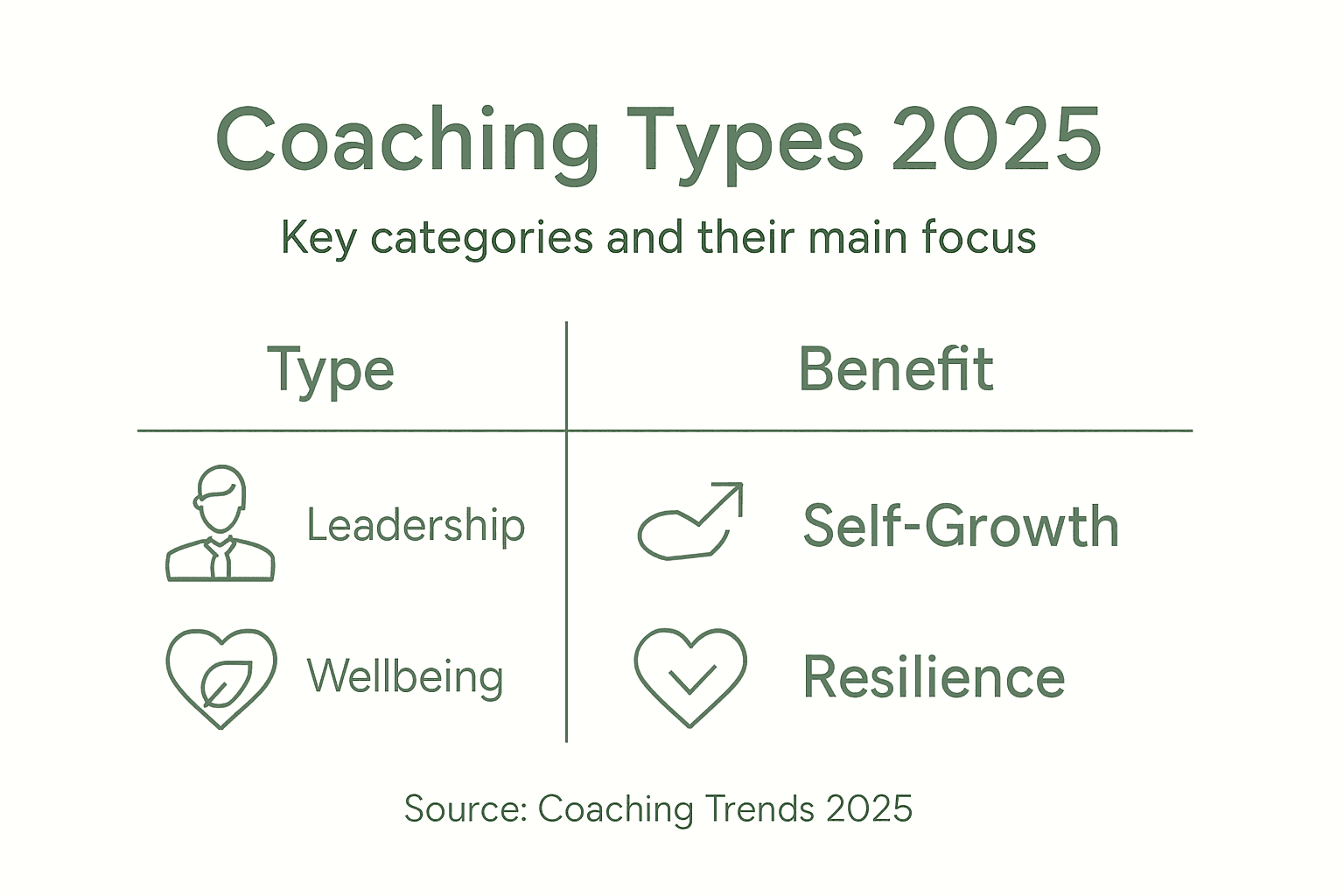
The contemporary coaching landscape encompasses several distinct categories, each with unique methodological approaches. Leadership coaching focuses on developing executive potential and strategic thinking, while personal coaching targets individual growth and self-actualisation. Business coaching remains primarily performance-oriented, supporting professionals in achieving specific organisational objectives. Life coaching, by contrast, adopts a more holistic perspective, addressing comprehensive life satisfaction across multiple domains.
Research indicates that coaching effectiveness varies considerably depending on contextual factors. Academic studies reveal significant variations in coaching impact across different organisational cultures, suggesting that no single approach universally applies. Third-generation coaching models particularly emphasise adaptability, integrating psychological insights with practical goal-setting techniques.
Key distinctions between modern coaching types include:
To clarify how different coaching types serve distinct developmental needs, here is a comparative overview:
Coaching Type | Main Focus | Typical Beneficiaries | Approach Style |
Leadership Coaching | Executive potential and decision-making | Senior managers, executives | Strategic and reflective |
Personal Coaching | Self-actualisation, personal growth | Individuals seeking change | Highly personalised |
Business Coaching | Organisational performance improvement | Teams, business leaders | Goal-oriented and structured |
Life Coaching | Holistic life satisfaction | Anyone pursuing well-being | Supportive and broad-spectrum |
Scope of intervention
Theoretical foundations
Target outcomes
Duration and intensity
Methodological frameworks
Modern coaching recognises individual complexity, moving beyond prescriptive models towards personalised, adaptive interventions that respect each client’s unique context and potential.
Pro tip: When selecting a coach, prioritise alignment between their specialisation and your specific developmental objectives.
How Coaching Supports Wellbeing and Balance
Coaching has emerged as a transformative approach to supporting individual wellbeing, offering personalised strategies for managing stress, enhancing emotional resilience, and creating sustainable life balance. Emotional well-being techniques demonstrate the profound impact of structured, non-judgmental support in helping individuals navigate complex personal and professional challenges.

The core mechanism of coaching involves creating a supportive environment where individuals can explore their thoughts, emotions, and potential barriers to wellbeing. Mindfulness techniques, positive self-talk, and strategic goal-setting become powerful tools for developing emotional awareness and building psychological flexibility. Coaches help clients identify underlying patterns of stress, develop healthier coping mechanisms, and create personalised strategies that align with their unique life circumstances and aspirations.
Modern coaching approaches recognise that wellbeing is multidimensional, encompassing mental, emotional, physical, and professional aspects. By adopting a holistic perspective, coaching supports individuals in understanding the interconnected nature of their experiences. This approach allows for targeted interventions that address specific challenges while simultaneously promoting overall life balance, enabling clients to develop more resilient and adaptive responses to external pressures.
Key strategies for supporting wellbeing through coaching include:
Identifying personal stress triggers
Developing emotional regulation skills
Creating sustainable self-care routines
Establishing healthy boundary-setting practices
Cultivating a growth-oriented mindset
Ultimately, coaching provides a structured yet flexible pathway for individuals to reclaim agency over their personal and professional development, transforming potential limitations into opportunities for growth and self-discovery.
Pro tip: Select a coach who demonstrates genuine understanding of your unique challenges and offers practical, actionable strategies for personal transformation.
Coaching Techniques for Creative Professionals
Coaching for creative professionals has evolved into a nuanced discipline that recognises the unique psychological and professional challenges inherent in artistic work. Creative coaching strategies have become sophisticated tools for unlocking artistic potential and navigating complex emotional landscapes.
The most effective coaching techniques for creatives focus on addressing mental barriers, developing resilience, and creating structured yet flexible approaches to professional development. Reflective questioning emerges as a powerful technique, enabling artists to explore underlying beliefs, challenge self-limiting narratives, and reconnect with their core creative purpose. Coaches specialising in creative work utilise approaches that honour the non-linear nature of artistic inspiration, helping professionals develop adaptive strategies that support both emotional well-being and professional momentum.
Visualization and mindfulness techniques play a crucial role in supporting creative professionals. These approaches help artists manage performance anxiety, overcome creative blocks, and develop more intentional work rhythms. Time management strategies specifically designed for creative workflows, such as flexible time-blocking and rhythm-based productivity methods, allow professionals to balance structured progress with the necessary space for creative exploration and spontaneity.
Key coaching techniques for creative professionals include:
Deep reflective questioning
Personalised visualization practices
Adaptive time management strategies
Emotional resilience building
Creative momentum mapping
Accountability frameworks tailored to artistic rhythms
Ultimately, coaching provides a supportive framework that transforms creative challenges into opportunities for personal and professional growth, helping artists maintain both their artistic integrity and professional sustainability.
Pro tip: Choose a coach who understands the unique rhythms of creative work and can offer strategies that respect your artistic process.
Risks, Costs, and Choosing the Right Coach
Navigating the complex landscape of coaching requires careful consideration of potential risks, financial investment, and individual compatibility. Selecting an appropriate coaching professional involves understanding nuanced factors that extend beyond surface-level credentials.
Coaching costs can vary significantly, ranging from £50 to £250 per hour depending on the coach’s expertise, specialisation, and professional background. Financial investment should be viewed as a strategic decision rather than an expense, with potential returns including enhanced personal effectiveness, improved professional performance, and long-term psychological well-being. Potential risks include engaging with an unqualified coach, experiencing minimal progress, or encountering a misaligned coaching approach that fails to address individual needs.
Critical factors in choosing the right coach include verifying professional credentials, understanding their specific methodology, and assessing personal compatibility. Reputable coaches should provide clear evidence of their training, demonstrate a structured approach to goal setting, and offer transparent progress evaluation mechanisms. Clients should prioritise coaches who balance challenging perspectives with supportive guidance, ensuring a constructive and transformative coaching relationship.
Key considerations when selecting a coach include:
Below is a summary of key factors to weigh when choosing a coach, helping ensure a productive engagement:
Factor | Why It Matters | What To Look For |
Credentials and Accreditation | Assures professional standards | Verified certifications |
Specialisation Fit | Enhances relevance to your needs | Aligned expertise |
Communication Approach | Supports positive coaching relationship | Open, clear feedback style |
Outcome Evidence | Indicates likely effectiveness | Documented client successes |
Transparent Pricing | Sets expectations before commitment | Clear, upfront session fees |
Professional qualifications and accreditations
Specialisation matching personal or professional goals
Coaching style and communication approach
Evidence of successful client outcomes
Transparent pricing and session structures
Confidentiality and ethical practice commitments
Proper due diligence can significantly mitigate potential risks and enhance the likelihood of a successful, meaningful coaching experience that delivers tangible personal and professional development.
Pro tip: Request an initial consultation to assess coach compatibility before committing to a long-term engagement.
Unlock Your Wellbeing and Creative Potential with Tailored Coaching
The 2025 coaching landscape emphasises holistic wellbeing and creative success, recognising that personal growth involves navigating complexity, emotional resilience, and mindful balance. If you feel overwhelmed by stress, stuck in unhelpful routines, or challenged by work-life balance, the SCALES Model used at Tom Ryder Wellbeing offers a practical, personalised coaching framework to help you regain control. By addressing key areas like sleep, creativity, movement, and social connection, our coaching supports lasting change and wellbeing.
Take the next step towards transforming your mental health and creativity with Mental Health & Wellbeing Coaching or build resilience through focused Stress Management Coaching. Whether you are a creative professional seeking tailored support or someone striving for better balance in life, our coaching combines professional experience with genuine empathy. Discover how coaching can help you break free from limitations and foster sustainable personal growth by visiting Tom Ryder Wellbeing today.
Frequently Asked Questions
How does coaching support wellbeing in 2025?
Coaching in 2025 supports wellbeing by providing personalised strategies for managing stress, enhancing emotional resilience, and creating sustainable life balance, allowing individuals to reclaim agency over their development.
What are some key coaching techniques used to foster creative success?
Effective coaching techniques for creative professionals include deep reflective questioning, personalised visualisation practices, adaptive time management strategies, and emotional resilience building, all tailored to support the unique challenges of artistic work.
What are the main differences between types of coaching in 2025?
In 2025, coaching types such as leadership coaching focus on executive potential, personal coaching emphasises self-actualisation, business coaching remains performance-oriented, while life coaching addresses holistic life satisfaction across various domains.
What should I consider when choosing the right coach for my needs?
When choosing a coach, consider their credentials, specialisation fit, communication style, evidence of successful outcomes, and transparent pricing to ensure a productive coaching relationship aligned with your personal and professional goals.
Recommended
Comments