


Creative Wellbeing: Unlocking Health Through Expression


Many UK professionals and creatives find themselves juggling relentless demands, leaving little room for the kind of mental balance that keeps burnout at bay. Yet, despite what you might have heard, creative wellbeing is not a luxury or something reserved for the naturally artistic. In fact, research from the Arts Council makes it clear that a rich cultural and creative life is essential for happiness, life satisfaction, and productivity. This guide clears up the myths and shows how creative outlets can become a powerful part of your daily approach to mental health and resilience.
Table of Contents
Key Takeaways
Point | Details |
Creative Wellbeing is Essential | Engaging in creative activities is crucial for mental health, life satisfaction, and productivity. It facilitates emotional processing and builds resilience. |
Misconceptions About Creativity | You do not need to be artistically skilled to benefit from creative engagement; self-expression is what matters most. |
SCALES Model for Holistic Wellbeing | The SCALES framework highlights interconnected areas of wellbeing, emphasising the importance of addressing multiple factors for a balanced life. |
Combining Approaches | Integrating creative wellbeing practices with traditional mental health support enhances resilience and self-discovery, allowing for a more comprehensive approach to wellbeing. |
Defining Creative Wellbeing And Common Misconceptions
Creative wellbeing is far more than just a pleasant hobby or something you turn to when you have spare time. It is, fundamentally, a rich cultural and creative life that enables flourishing and contributes directly to your mental health, life satisfaction, and productivity. For professionals and creatives in the UK feeling the weight of stress and burnout, this distinction matters enormously. Creative wellbeing integrates psychological and social functioning, meaning that when you engage in creative expression, you are not simply doing something nice for yourself. You are actively rewiring how your brain functions, how you process emotion, and how you connect with others. The research is clear: creativity is not optional to wellbeing. It is essential.
Yet misconceptions about creative wellbeing persist, and they often hold people back. The most damaging myth is that you need to be “artistically skilled” to benefit from creative activity. This is simply untrue. Creative engagement spans diverse activities including reading, crafts, music, festivals, and museum visits. You do not need to produce gallery-worthy art or perform on stage. Whether you are sketching in a notebook, writing badly, cooking an experimental meal, or reorganising your garden, you are engaging in creative wellbeing. Another misconception suggests that creativity is a separate strand of wellbeing, detached from your physical health or stress management. In reality, creative expression works alongside other wellbeing practices. When combined with movement, social connection, and good sleep, it becomes a powerful tool for managing the constant pressure many professionals face.
For many creatives and professionals, the barrier is not ability but belief. You might think you are “not creative enough” or that your creative efforts do not count because they are not professional work. This is where clarity helps. Creative wellbeing is about expression, not perfection. It is about the process, not the product. When you understand this, something shifts. The pressure lifts. You begin to see that creative wellbeing activities for stress relief are not indulgences or distractions from your real work. They are part of your real work. They are part of keeping yourself functioning well, thinking clearly, and feeling capable of meeting the demands your career places on you.
Pro tip: Start by identifying one creative activity you already do or have done in the past that made you lose track of time. It does not matter if it feels “skilled” or “serious” to you; if it felt absorbing and left you feeling lighter afterwards, that is your entry point into creative wellbeing.
Creative Outlets For Improved Mental Health
When you are overwhelmed by work deadlines, relationship stress, or the weight of constant pressure, your instinct might be to push harder, to solve everything through sheer effort. But your mind and body need something different. They need expression. Creative outlets offer a pathway that clinical treatments alone cannot provide. Active participation in art and cultural activities such as immersive storytelling, craft workshops, and performance arts helps you express lived experience and emotional care in ways that words sometimes cannot reach. For professionals and creatives dealing with stress and burnout, this distinction is powerful. You are not just “doing an activity.” You are processing emotion, building resilience, and strengthening your capacity to recover from difficulty.
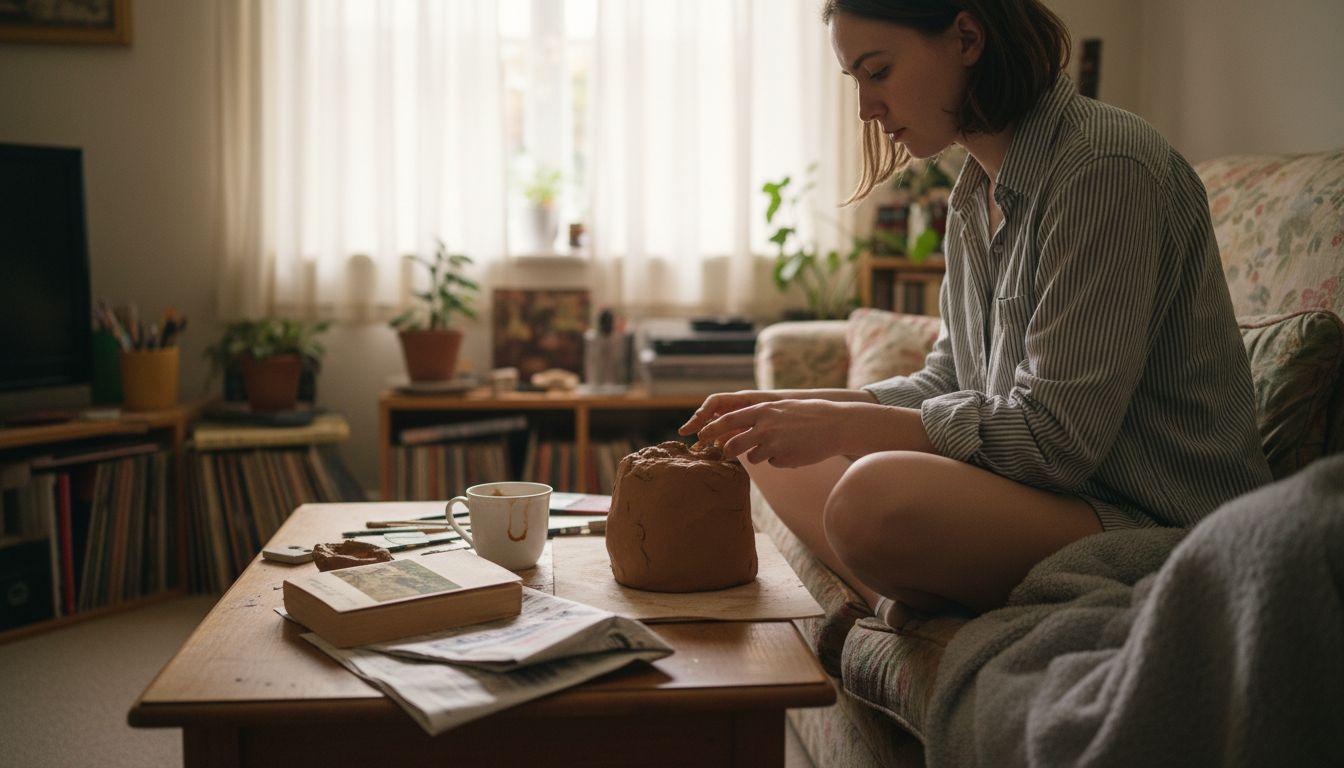
The beauty of creative outlets is their diversity and accessibility. You do not need to choose between art therapy or music or movement. The reality is that creative therapies such as art therapy, music therapy, and dance movement therapy all support mental health by enabling expression beyond verbal communication. Whether you engage in these formally through a therapist or informally on your own, the mechanism is the same. You are giving your nervous system a way to process what words cannot fully capture. A graphic designer might find relief in painting abstractly after a stressful client meeting. A project manager might discover that playing an instrument or building something with their hands quietens the constant mental chatter. Someone working in a high-pressure role might find that dancing, even alone in their living room, shifts their emotional state in minutes. These are not indulgences. They are tools for maintaining mental wellbeing.
What matters is consistency and permission. Many professionals wait until they are completely depleted before they turn to creative outlets, treating them as a rescue effort rather than a regular practice. But the mental health benefits compound when creativity becomes part of your rhythm, not just an emergency intervention. You might spend twenty minutes sketching, writing badly, making music, or moving to songs that matter to you. You might do this weekly, or several times a week. Over time, you notice something shift. Your sleep improves. Your anxiety quietens. Your capacity to handle setbacks strengthens. Your relationships improve because you are less emotionally reactive. These are not side effects of creative engagement. They are the direct result of giving yourself regular space to express, process, and play.
Pro tip: Choose a creative outlet that requires no skill assessment and costs nothing or very little to start: drawing, writing, dancing, singing, or making something with materials you already have at home. The lower the barrier to entry, the more likely you are to actually do it when stress hits.
How The SCALES Model Supports Wellbeing
The SCALES model is a practical framework that looks at six interconnected areas of your life. Think of it like tuning a guitar. When all six strings are in tune, the music flows. When one or more goes out of tune, everything sounds off. That is exactly how wellbeing works. The six strings of SCALES are Sleep, Creative, Active, Listen, Earth, and Social. Rather than treating wellbeing as a single monolithic problem to solve, SCALES breaks it into manageable areas you can actually address. This approach aligns with holistic wellbeing frameworks that embed multiple factors affecting overall health, recognising that your mental state, physical health, social connections, and creative expression are all interdependent.
Each pillar of SCALES targets a specific need. Sleep addresses rest and recovery, giving your body and mind time to recharge. Creative provides outlets for expression and play, which you now understand is fundamental to mental health. Active focuses on movement that supports both body and mind, recognising that physical activity has profound effects on mood and resilience. Listen means paying attention to your thoughts, feelings, and physical signals rather than ignoring or overriding them. Earth grounds you in nature, environment, and present moment awareness. Social ensures you maintain connections and community. What makes SCALES powerful is that it is not a checklist. You are not failing if all six areas are not perfect simultaneously. Instead, it is a diagnostic tool. You can look at your life right now and ask, “Which of these strings feels out of tune?” Is your sleep suffering? Has creative expression dropped off your agenda entirely? Are you moving your body regularly, or spending eight hours at a desk? Are you actually listening to what your emotions are telling you, or pushing through? Getting outside regularly? Seeing friends, or has work consumed all your time? Once you identify which areas need attention, SCALES gives you a framework for rebuilding them.
The beauty of SCALES is that it works alongside other support. Whether you are in counselling, taking medication, or working with a coach, SCALES provides a shared language and toolkit. When you work on building healthy routines for wellbeing, you are not random. You are deliberately tuning specific strings. You might start by improving your sleep by thirty minutes earlier. Then add a creative outlet twice a week. Then commit to a walk outside three times a week. Then schedule one phone call with a friend. Small, deliberate changes across multiple areas compound over time. You are not waiting for one perfect solution. You are building a life where multiple foundations support your wellbeing, making you more resilient when stress or difficulty arrives.
Here’s a concise overview of the SCALES model pillars and their real-world impact:
Pillar | Focus Area | Common Benefits | Example Daily Action |
Sleep | Rest & recovery | Improved mood, clarity | Going to bed 30 minutes earlier |
Creative | Expression & play | Stress reduction, resilience | Sketching or writing regularly |
Active | Physical movement | Boosted energy, better mood | Walking three times a week |
Listen | Self awareness | Emotional regulation | Checking in with feelings daily |
Earth | Nature connection | Grounding, relaxation | Spending time outdoors |
Social | Relationships | Increased optimism, belonging | Calling a friend each week |
Pro tip: Map your own SCALES right now by rating each area from one to ten on a piece of paper. Do not overthink it; trust your gut. Look at your lowest two scores and pick one small action you can take this week to address just that area. Ignore the others for now.
Practical Benefits For Stress And Burnout
Burnout is not a character flaw. It is a signal that something in your system has broken down. Your body is exhausted. Your mind is foggy. Your motivation has evaporated. You know you should rest, but resting feels impossible because the work keeps piling up. This is where creative wellbeing becomes practical medicine. Engagement in creative activities offers substantial benefits for stress reduction and burnout alleviation by promoting emotional resilience, social connection, and mental restoration. When you engage in creative expression, you are not distracting yourself from the problem. You are actively rewiring your nervous system. You are giving your brain permission to shift out of the survival mode it has been locked in, and into a state where it can actually think, feel, and recover.
The mechanisms are tangible and measurable. When you engage creatively, your heart rate lowers. Your anxiety decreases. The constant mental churn quiets. Creative activities improve brain function, reduce stress, and foster a state of flow which directly lowers heart rate and alleviates both anxiety and depression. Flow is that absorbed state where time disappears and you are fully present. A designer lost in a design problem. A musician playing without thinking about the next note. A writer caught in the story. A potter with hands in clay. In those moments, the stressed, overwhelmed part of your mind finally gets to rest. Your nervous system settles. Your sleep improves. Your capacity to handle difficulty increases. For professionals under constant pressure, these benefits compound. You are not just feeling better in the moment. You are building resilience that carries forward into your work and relationships.
What makes creative wellbeing different from other stress management advice is that it actually works with your burnout rather than against it. You do not need motivation to start. You do not need energy or belief that it will work. You simply need to show up and create something, badly if necessary. A sketch that looks nothing like what you intended. Words that do not make sense. A song that is off key. This is not failure. This is the beginning of recovery. The low barrier to entry means you can start today, right now, without waiting for conditions to be perfect. You can spend fifteen minutes drawing, writing, moving, or making something. That fifteen minutes begins to shift your physiology. Over weeks and months, as this becomes a regular practice, the cumulative effect is profound. You sleep better. You think more clearly. You handle setbacks without falling apart. You feel like yourself again.
Pro tip: When burnout is severe, do not wait for motivation or the perfect conditions to create; set a timer for just ten minutes and do the simplest creative act you can think of, understanding that consistency matters far more than quality or ambition.
Creative Wellbeing Versus Traditional Approaches
Traditional mental health approaches tend to focus on problems. You go to a therapist or counsellor, you name the issue, and you work to fix it. There is enormous value in this. Clinical support saves lives and provides essential care for people in crisis. But there is a limitation. By focusing primarily on the problem, traditional approaches can inadvertently reinforce the idea that something is wrong with you, that you are broken and need repair. Creative wellbeing takes a different path entirely. Rather than starting with what is broken, it starts with what is alive in you. It says, “What can you express? What can you create? What lights you up?” Creative wellbeing in education complements traditional mental health approaches by fostering emotional and social skills through arts and cultural participation, rather than focusing solely on clinical symptoms. This is not a replacement for therapy or medical care. It is a complement. It is a parallel approach that builds resilience, self-expression, and engagement alongside whatever clinical support you are receiving.
The difference in approach matters profoundly. Traditional mental health interventions often work top-down. An expert diagnoses, prescribes, and you follow the protocol. Creative wellbeing is bottom-up. You discover what works for you through experimentation and play. You are not following someone else’s blueprint. You are listening to yourself. This distinction is crucial for professionals and creatives who have spent years listening to everyone else’s needs, feedback, and demands. The creative approach says your voice, your expression, your authentic experience matters. It is not something to manage or overcome. It is something to honour and explore. When you engage creatively, you are not pathologising yourself. You are developing yourself. You are learning who you are beyond your job title, your responsibilities, and your stress levels.
The research shows both matter. Creative wellbeing encourages development of resilience, emotional intelligence, and wellbeing through participatory, community-focused activities that contrast with the conventional medicalized model. The most effective approach combines them. You might work with a therapist on processing trauma or managing anxiety whilst also engaging regularly in creative outlets that rebuild your sense of self. You might take medication to stabilise your mood whilst also reconnecting with activities that make you feel alive. You might attend counselling to work through relationship patterns whilst also joining a music group or art class that reminds you who you are beyond those patterns. The medicalized model asks, “What is wrong?” Creative wellbeing asks, “What is possible?” Both questions matter. Both approaches deserve space in your life.
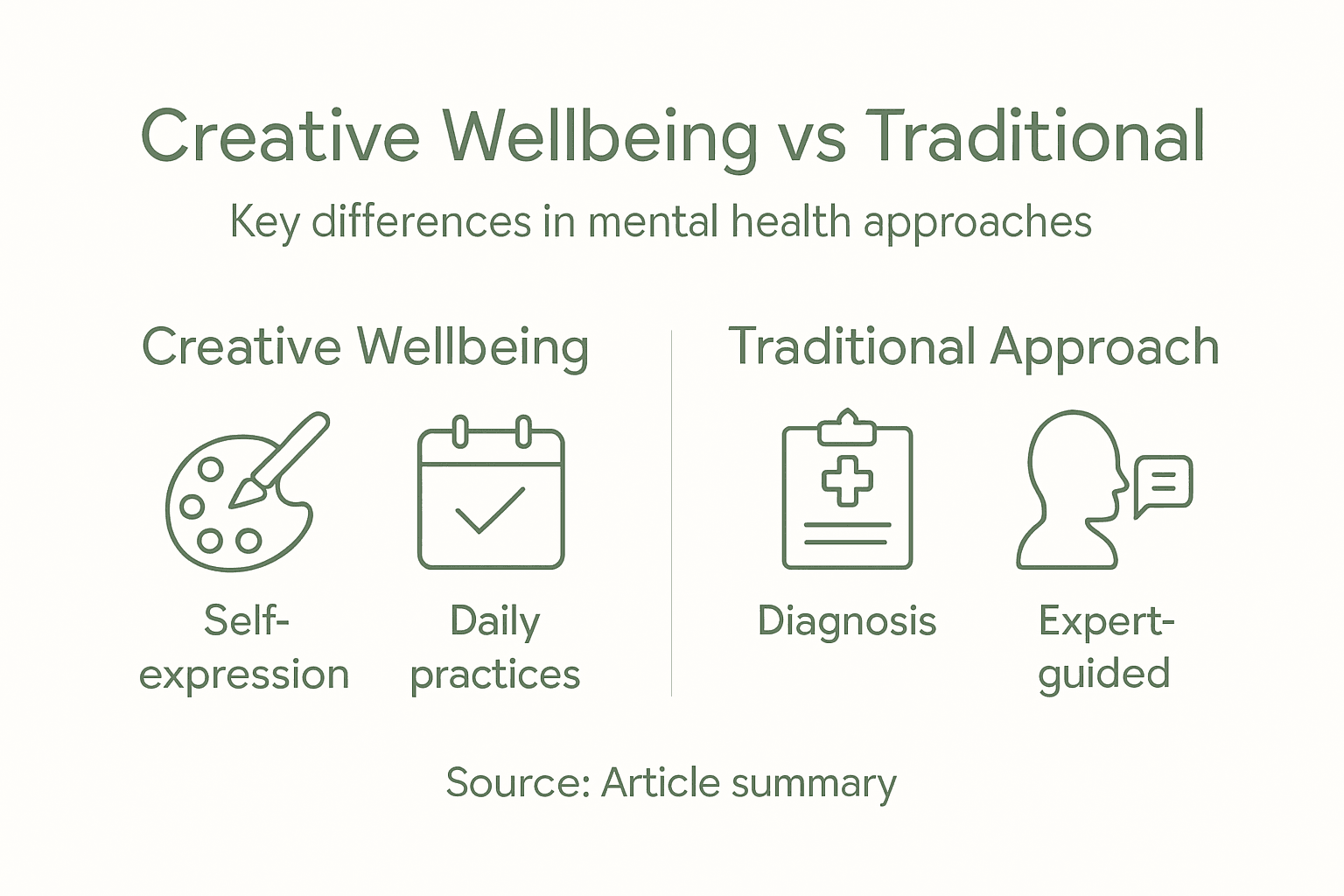
The table below highlights the key differences between traditional mental health approaches and creative wellbeing methods:
Approach Type | Primary Focus | Typical Method | Unique Benefit |
Traditional Clinical | Problem diagnosis | Talking therapy, medication | Addresses clinical symptoms |
Creative Wellbeing | Personal expression | Arts, music, movement | Builds resilience and self-discovery |
Pro tip: Do not choose between traditional support and creative wellbeing; stack them together by continuing whatever clinical or therapeutic support you have whilst simultaneously adding one small creative practice to your week, letting them work in parallel rather than competition.
Harness Creative Wellbeing to Transform Your Mental Health and Resilience
If you find yourself overwhelmed by stress, burnout, or feeling stuck in your work and personal life, the insights from “Creative Wellbeing: Unlocking Health Through Expression” could be a turning point. This article highlights how unlocking your creative expression is not a luxury but a vital part of balancing your mental health through frameworks like the SCALES Model. Whether it is feeling “off balance” or struggling with motivation, you are not alone — and there are practical, proven ways to start feeling better right now.
At Tom Ryder Wellbeing, we specialise in Mental Health And Wellbeing Coaching and Stress Management Coaching that integrate creative outlets alongside holistic lifestyle changes. Our coaching uses the very SCALES Model the article explains, focusing on Sleep, Creative, Active, Listen, Earth, and Social pillars to help you rebuild resilience and reduce burnout in real, manageable steps. Don’t wait for motivation to appear — start small, start today, and watch your wellbeing improve.
Take the first step towards a better balance in life with Wellbeing Coaching UK. Discover how combining creativity with coaching can restore clarity and energy. Visit Tom Ryder Wellbeing to schedule your free consultation and begin your personal journey to feeling like yourself again.
Frequently Asked Questions
What is creative wellbeing?
Creative wellbeing refers to engaging in creative activities that enhance mental health, life satisfaction, and overall wellbeing. It involves expressing oneself through various forms of creativity, which is essential for emotional and psychological health.
Do I need artistic skills to benefit from creative wellbeing?
No, you do not need to be artistically skilled to enjoy the benefits of creative wellbeing. Activities such as writing, cooking, or even rearranging your garden can contribute positively to your mental health.
How does creative wellbeing support stress management?
Engaging in creative activities helps to express emotions and process experiences that may be difficult to articulate verbally. This artistic expression can lead to reduced anxiety, improved mood, and a sense of accomplishment, which collectively assist in stress management and burnout recovery.
What components are included in the SCALES model for wellbeing?
The SCALES model comprises six interconnected areas: Sleep, Creative, Active, Listen, Earth, and Social. Each area addresses different aspects of wellbeing and can be used together to identify and improve your overall mental and emotional health.
Recommended
Comments