


Emotional Resilience: Why It Matters for Wellbeing


Burnout rates among British professionals have surged by over 40 percent in recent years. For many in Essex, relentless pressure leaves little room to recover, making emotional resilience more relevant than ever. With practical strategies grounded in psychological research, you can move beyond common myths and begin building authentic coping skills that protect your mental wellbeing at work and home.
Table of Contents
Key Takeaways
Point | Details |
Resilience is Developable | Emotional resilience is a skill that can be cultivated through practice and self-awareness, rather than an inherent trait. |
Acknowledge Emotions | True resilience involves recognising and processing difficult emotions instead of avoiding them, allowing for constructive responses to adversity. |
Diverse Applications | Emotional resilience manifests in various areas of life, including interpersonal, professional, personal, and social domains, each requiring different approaches. |
Barriers Exist | Psychological misconceptions and lack of mindfulness can hinder the development of resilience, making it crucial to adopt reflective practices for growth. |
Defining Emotional Resilience and Common Myths
Emotional resilience represents our fundamental capacity to navigate life’s challenges with strength and adaptability. At its core, resilience is not about avoiding difficulties but developing the psychological flexibility to respond constructively when confronted with stress. Understanding resilience means recognising it as a skill that can be developed and refined, rather than an innate personality trait.
The capacity to recover quickly from difficulties involves several key psychological mechanisms. Resilient individuals demonstrate remarkable emotional regulation, maintaining a balanced perspective even during turbulent circumstances. They understand that setbacks are temporary and view challenges as opportunities for growth rather than insurmountable obstacles. This perspective allows them to adapt, learn, and continue moving forward despite adversity.
Understanding common myths about emotional resilience is crucial for personal development. Many people mistakenly believe resilience means never experiencing negative emotions or always appearing strong. In reality, resilience is about acknowledging difficult feelings, processing them effectively, and maintaining forward momentum. Research indicates that resilience is not an innate trait but a skill that can be systematically developed, which means anyone can enhance their emotional strength through purposeful practice and self-awareness.
Pro Practical Strategy: Start building resilience by keeping a reflective journal where you document challenging experiences, your emotional responses, and the lessons learned, helping you develop greater self-understanding and psychological flexibility.
The table below compares common myths about resilience to the actual psychological reality:
Common Myth | Psychological Reality |
Resilience means never feeling upset | It involves acknowledging and processing emotions |
Only tough people are resilient | Everyone can develop resilience with effort |
Setbacks mean personal failure | Challenges are opportunities for growth |
Resilience is fixed at birth | It is a skill that develops over time |
Types of Emotional Resilience in Daily Life
Emotional resilience manifests differently across various aspects of our personal and professional experiences. The Resilience Framework identifies key areas that contribute to our emotional strength, highlighting how resilience is not a singular skill but a complex interaction of multiple psychological and environmental factors. These areas include basic needs, sense of belonging, continuous learning, effective coping mechanisms, and developing a robust core sense of self.
In practical terms, emotional resilience reveals itself through our ability to navigate everyday challenges with composure and adaptability. This might involve managing workplace stress, maintaining healthy relationships, handling unexpected life transitions, or processing personal setbacks. Resilient individuals demonstrate remarkable flexibility, viewing obstacles as opportunities for growth rather than insurmountable barriers. They possess an inherent capacity to regulate emotions, maintain perspective, and take constructive action even when circumstances feel overwhelming.

Understanding the nuanced types of emotional resilience helps us recognise our own strengths and areas for development. Some individuals excel in interpersonal resilience, effectively managing relationship dynamics and communication challenges. Others might demonstrate professional resilience, bouncing back from career setbacks or adapting to rapidly changing work environments. Personal resilience encompasses our ability to maintain mental well-being during individual life challenges, while social resilience relates to our capacity to support and draw strength from community networks.
Pro Practical Strategy: Conduct a monthly self-assessment of your resilience across different life domains, identifying specific areas where you feel strong and those requiring additional emotional skill development and support.
To clarify the various forms of emotional resilience, here is a summary of how it may be expressed in different domains:
Domain | Description | Real-life Example |
Interpersonal | Navigating relationship challenges | Resolving conflicts with family members |
Professional | Managing career setbacks | Adapting to job changes or redundancy |
Personal | Maintaining individual wellbeing | Coping with illness or loss |
Social | Drawing strength from community | Participating in support groups |
Key Traits and How Resilience Works
Key characteristics of emotional resilience reveal a complex psychological mechanism that enables individuals to navigate challenging circumstances with remarkable composure. Fundamental traits include optimism, self-awareness, empathy, and emotional stability. These attributes work collaboratively, creating a psychological framework that allows people to process difficulties without becoming overwhelmed or losing perspective.
The mechanism of resilience operates through sophisticated psychological and neurological processes. When confronted with stress or adversity, resilient individuals activate adaptive coping strategies that help them maintain emotional equilibrium. This involves recognising emotional triggers, regulating immediate reactions, and consciously choosing constructive responses. Their ability to remain calm under pressure stems from a well-developed capacity for emotional self-management and a realistic yet positive outlook on challenging situations.
Understanding how resilience functions requires recognising its dynamic nature. Resilience research suggests a Bi-Dimensional Framework where protective factors actively mitigate the impact of adverse experiences, enabling individuals to maintain psychological balance. These protective factors might include robust social support networks, healthy coping mechanisms, strong self-esteem, and the ability to reframe negative experiences as opportunities for personal growth and learning. Resilience is not a static trait but a skill that can be consistently developed and refined through intentional practice and self-reflection.
Pro Practical Strategy: Develop a weekly reflection practice where you consciously analyse challenging situations, identifying your emotional responses and exploring alternative perspectives that promote psychological flexibility and emotional growth.
Benefits for Mental Health and Wellbeing
Emotional resilience offers profound advantages for mental health, transforming how individuals navigate life’s complex challenges. Strong social connections in early life can significantly predict long-term psychological wellbeing, with research indicating that quality relationships during adolescence create lasting psychological foundations that support emotional stability and adaptive coping mechanisms.
The psychological benefits of resilience extend far beyond immediate stress management. Resilient individuals demonstrate enhanced ability to maintain mental equilibrium during challenging circumstances, effectively reducing risks of anxiety, depression, and chronic stress. This psychological robustness enables people to process difficult experiences without becoming overwhelmed, maintaining a balanced perspective that supports overall mental wellbeing. The capacity to reframe challenges as opportunities for growth becomes a powerful protective mechanism against potential mental health deterioration.
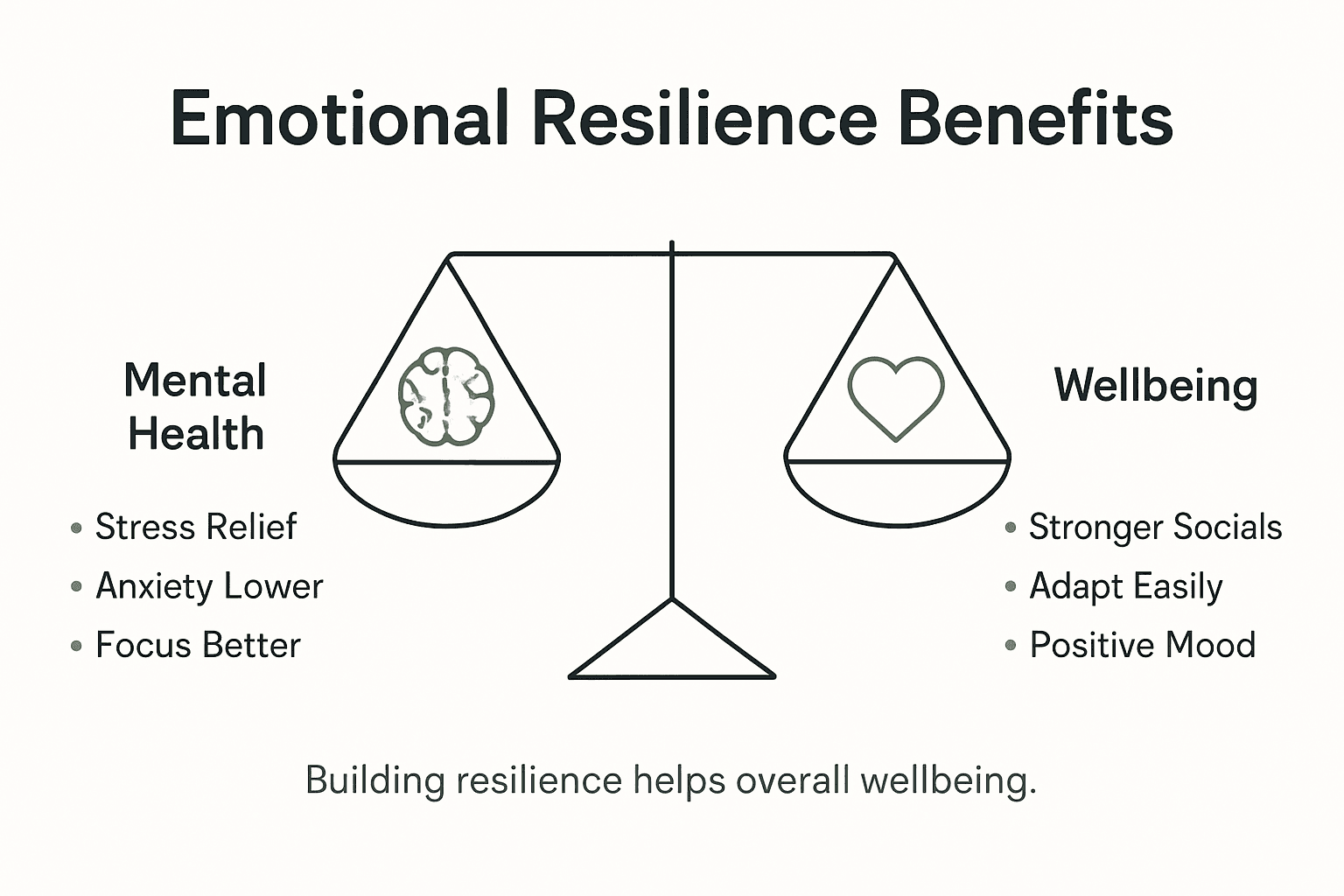
Professional contexts also highlight the critical role of emotional resilience in maintaining psychological health. Workplace resilience is crucial for preventing burnout and maintaining positive mental states, particularly in high-pressure environments. Individuals with strong resilience skills can effectively manage professional demands, maintain emotional boundaries, and sustain their psychological energy. This translates into improved job satisfaction, reduced workplace stress, and a more balanced approach to professional challenges that supports long-term career sustainability and personal contentment.
Pro Practical Strategy: Develop a daily emotional check-in routine where you consciously assess your stress levels, emotional state, and potential coping strategies, creating a proactive approach to maintaining your psychological wellbeing.
Barriers to Building Emotional Resilience
Psychological misconceptions frequently obstruct individuals’ ability to develop genuine emotional resilience. Common myths about emotional wellbeing can significantly impede personal growth and psychological development, creating mental barriers that prevent people from effectively managing their emotional experiences. These myths often include destructive beliefs such as assuming happiness is a default state, viewing emotional challenges as personal failings, and believing that negative feelings must be completely eliminated to achieve wellbeing.
Psychological and cognitive barriers represent complex internal mechanisms that restrict emotional growth. Many individuals struggle with deeply ingrained thought patterns that undermine their resilience, such as catastrophising difficult experiences, maintaining rigid thinking styles, or habitually avoiding emotional discomfort. These patterns create psychological defence mechanisms that paradoxically reduce emotional flexibility and adaptability, making it increasingly challenging to develop genuine resilience.
Lack of mindfulness and reflective practices represents another significant barrier to building emotional resilience. Without intentional strategies for stress management and emotional awareness, individuals often remain trapped in reactive patterns, unable to develop the self-awareness necessary for meaningful psychological growth. Mindfulness techniques offer crucial tools for enhancing emotional literacy, enabling individuals to observe their internal experiences without judgment and develop more sophisticated emotional regulation skills.
Pro Practical Strategy: Create a daily ten-minute meditation practice focusing on emotional observation, allowing yourself to acknowledge feelings without immediate judgment or attempts to change them.
Practical Strategies for Strengthening Resilience
Physical activity and intentional lifestyle practices represent foundational approaches to developing emotional resilience. Regular exercise, mindful movement, and purposeful physical engagement create neurological pathways that enhance stress management capabilities. These activities trigger positive biochemical responses, releasing endorphins that improve mood, reduce anxiety, and build psychological strength, enabling individuals to develop more robust emotional coping mechanisms.
Developing psychological strategies is equally crucial in building resilience. Practicing self-compassion involves treating oneself with kindness during challenging moments, acknowledging personal limitations without harsh self-judgment. Mindfulness techniques such as meditation, deep breathing exercises, and reflective journaling help individuals cultivate present-moment awareness, allowing them to observe emotional experiences without becoming overwhelmed. These practices create psychological distance from stressful thoughts, enabling more balanced and constructive responses to life’s challenges.
Maintaining strong social connections serves as another critical strategy for strengthening emotional resilience. Building supportive relationships provides external perspectives, emotional validation, and practical assistance during difficult times. Cultivating a diverse network of relationships helps individuals normalise challenging experiences, gain different insights, and feel less isolated. This social support acts as a psychological buffer, helping people navigate complex emotional landscapes with greater confidence and adaptability.
Pro Practical Strategy: Create a weekly resilience journal documenting personal challenges, emotional responses, and constructive coping strategies, allowing for systematic reflection and continuous psychological growth.
Build Your Emotional Resilience with Practical Coaching Support
If you find yourself overwhelmed by stress or struggling to bounce back from setbacks, developing emotional resilience is essential. This article highlights how recognising and strengthening your ability to manage emotions and adapt to challenges can transform your mental health and wellbeing. At Tom Ryder Wellbeing, we understand that true resilience involves more than just enduring difficulties it is about learning to adapt, process emotions, and build sustainable habits that support your overall balance.
Our Emotional Resilience Coaching and Mental Health and Wellbeing Coaching programmes are tailored to help you develop these vital skills using the proven SCALES Model. Whether you feel stuck, exhausted by stress, or need guidance on practical strategies to build resilience in daily life our supportive and honest coaching style can provide clarity and real progress. Take the next step today by visiting Tom Ryder Wellbeing to explore how personalised coaching helps you face challenges with confidence and lasting strength.
Frequently Asked Questions
What is emotional resilience?
Emotional resilience is the capacity to navigate life’s challenges with strength and adaptability. It involves developing the psychological flexibility to respond constructively to stress, rather than avoiding difficulties.
How can I develop emotional resilience?
Emotional resilience can be systematically developed through practices such as keeping a reflective journal, developing mindfulness techniques, and engaging in physical activity. These strategies help enhance self-awareness and emotional regulation.
What are common myths about emotional resilience?
Common myths include the belief that resilient people never feel upset, only tough individuals can be resilient, setbacks signify personal failure, and that resilience is fixed at birth. In reality, resilience includes acknowledging emotions, is developable by anyone, and involves viewing challenges as growth opportunities.
Why is emotional resilience important for mental health?
Emotional resilience plays a vital role in mental health by enhancing an individual’s ability to manage stress, reduces risks of anxiety and depression, and improves overall well-being. It allows people to maintain emotional equilibrium even during challenging situations.
Recommended
Comments