


What Is Student Wellbeing and Why It Matters


More than half of British university students report struggling with stress and identity shifts during exams. In the heart of the United Kingdom, student wellbeing means more than just getting good grades—it is about balancing emotional, social, and academic health among constant change. By exploring practical strategies rooted in real research, you can discover how to strengthen mental resilience, boost confidence, and create a supportive foundation for university life.
Table of Contents
Key Takeaways
Point | Details |
Holistic View of Wellbeing | Student wellbeing encompasses emotional, social, and academic dimensions, recognising the interplay between these aspects in influencing overall health and academic success. |
Interconnected Challenges | Academic pressures, financial strain, and personal identity issues collectively affect students’ mental health, necessitating nuanced support systems. |
Impact on Academic Performance | Wellbeing significantly correlates with academic success; positive mental health enhances motivation, cognitive performance, and resilience in learning environments. |
Proactive Support Strategies | Implementing structured support networks and self-management techniques is essential for fostering student wellbeing and navigating academic challenges effectively. |
Defining Student Wellbeing in the UK Context
Student wellbeing represents a holistic approach to understanding and supporting the comprehensive health of students across educational environments. Far from being a simple concept, it encompasses multiple interconnected dimensions that significantly influence academic performance and personal development.
In the United Kingdom, student wellbeing is increasingly recognised as a multidimensional construct that extends beyond traditional academic metrics. Research from King’s College London highlights the complex nature of student wellbeing as encompassing physical, mental, social, and emotional domains. This comprehensive perspective acknowledges that students’ experiences are not limited to academic achievements but include their psychological resilience, social connections, and overall life satisfaction.
The emerging understanding of student wellbeing in the UK recognises it as a dynamic process involving personal growth, emotional regulation, and adaptive capabilities. Oxford University Press evidence reviews confirm that wellbeing encompasses emotional, social, and psychological health, emphasising the need for supportive educational environments that nurture students’ holistic development. Key elements include mental health support, social integration, academic engagement, and personal skill development.
Student wellbeing strategies must therefore address multiple interconnected aspects of a student’s life, recognising that academic success is intrinsically linked to emotional and social well-being. By understanding these complex interactions, educational institutions can develop more targeted and effective support systems.
To clarify the dimensions of student wellbeing, here is a summary of core domains and their typical indicators:
Wellbeing Domain | Key Indicators | Impact on Student Life |
Emotional | Stress levels, self-esteem, resilience | Influences motivation and coping skills |
Social | Peer relationships, sense of belonging, support networks | Affects engagement and sense of inclusion |
Academic | Curiosity, persistence, goal-setting | Drives learning outcomes and satisfaction |
Pro Tip: Holistic Self-Assessment: Regularly reflect on your physical, emotional, and social health by keeping a weekly journal tracking your energy levels, mood, social interactions, and academic progress.
Types of Student Wellbeing: Emotional, Social, Academic
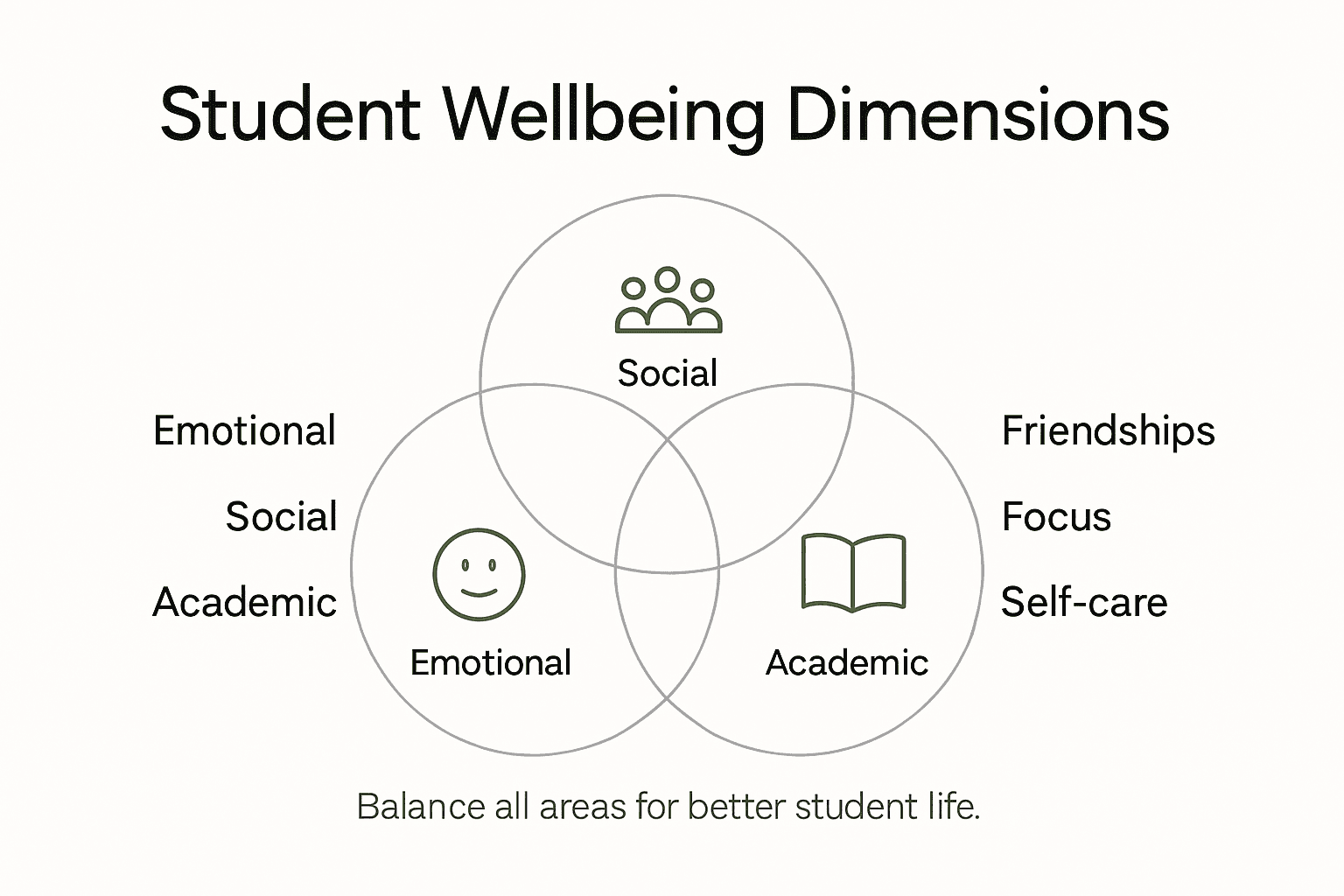
Student wellbeing is a complex, multifaceted concept that extends far beyond traditional academic performance, encompassing emotional, social, and academic dimensions that are deeply interconnected and mutually reinforcing. Researchers have identified distinct yet interrelated types of wellbeing that collectively shape a student’s overall educational experience and personal development.

Emotional Wellbeing represents the psychological landscape of a student’s inner world, involving self-awareness, emotional regulation, resilience, and mental health. It involves understanding and managing one’s feelings, developing coping strategies for stress, and maintaining a positive self-image. Students with strong emotional wellbeing can navigate challenges more effectively, maintain motivation, and build healthy relationships with peers and educators.
Social Wellbeing focuses on interpersonal connections, communication skills, and a sense of belonging within educational communities. Comprehensive meta-analyses demonstrate that social interactions significantly impact student outcomes, highlighting the importance of supportive networks, collaborative learning environments, and opportunities for meaningful social engagement. This dimension includes the ability to form positive relationships, communicate effectively, and feel integrated within academic and broader social contexts.
Academic Wellbeing encompasses a student’s engagement with learning, intellectual growth, and educational achievements. It involves developing curiosity, maintaining academic motivation, setting realistic goals, and cultivating a growth mindset. Students with robust academic wellbeing demonstrate resilience in facing educational challenges, maintain intellectual curiosity, and view learning as a dynamic, enjoyable process rather than a mere performance metric.
Pro Tip: Holistic Self-Monitoring: Create a weekly reflection journal tracking your emotional states, social interactions, and academic progress to identify patterns and areas requiring targeted support and development.
Common Drivers and Challenges for Students
Student life in the United Kingdom presents a complex landscape of challenges and opportunities that significantly impact individual wellbeing. Systematic reviews of student experiences reveal a multifaceted array of factors influencing mental health and academic performance, highlighting the intricate nature of navigating higher education.
Academic pressures represent a primary challenge, with students experiencing intense stress from rigorous coursework, examination expectations, and competitive academic environments. These pressures are compounded by financial challenges, including increasing tuition costs, living expenses, and the need to balance part-time work with academic commitments. Research from the UK House of Commons Library underscores the profound impact of financial strain on student mental health, demonstrating how economic uncertainties can significantly disrupt students’ emotional and psychological wellbeing.
Personal transitions and identity challenges further contribute to student stress. Moving away from familiar support networks, adapting to independent living, and negotiating complex social and personal identities create additional psychological demands. Minority students, including those from LGBTQ+ communities, international students, and individuals with disabilities, often face additional layers of complexity in their university experience, requiring more nuanced support and understanding.
External societal factors, including post-pandemic uncertainties, evolving job markets, and global economic challenges, introduce additional layers of complexity to student experiences. These broader contextual pressures intersect with individual academic and personal journeys, creating a dynamic and often unpredictable environment that requires significant emotional resilience and adaptability.
Pro Tip: Proactive Support Planning: Develop a personal support network map identifying academic advisors, counselling services, peer support groups, and trusted friends to create a comprehensive safety net for managing potential challenges.
The following table contrasts common challenges faced by UK students with practical support solutions:
Challenge Type | Typical Example | Potential Support Solution |
Academic Pressure | Exam stress, heavy workload | Study skills workshops, time management courses |
Financial Strain | Rising tuition, living costs | Scholarships, budgeting advice services |
Social Adjustment | Homesickness, loneliness | Peer mentoring, student societies |
Personal Identity Issues | Discrimination, cultural barriers | Inclusive programmes, specialist counselling |
How Wellbeing Affects Academic Success
The intricate relationship between student wellbeing and academic performance reveals a profound interconnection that extends far beyond traditional measures of educational achievement. Longitudinal studies from the Institute of Education demonstrate how emotional and social wellbeing directly correlate with educational outcomes, highlighting the critical importance of holistic student support.
Cognitive Performance is fundamentally linked to psychological wellbeing. Students experiencing positive mental health exhibit enhanced concentration, more effective information processing, and greater cognitive flexibility. Emotional stability allows learners to engage more deeply with academic material, manage stress more efficiently, and maintain consistent motivation through challenging academic periods. This psychological resilience enables students to approach complex learning tasks with greater confidence and adaptability.
Research from Oxford University Press confirms that targeted wellbeing interventions can significantly improve both academic progress and mental health resilience. The connection between wellbeing and academic success is not merely correlational but causal, with positive psychological states creating neurological conditions that support learning, memory retention, and critical thinking skills. Students who develop robust emotional regulation strategies demonstrate more consistent academic engagement, higher attendance rates, and improved overall educational outcomes.
Moreover, wellbeing impacts academic success through broader mechanisms of social and emotional competence. Students with strong interpersonal skills, effective stress management techniques, and a supportive network are better equipped to navigate academic challenges, seek help when needed, and maintain long-term educational commitments. These skills transform academic obstacles from insurmountable barriers into manageable learning opportunities.
Pro Tip: Holistic Learning Strategy: Create a weekly self-care schedule that integrates academic tasks with mental health practices, ensuring balanced progress across emotional and educational dimensions.
Practical Strategies and Support Options
Comprehensive mental health support strategies represent a critical approach to addressing student wellbeing in the United Kingdom, recognising that proactive intervention and holistic support are essential for academic and personal success.
The institutional approach involves multi-layered support systems. Universities and colleges are increasingly implementing whole-institution strategies that integrate mental health considerations across academic and pastoral environments. These approaches include training staff to recognise early signs of mental health challenges, establishing dedicated support teams, and creating accessible counselling services that provide confidential, professional guidance for students experiencing emotional or psychological difficulties.
Individual self-management strategies play an equally crucial role in maintaining wellbeing. Evidence-based resources from student wellbeing handbooks recommend practical techniques such as developing structured daily routines, practicing mindfulness and stress-reduction techniques, maintaining regular physical exercise, and cultivating strong social connections. These strategies empower students to take an active role in managing their mental health, building resilience, and creating personal support networks that can buffer against academic and personal challenges.
Technology and digital platforms now offer additional avenues for support, providing students with flexible, accessible mental health resources. Online counselling services, peer support forums, mental health apps, and virtual workshops complement traditional face-to-face interventions, ensuring students can access support that fits their individual preferences and circumstances.
Pro Tip: Holistic Wellbeing Mapping: Create a personalised wellbeing dashboard tracking your emotional states, academic progress, social interactions, and self-care activities to identify patterns and proactively manage your mental health.
Enhance Your Student Wellbeing with Practical Coaching Support
Understanding that student wellbeing involves emotional, social, and academic challenges is the first step to making meaningful change. If you are feeling overwhelmed by stress, struggling to find balance, or facing motivation dips during important transitions like exams or university life, you are not alone. The concepts from the article — such as emotional regulation, social connection, and managing academic pressures — highlight how interconnected wellbeing truly is. These are exactly the areas Tom Ryder Wellbeing helps you address with personalised, practical coaching.
Our approach using the SCALES Model empowers you to tune into key life areas including Sleep, Creativity, Activity, and Social support to build resilience and improve your daily experience. Whether you want support through Mental Health and Wellbeing Coaching or need focused strategies like Stress Management Coaching, Tom offers grounded, honest guidance shaped by professional training and real lived experience. Don’t wait for challenges to escalate. Start taking small, sustainable steps now that lead to long-term wellbeing and more satisfying academic success. Visit Tom Ryder Wellbeing to explore coaching options and book your free discovery consultation today.
Frequently Asked Questions
What is student wellbeing?
Student wellbeing refers to a holistic approach to understanding and supporting the emotional, social, and mental health of students in educational environments.
Why is student wellbeing important for academic success?
Student wellbeing impacts cognitive performance; students with good emotional health are more focused, resilient, and capable of engaging fully in their academic work, leading to better educational outcomes.
What are the key dimensions of student wellbeing?
The key dimensions of student wellbeing include emotional wellbeing, social wellbeing, and academic wellbeing, all of which are interconnected and influence a student’s overall health and success.
How can students improve their wellbeing?
Students can improve their wellbeing by developing self-management strategies, maintaining social connections, participating in structured routines, and engaging in fitness and mindfulness practices.
Recommended
Comments