


Holistic Wellbeing: Transforming Everyday Mental Health


More than half of British adults have tried at least one holistic wellbeing approach in their search for better health. The growing popularity of these methods shows that many people are seeking solutions that acknowledge the full picture, rather than just treating a single symptom. Whether you are new to these ideas or curious about how holistic wellbeing works, you will discover clear explanations and practical insights to help you make sense of this integrated path to balance.
Table of Contents
Key Takeaways
Point | Details |
Holistic Wellbeing Approach | This approach integrates multiple life domains, emphasising the interconnection between mental and physical health for comprehensive personal growth. |
SCALES Model Overview | The SCALES Model promotes balance across six dimensions: Sleep, Creative Expression, Active Living, Listening, Earth Connection, and Social Engagement, which work synergistically for overall wellness. |
Transformative Principles | Holistic wellness models prioritise prevention and personal agency, viewing wellbeing as a dynamic process rather than a static condition, encouraging active participation in personal growth. |
Avoiding Common Pitfalls | Individuals should focus on personalised strategies and patience, recognising that progress in holistic wellbeing is nonlinear and requires adaptation to individual experiences. |
Understanding Holistic Wellbeing Approaches
Holistic wellbeing represents a comprehensive approach to mental and physical health that transcends traditional fragmented healthcare models. Unlike conventional treatments that often focus on isolated symptoms, this approach recognises that human wellness interconnects multiple life domains. Researchers at the University of Manchester have highlighted the importance of integrated frameworks that consider psychological, social, emotional, and physical aspects of an individual’s experience.
The core principle of holistic wellbeing is understanding that our mental state profoundly influences our physical health and vice versa. This means addressing challenges not through singular interventions, but by examining broader lifestyle patterns, relationships, work environments, personal beliefs, and daily routines. Swansea University’s research emphasizes the need for action-based solutions that promote human flourishing across multiple interconnected scales.
Practically, a holistic approach involves considering six key dimensions of wellness: physical health, emotional balance, intellectual stimulation, social connections, spiritual alignment, and environmental interactions. Each dimension influences the others, creating a complex yet dynamic system of personal wellbeing. By understanding these interactions, individuals can develop more nuanced strategies for maintaining mental and physical health.
Pro Tip: Holistic Health Check: Spend 15 minutes each week reflecting on your wellbeing across these six dimensions, noting areas that feel balanced or need attention, and identify one small, actionable step to support your overall wellness.
Key Differences From Traditional Wellness
Traditional wellness models typically approach health through a reductive lens, treating symptoms in isolation and often fragmenting human experience into disconnected medical categories. Research from the Journal of Contemporary Education Theory & Research demonstrates that holistic approaches fundamentally challenge this paradigm by recognising individuals as complex, interconnected systems where physical, emotional, social, and spiritual dimensions are deeply interrelated.
Psychological perspectives differ significantly between traditional and holistic wellness frameworks. While conventional models focus on diagnosing and treating specific mental health conditions, holistic approaches prioritise understanding an individual’s entire lived experience. Three Principles Psychology offers an alternative perspective that emphasises how thought processes and individual consciousness shape psychological experiences, moving beyond symptom management towards intrinsic resilience and personal understanding.
Holistic wellness models introduce several transformative principles that distinguish them from traditional approaches. These include promoting personal agency, recognising multiple dimensions of health, emphasising prevention over intervention, and viewing wellbeing as a dynamic, evolving process rather than a static condition. This approach encourages individuals to become active participants in their healing journey, understanding that mental health is not simply about treating problems but about cultivating comprehensive personal growth.
To clarify the distinctions between holistic and traditional wellness models, consider the following comparison:
Aspect | Traditional Wellness | Holistic Wellbeing |
Focus | Single symptoms | Interconnected life areas |
Approach to Health | Reactive, problem-based | Preventive, growth-oriented |
Patient Role | Passive recipient | Active, self-guided |
View of Progress | Linear improvement | Dynamic, evolving process |
Pro Tip: Holistic Wellness Audit: Spend 20 minutes mapping your current wellness across physical, emotional, intellectual, social, and spiritual domains, identifying areas of strength and potential growth opportunities.
How the SCALES Model Supports Balance
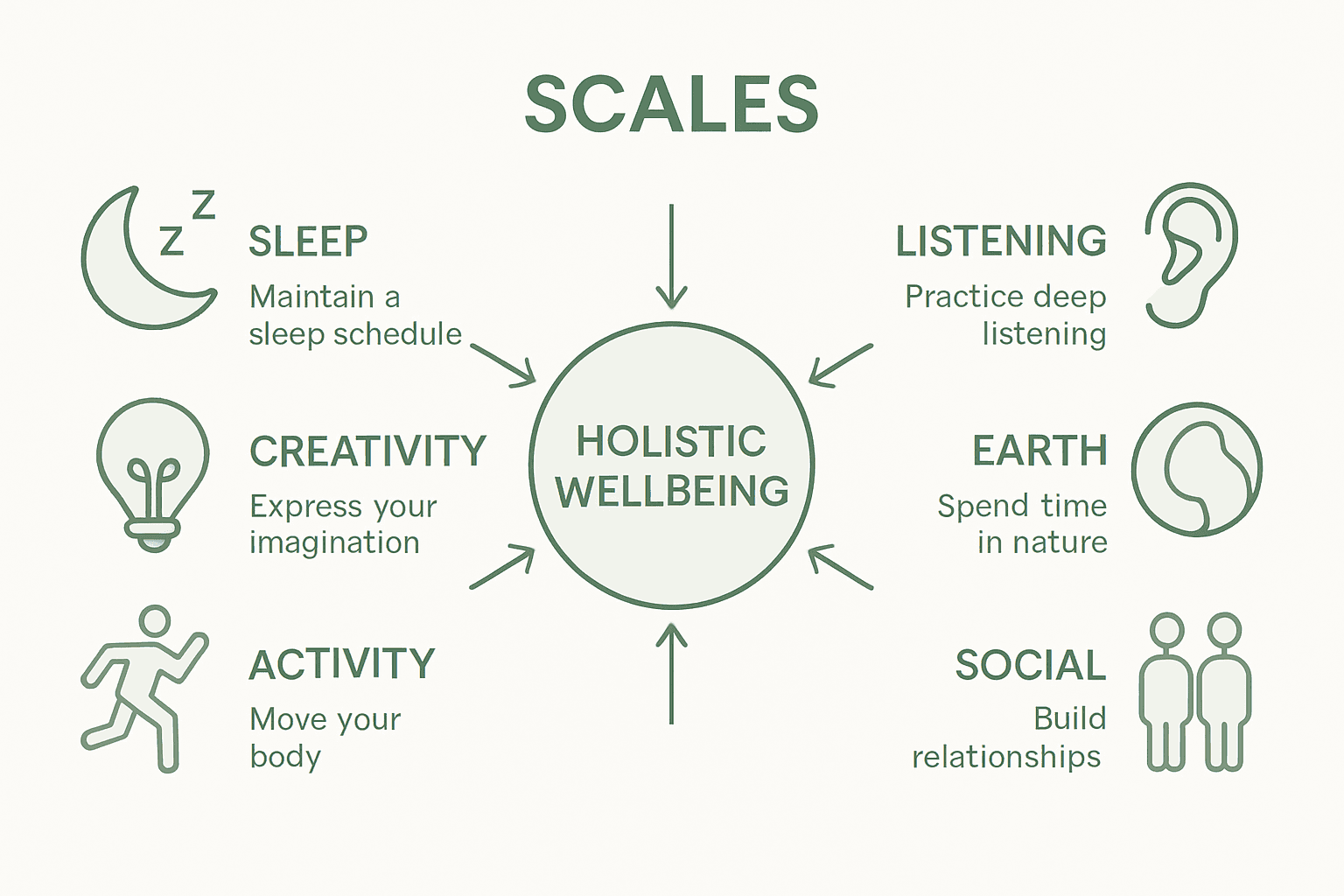
The SCALES Model represents a revolutionary approach to holistic wellbeing, offering a comprehensive framework that addresses psychophysical energy investments across multiple life domains. By conceptualising wellness as an interconnected system, the model moves beyond traditional fragmented approaches to personal development, recognising that true balance requires attention to six critical dimensions: Sleep, Creative Expression, Active Living, Listening, Earth Connection, and Social Engagement.

Sleep forms the foundational pillar of the model, acknowledging that restorative rest is fundamental to mental and physical recovery. Creative aspects emphasise the importance of expressive outlets that support emotional processing and psychological flexibility. The Active component focuses on physical movement and its profound impact on mood regulation and overall energy levels, while Listen encourages deep self-awareness and emotional intelligence through mindful introspection.
The final two dimensions—Earth and Social—complete the holistic approach by grounding individuals in their physical environment and nurturing meaningful interpersonal connections. This integrated model recognises that wellbeing is not about perfecting individual elements but creating a harmonious, dynamic balance where each dimension supports and enhances the others. By understanding these interconnections, individuals can develop more nuanced, personalised strategies for maintaining mental and emotional equilibrium.
Pro Tip: SCALES Self-Check: Spend 10 minutes each evening reviewing your day through the six SCALES dimensions, noting which areas felt balanced and which might need gentle attention in the coming days.
The SCALES Model introduces six unique dimensions. Here’s what each contributes to overall wellbeing:
Dimension | Primary Benefit | Example Practice |
Sleep | Supports restoration and recovery | Consistent bedtime |
Creative | Fosters emotional flexibility | Art or music activities |
Active | Enhances energy and mood | Daily walking or exercise |
Listen | Builds self-awareness | Mindful reflection |
Earth | Connects with environment | Time in nature |
Social | Strengthens relationships | Meaningful conversations |
Benefits for Stress, Mood, and Resilience
Holistic wellbeing approaches offer profound benefits for managing stress, improving emotional regulation, and building long-term psychological resilience. The Warwick-Edinburgh Mental Well-being Scale highlights how comprehensive wellness strategies can positively transform an individual’s mental landscape by addressing multiple dimensions of psychological functioning simultaneously.
By integrating strategies that target stress reduction across physical, emotional, and cognitive domains, individuals can develop more robust coping mechanisms. Research suggests that innovative interventions, such as mindful breathing techniques delivered through interactive technologies, demonstrate promising potential for mood enhancement and stress management. These approaches move beyond traditional therapeutic models by empowering individuals to actively participate in their mental health journey, recognising that resilience is not about eliminating stress but developing adaptive responses to life’s challenges.
The cumulative effect of a holistic approach is a more nuanced, flexible psychological profile. Individuals learn to recognise early stress signals, implement personalised recovery strategies, and maintain emotional equilibrium even during challenging periods. This approach transforms stress from an overwhelming force into a manageable, informative experience that can drive personal growth and self-understanding.
Pro Tip: Stress Resilience Practice: Dedicate 15 minutes daily to a holistic stress-management routine that combines physical movement, mindful breathing, and reflective journaling to build comprehensive emotional strength.
Common Pitfalls and How to Avoid Them
Holistic wellbeing journeys often encounter predictable challenges that can derail personal growth and mental health progress. The Choice and Partnership Approach highlights the critical importance of collaborative engagement and user-centred strategies in avoiding common mental health intervention pitfalls. One significant challenge is the tendency to adopt a one-size-fits-all approach, which fails to recognise the unique complexity of individual experiences.
A primary pitfall involves setting unrealistic expectations and pursuing transformation through rigid, prescriptive methods. Many individuals become discouraged when holistic practices do not yield immediate results, leading to premature abandonment of potentially beneficial strategies. The British Association of Mindfulness-Based Approaches emphasises the critical need for consistent, evidence-based practices that prioritise individual adaptation and patient-centred implementation. This means understanding that progress is nonlinear and requires patience, self-compassion, and a willingness to adjust strategies as personal circumstances evolve.
Another common mistake is treating holistic wellbeing as a series of disconnected techniques rather than an integrated, systemic approach. Individuals often compartmentalise wellness practices, attempting to implement sleep strategies, creative expressions, or physical activities in isolation. The most effective holistic models recognise the intricate interdependence of these dimensions, understanding that improvements in one area naturally support growth in others. By maintaining a flexible, responsive mindset and viewing wellness as a dynamic, ongoing process, people can develop more sustainable and meaningful approaches to personal development.
Pro Tip: Holistic Reality Check: Create a monthly reflection journal where you document your wellbeing journey, noting not just achievements but also challenges, learning moments, and subtle shifts in your overall perspective and energy.
Discover Practical Holistic Wellbeing Coaching Tailored for Your Life
The journey to balanced mental health often feels overwhelming when stress, low energy, or anxiety take over your daily life. This article highlights how holistic wellbeing addresses all parts of your life together rather than isolated symptoms. If you relate to feeling off balance or stuck despite trying different approaches, our coaching rooted in the proven SCALES Model offers the clarity and practical steps you need.
Tom Ryder Wellbeing specialises in helping you reconnect Sleep, Creative outlets, Active habits, Listening to yourself, Earth connection, and Social support. With customised coaching in Essex and online across the UK, we guide you through manageable routines and mindset shifts that lead to lasting improvements in mood, resilience, and overall wellbeing.
Ready to make small, effective changes that add up to real transformation? Explore our Mental Health and Wellbeing Coaching or Stress Management Coaching services today. Take your first step with a free consultation at Tom Ryder Wellbeing and start creating the balanced life you deserve.
Frequently Asked Questions
What is holistic wellbeing?
Holistic wellbeing is an approach to health that considers the interconnectedness of various life domains, including mental, emotional, physical, social, and spiritual elements. It focuses on overall wellness rather than just treating isolated symptoms.
How can I implement the SCALES model in my daily life?
To implement the SCALES model, focus on the six dimensions: ensure adequate Sleep, engage in Creative pursuits, maintain Active living, practice Listening to your inner self, establish an Earth Connection with nature, and foster Social Engagement through meaningful relationships. Reflect on these areas regularly to promote balance.
What benefits does holistic wellbeing offer for stress management?
Holistic wellbeing offers comprehensive strategies for managing stress by addressing physical, emotional, and cognitive domains. This can lead to more robust coping mechanisms, improved mood regulation, and a proactive approach to developing resilience against stressors.
What are common pitfalls in holistic wellbeing practices?
Common pitfalls include setting unrealistic expectations, treating holistic practices as disconnected techniques, and abandoning methods when immediate results aren’t seen. It’s essential to maintain a flexible mindset and view wellness as a dynamic, ongoing journey.
Recommended
Comments