


Why Set Wellbeing Goals: Real Impact for UK Professionals


Stress levels among British professionals have surged in recent years, with more than half reporting they feel overwhelmed on a regular basis. Juggling demanding careers and personal commitments in Essex can test anyone’s resilience, especially for those in creative roles or high-pressure environments. Addressing this head-on, practical wellbeing goals give structure to work-life balance and mental health, providing tangible ways to build emotional strength and protect long-term happiness.
Table of Contents
Key Takeaways
Point | Details |
Holistic Wellbeing Goals | Wellbeing goals are personalised objectives focusing on mental, emotional, and physical health to enhance quality of life. |
Types of Wellbeing Goals | They address various aspects such as mental health, physical fitness, work-life balance, and personal development. |
Importance of Specificity | Effective wellbeing goals should be specific, measurable, and action-oriented to ensure progress and maintain motivation. |
Overcoming Barriers | Identifying both psychological and external barriers is crucial; developing strategies to address these can significantly improve goal attainment. |
What Are Wellbeing Goals and Why They Matter
Wellbeing goals represent strategic, personalised objectives designed to enhance an individual’s overall quality of life across multiple dimensions. Unlike traditional performance targets, these goals focus holistically on mental, emotional, and physical health. The National Centre for Social Research emphasises that wellbeing encompasses not just individual experiences, but also community and societal functioning.
At their core, wellbeing goals are structured intentions that help professionals systematically improve their life balance. They typically address key areas such as mental health, physical fitness, work-life integration, personal relationships, and emotional resilience. Professionals in high-stress environments like Essex often find these goals crucial for preventing burnout and maintaining sustainable performance. Research on holistic wellbeing suggests that deliberately setting such goals can significantly enhance personal functioning and overall life satisfaction.
Successful wellbeing goals are characterised by their specificity and actionability. Rather than vague aspirations, they involve clear, measurable targets that can be tracked and adjusted. For instance, a wellbeing goal might involve establishing a consistent sleep routine, developing stress management techniques, or creating dedicated time for physical exercise and personal creativity. The key is creating goals that are both challenging and achievable, tailored to an individual’s unique circumstances and capacity.
Pro tip: Start by conducting a personal audit of your current wellbeing, identifying 2-3 specific areas where targeted improvement could have the most significant impact on your overall quality of life.
Different Types of Wellbeing Goals Explained
Wellbeing goals are multifaceted strategies that address various aspects of personal and professional life. The Five Ways to Wellbeing framework provides a comprehensive approach to understanding these diverse goal types, highlighting five critical dimensions of holistic personal development: connecting with others, staying physically active, practicing mindfulness, continuous learning, and engaging in altruistic activities.
These goals can be broadly categorised into distinct domains that reflect different aspects of human experience. Mental health goals might focus on stress reduction, emotional regulation, and developing resilience. Physical wellbeing goals typically involve establishing consistent exercise routines, improving nutrition, and maintaining healthy sleep patterns. Professional development goals often centre on work-life balance, skill enhancement, and creating sustainable career progression strategies. Research on wellbeing dimensions suggests that effective goals should balance both subjective experiences (how individuals feel) and objective conditions (external circumstances).
Successful wellbeing goals are typically personalised and context-specific. A professional in a high-pressure Essex corporate environment might prioritise stress management and boundary-setting, while someone in a creative field might focus more on maintaining creative inspiration and managing irregular work patterns. The key is creating goals that are specific, measurable, and aligned with individual values and life circumstances.
Pro tip: Create a personal wellbeing goal ‘portfolio’ that covers at least three different life domains, ensuring a holistic approach to your overall development and satisfaction.
Here is a summary of key wellbeing goal categories and their core objectives:
Domain | Primary Objective | Example Goal | Typical Benefit |
Mental Health | Improve emotional resilience | Develop stress regulation techniques | Increased stress tolerance |
Physical Wellbeing | Enhance physical fitness | Establish regular exercise routine | Better energy and sleep |
Work-Life Balance | Achieve sustainable pace | Implement ‘unplugged’ hours | Reduced burnout risk |
Personal Development | Foster lifelong learning | Learn a new skill quarterly | Enhanced self-confidence |
How Setting Goals Supports Mental Health
Setting specific, measurable goals provides critical psychological scaffolding for mental health, transforming abstract aspirations into tangible, achievable steps. The SMART goal framework enables professionals to break complex challenges into manageable actions, reducing overwhelm and creating a sense of progressive control over their mental wellbeing.
The psychological benefits of goal setting extend far beyond simple task completion. Mental resilience emerges through the process of setting, pursuing, and reflecting on personal objectives. Research on goal-setting strategies demonstrates that structured goal approaches can significantly reduce stress by providing clear direction and meaningful benchmarks. For UK professionals navigating high-pressure work environments, this approach offers a systematic method to manage anxiety, build confidence, and maintain emotional equilibrium.

Goal setting acts as a powerful cognitive restructuring tool, helping individuals reframe negative thought patterns and develop more constructive mental frameworks. By establishing realistic, incremental objectives, professionals can gradually rebuild self-efficacy, challenge self-limiting beliefs, and create positive feedback loops that support ongoing mental health maintenance. The process encourages self-reflection, promotes a growth mindset, and provides tangible evidence of personal progress and capability.
Pro tip: Develop a weekly goal-tracking ritual where you review your objectives, celebrate small wins, and compassionately adjust your approach without self-criticism.
Common Barriers and Practical Solutions
Mental health intervention challenges frequently stem from systemic barriers that prevent professionals from effectively pursuing wellbeing goals. Psychological obstacles like self-doubt, imposter syndrome, and deeply ingrained negative thought patterns can significantly undermine even the most well-intentioned personal development strategies. These internal barriers often manifest as procrastination, fear of failure, and a persistent sense of overwhelm that paralyses constructive action.
External challenges compound these internal struggles. Research on wellbeing interventions highlights socioeconomic inequalities and limited access to supportive resources as critical impediments to mental health progress. For UK professionals, particularly those in high-stress sectors like finance, technology, and creative industries, these challenges are magnified by competitive work environments, long working hours, and insufficient organisational support for mental wellness.
Practical solutions require a multifaceted approach that addresses both psychological and systemic barriers. Strategies might include developing robust support networks, implementing regular self-reflection practices, seeking professional coaching, and creating personalised stress management techniques. Breaking down large, intimidating goals into smaller, manageable steps can help professionals overcome inertia and build momentum. Crucially, this approach requires self-compassion, recognising that progress is rarely linear and setbacks are normal parts of personal growth.
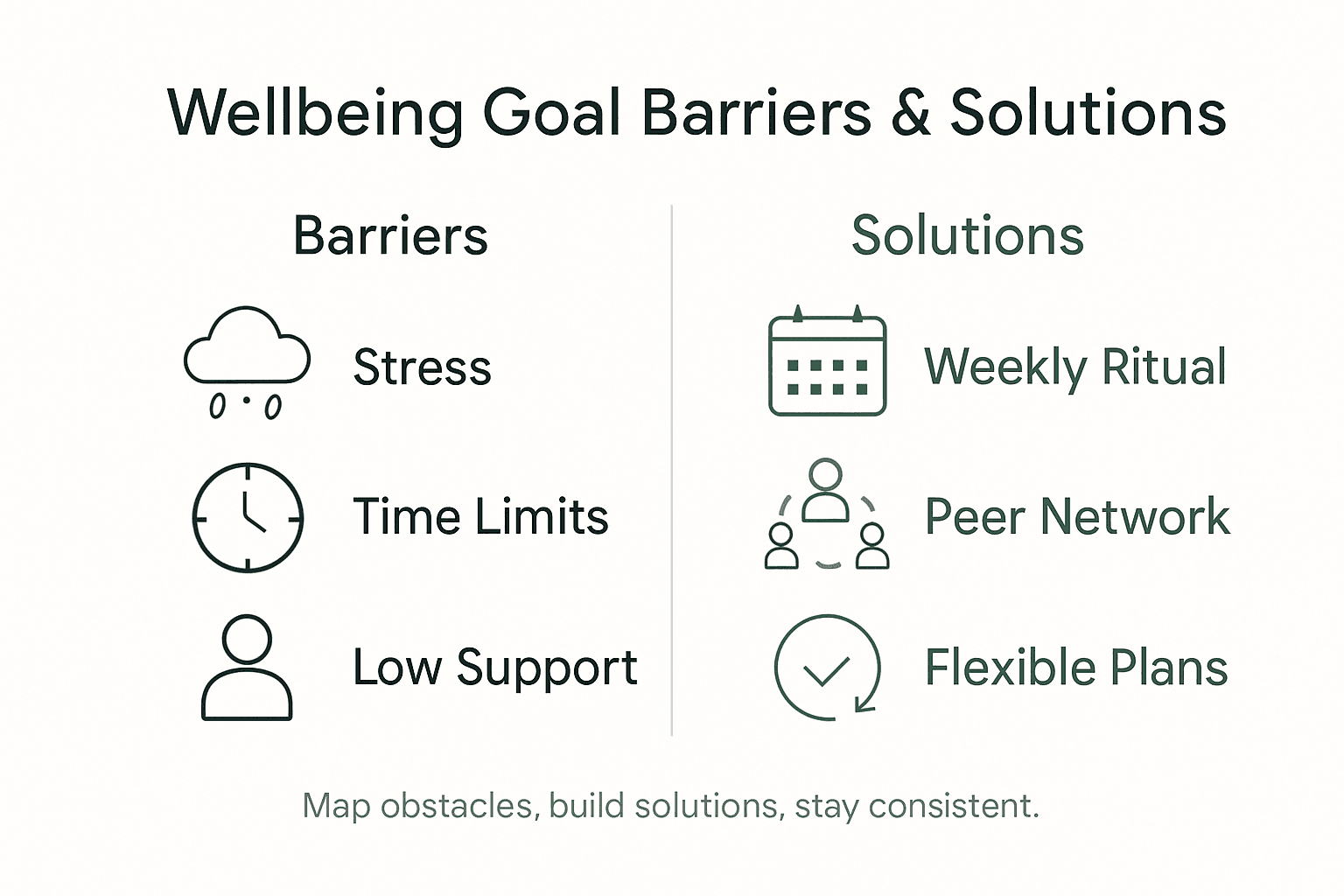
Pro tip: Create a ‘barrier blueprint’ where you explicitly map out potential obstacles to your wellbeing goals, developing specific counterstrategies for each identified challenge.
The following table compares common barriers to pursuing wellbeing goals with practical solutions:
Barrier | Impact on Progress | Practical Solution |
Self-doubt and imposter syndrome | Erodes confidence and motivation | Seek coaching and peer support |
Procrastination | Prevents goal initiation | Break tasks into manageable steps |
Socioeconomic inequalities | Limits access to resources | Identify affordable local options |
Lack of organisational support | Hinders work-life balance | Advocate for wellbeing policies |
Mistakes to Avoid When Pursuing Wellbeing
Systemic mistakes in wellbeing approaches often emerge from fundamental misunderstandings about mental health and personal development. Many professionals mistakenly treat wellbeing as a linear, one-dimensional journey, overlooking the complex, interconnected nature of mental, emotional, and physical health. This reductive approach can lead to superficial interventions that fail to address root causes of stress and personal limitations.
One critical error professionals frequently make is conflating activity with genuine progress. Performative wellbeing strategies like sporadic meditation apps or isolated fitness challenges rarely create sustainable change. Research on comprehensive wellbeing interventions demonstrates that effective approaches must be holistic, integrating multiple dimensions of personal health and addressing individual context. Professionals should avoid adopting generic wellness trends without critically evaluating their personal relevance and potential impact.
Another significant mistake involves unrealistic expectations and all-or-nothing thinking. Wellbeing is not about achieving perfect balance but developing resilience and adaptability. Many individuals sabotage their progress by setting unattainable standards, leading to cycles of frustration and self-criticism. Successful wellbeing strategies require patience, self-compassion, and a willingness to experiment, adjust, and learn from setbacks. Recognising that progress is rarely linear and embracing incremental improvements is fundamental to sustainable personal growth.
Pro tip: Create a personal ‘wellbeing experiments’ journal where you document your approaches, track what works, and reflect on your learning without judgment.
Take Control of Your Wellbeing Goals Today
The article highlights the importance of setting clear, achievable wellbeing goals to improve mental resilience, reduce stress, and create a balanced life amid modern pressures faced by UK professionals. If you find yourself overwhelmed by constant stress, low energy, or difficulty maintaining routines, you are not alone. Using practical frameworks like the SCALES Model, Tom Ryder Wellbeing specialises in helping people break down those big challenges into small, manageable steps that truly work.
Whether you want support with Mental Health and Wellbeing Coaching, need tailored strategies for Stress Management Coaching, or seek insights from a Work Life Balance Coach, coaching with Tom Ryder offers grounded, honest guidance based on lived experience and professional expertise. Take your first step toward clearer direction and sustainable change by visiting Tom Ryder Wellbeing and booking your free consultation now. Make wellbeing goals that stick and feel better every day.
Frequently Asked Questions
What are wellbeing goals?
Wellbeing goals are personalised objectives aimed at improving an individual’s overall quality of life, focusing on mental, emotional, and physical health, rather than purely performance targets.
Why is it important to set wellbeing goals?
Setting wellbeing goals helps individuals achieve a balanced life, reduce stress, enhance emotional resilience, and improve overall satisfaction, making it crucial for professionals in high-stress environments.
How can I create effective wellbeing goals?
Effective wellbeing goals should be specific, measurable, achievable, relevant, and time-bound (SMART), and tailored to your unique circumstances, ensuring they are both challenging and realistic.
What common barriers do professionals face when pursuing wellbeing goals?
Common barriers include psychological challenges like self-doubt, external pressures such as lack of organisational support, and socioeconomic inequalities that limit access to resources for personal development.
Recommended
Comments