


How to Support Student Resilience for College Success


Exam stress and changing friendships can make college in Essex feel overwhelming for many young adults. Facing constant pressure to fit in, perform well, and manage your wellbeing often leaves real challenges unspoken or unaddressed. By focusing on wellbeing measurement frameworks and practical resilience routines, you can uncover what truly affects your daily life and build specific coping strategies that actually work. Discover how targeted support and creative solutions create space for stronger mental health and self-understanding.
Table of Contents
Quick Summary
Key Insight | Explanation |
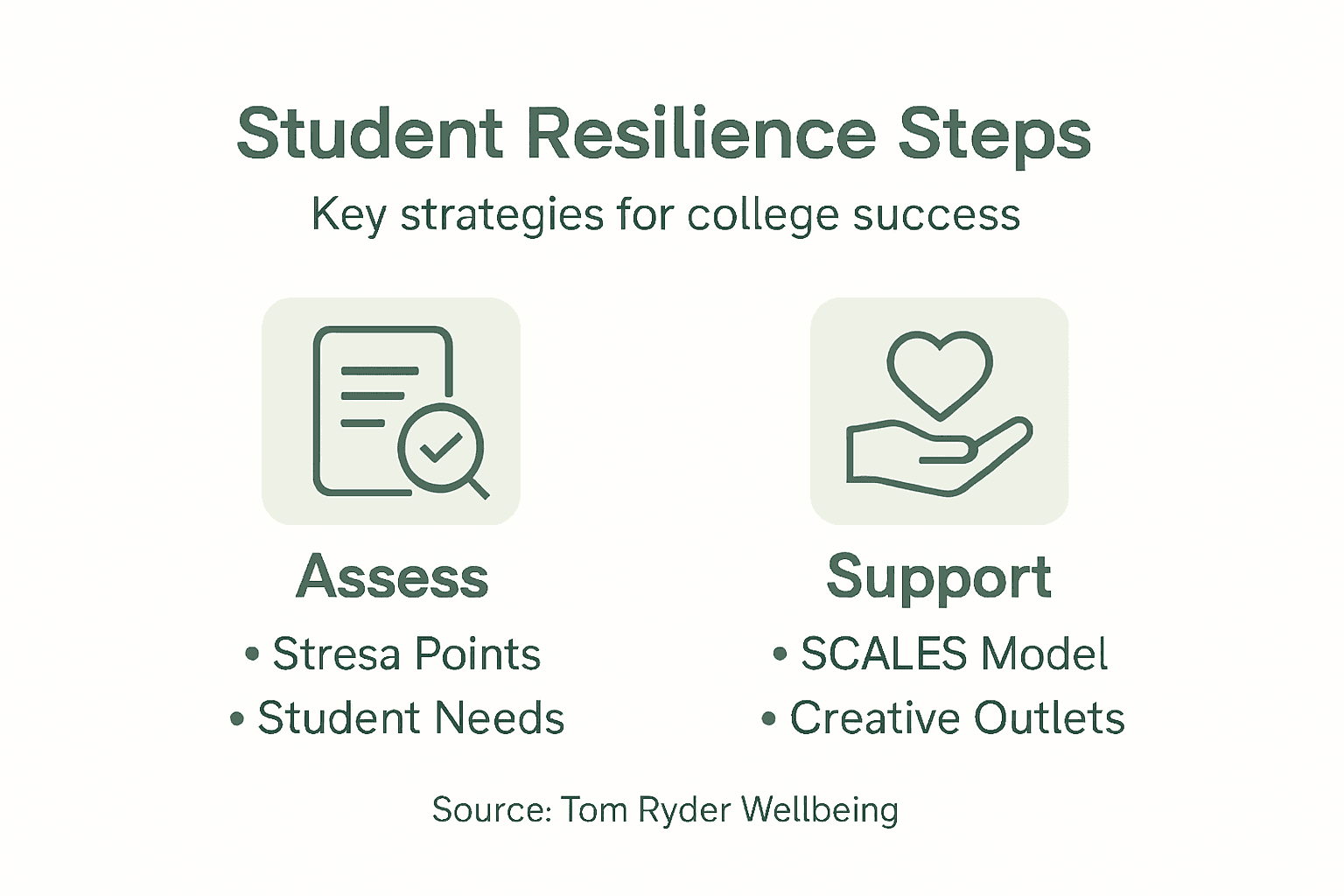
1. Assess Student Stress Factors | Understand the unique stressors affecting students through conversations and observations to tailor support effectively. |
2. Implement the SCALES Model | Use SCALES (Sleep, Creative, Active, Listen, Earth, Social) to create manageable routines addressing specific student stress points. |
3. Facilitate Creative and Social Outlets | Normalize and integrate creative and social activities as vital coping strategies to help students manage stress and build connections. |
4. Monitor and Adjust Support | Regularly check in on student progress and adapt support strategies based on their feedback and emerging needs to ensure effectiveness. |
Step 1: Assess Key Stress Points and Student Needs
Before you can support resilience effectively, you need to understand what’s actually causing stress for your students. This isn’t about guessing or making assumptions based on what you think college life should be like. It’s about listening, observing, and measuring what’s really happening in their daily lives so you can target support where it matters most.
Start by creating space for honest conversations. Many students won’t volunteer that they’re struggling with exam anxiety, friendship changes, or uncertainty about their future unless you specifically ask. Consider using structured tools like wellbeing measurement frameworks that include questionnaires such as the Warwick-Edinburgh Mental Wellbeing Scale, which helps identify both strengths and challenges across different areas of student life. You might also run one-to-one check-ins where you simply ask: “What’s been the hardest thing about college so far?” and “What would help you feel more in control?” Listen for patterns. Do several students mention sleeping poorly before exams? Are friendship groups changing and causing anxiety? Is the workload creating cycles of panic and procrastination? These patterns tell you where support will have the biggest impact.
Beyond conversations, observe behaviour and routines. Students under genuine stress often show up differently than they typically do. Some withdraw from social activities, others become irritable, and some throw themselves into work as a distraction. A student who never attends the college canteen might be skipping meals due to anxiety. Someone who’s always been punctual but starts arriving late could be struggling with sleep or motivation. Research from resilience initiatives in UK universities highlights how emotional control, self-management, and social connection all play a role in how students adapt to college life. This means you need to look at whether students feel supported socially, whether they have basic routines in place, and whether they’re developing the ability to bounce back from setbacks. Pay attention to how students handle smaller disappointments too. Do they see a lower test score as temporary feedback or permanent proof of failure? That reveals a lot about resilience patterns.
Once you’ve gathered this information, organise it. Create a simple record of which students are showing signs of stress, what seems to trigger it, and what’s already working for them. Some students might manage exam stress brilliantly but struggle with social transitions. Others might have strong friendships but poor sleep routines that undermine everything else. You might notice that students in your college dealing with building emotional resilience benefit most from practical support rather than endless reassurance. The goal isn’t a lengthy diagnostic report. It’s a clear, honest picture of where each student stands so you can match support to actual needs rather than generic advice.
Helpful hint Document what you observe without judgement, then group students by common stress points rather than individual cases. This helps you design group interventions like workshops on exam technique or sleep routines that address the patterns you’ve identified, reaching more students with targeted support.
Step 2: Apply the SCALES Model to Daily Routines
Now that you understand where your students are struggling, you can use the SCALES model to build practical routines that address those specific stress points. SCALES stands for Sleep, Creative, Active, Listen, Earth, and Social. Rather than treating these as separate concepts, think of them as six strings on an instrument. When all six are in tune, students feel balanced and resilient. When one or more goes out of tune, stress builds quickly. The beauty of applying SCALES to daily routines is that you’re not asking students to overhaul their entire lives. You’re identifying small, consistent actions within each area that fit into how they actually live.
Start by looking at which SCALES strings are most out of tune for the students you identified as stressed. If sleep emerged as a pattern during your assessment, that becomes your first focus. Work with students to build a realistic evening routine that supports better rest, not a perfect one. This might mean putting their phone away 30 minutes before bed, keeping their room at a cooler temperature, or having a consistent wind-down activity like reading or sketching. If social connection is the issue, maybe the routine involves sitting with a different friend group at lunch three times a week or joining one club that genuinely interests them. The key is specificity. “Be more social” fails because it’s vague and overwhelming. “Attend the art club on Thursdays” works because it’s concrete and manageable. Research on how routines reduce cognitive load shows that when students have predictable daily patterns, they worry less about what comes next and can focus energy on actual learning and growth rather than anxiety management.
Help students see how the SCALES strings connect to each other. A student sleeping better will have more energy for active pursuits. Someone spending time in nature (Earth) often feels calmer and sleeps deeper (Sleep). A student with a creative outlet like music or writing processes stress more effectively. When you help students see these connections, they stop viewing self-care as six separate tasks and start seeing it as an integrated system. You might create a simple weekly tracker where students note which SCALES areas they’ve tended to each day. This isn’t about perfection or checking every box. It’s about noticing patterns over a week or two. Did they sleep better when they moved their body that day? Did they feel more socially confident after doing something creative? These small observations help students build their own evidence that these routines actually work, which increases their willingness to stick with them.
Here’s a summary of how each SCALES area contributes to student resilience:
SCALES Area | Core Benefit | Daily Example |
Sleep | Restores energy and focus | Keeping a set bedtime |
Creative | Enables emotional expression | Sketching or writing daily |
Active | Reduces stress physically | Walking or stretching |
Listen | Strengthens self-awareness | Reflective journaling |
Earth | Grounds and calms mind | Time outdoors in nature |
Social | Builds connection and support | Sharing lunch with peers |
When introducing SCALES routines to your college, frame it around the specific stress points you identified. Don’t say “everyone needs better sleep routines.” Say “we noticed many of you struggle sleeping before exams, so we’re trying something specific on Tuesday evenings.” Make the connection between the routine and the real problem you’ve observed. This approach respects their intelligence and shows you’re not handing out generic advice. You might also consider how to build healthy routines naturally so students understand the reasoning behind what you’re suggesting rather than just following instructions. The goal is for students to eventually design their own SCALES routines, not depend on you to tell them what to do. You’re teaching them a framework they can use throughout college and beyond.
Practical tip Start with just one SCALES area that directly addresses a stress pattern you observed, rather than trying to overhaul all six at once. Once students experience real improvement in sleep, energy, or mood from one routine change, they’ll be naturally motivated to adjust other areas.
Step 3: Introduce Creative and Social Outlets for Coping
Creative and social outlets are not luxuries or distractions from studying. They are essential coping mechanisms that help students process stress, build connection, and develop emotional regulation skills. When students have a way to express what they’re feeling, whether through art, music, writing, or conversation, they’re literally changing how their brain handles stress. The same goes for social connection. Students who feel isolated struggle far more with resilience than those with genuine peer support. Your role is to make these outlets accessible, normalised, and integrated into college life rather than positioning them as add-ons for people who “have time.”

Start by identifying what creative outlets already exist in your college community and which ones are underused. Do you have art studios, music rooms, drama clubs, or writing groups? Perhaps there’s a maker space, sports facilities, or outdoor areas? The specific form matters less than whether it genuinely appeals to your students. A student who hates team sports won’t suddenly love resilience through football. But that same student might discover they process anxiety beautifully through painting or poetry. Have conversations with students about what activities help them feel calmer or more like themselves. You might hear that someone loses themselves in gaming, another finds peace in gardening, someone else comes alive whilst playing guitar. These aren’t frivolous preferences. They’re individual stress management systems already in place. Your job is to help expand and formalise them. Research emphasises how social support and creative coping mechanisms help students manage stress and build belonging, which directly strengthens resilience. When students can name their creative outlet as part of their wellbeing strategy rather than feeling guilty about it, they commit to it more consistently.
Create a low-pressure structure around these outlets. This might mean a weekly drop-in art session during lunch where no one’s judging the quality of work, just creating. Perhaps it’s a “creative Wednesday” where students bring any creative project they’re working on and sit together in a common space. It could be a peer support group where students share what they’re managing and how they’re coping. The structure removes barriers. Without it, students tell themselves they’ll go to the art room alone and then never do. With a regular time and a few familiar faces, they show up. You might also consider creative outlets designed to support wellbeing so you understand how to frame these activities to students. Think about how to make social connection feel organic rather than forced. A structured discussion circle might feel awkward to some students. A group project where collaboration happens naturally alongside creative work feels more genuine. The goal is students spending time together whilst doing something meaningful, not sitting in a circle being asked how they feel.
Be particularly mindful of students who feel disconnected from obvious peer groups. Some students find their people through creative outlets rather than through traditional social structures. The quiet student who sits alone at lunch might connect deeply with one other person in the photography club. The student struggling with exam anxiety might find their closest friends in a writing group rather than their form class. These connections matter enormously for resilience. You might also notice that some students prefer solo creative practice but still benefit from doing it alongside others. An anxious student might not want to chat whilst drawing, but knowing another person is there drawing too provides quiet companionship that shifts something neurologically. Honour these different preferences. Not everyone needs to be a social butterfly to build resilience.
The table below compares individual and group creative outlets for coping with stress:
Outlet Type | Key Features | Unique Benefits |
Individual | Self-directed activity | Fosters autonomy and self-discovery |
Group | Shared creative sessions | Enhances peer connection and belonging |
Practical tip Start with activities that students are already doing informally and create structure around them rather than inventing new programs. If you notice students gathering in the common room to sketch or a group chatting animatedly over lunch, turn those moments into intentional spaces. Students are far more likely to sustain something they’ve chosen than something adults designed for them.
Step 4: Monitor Progress and Adjust Support Strategies
Support doesn’t end once you’ve introduced routines, outlets, and frameworks. Real resilience building requires consistent monitoring and adjustment. What works for a student in September might need tweaking by November. A strategy that helped one cohort manage exam stress might fall flat with the next group. Your role is to stay attentive to what’s actually happening and make changes based on real data rather than sticking rigidly to a plan that isn’t delivering results.
Start by establishing a simple monitoring system that doesn’t become overwhelming paperwork. This could be as straightforward as check-in conversations every two to three weeks where you ask students specific questions about the strategies you introduced together. How’s the evening routine helping your sleep? Are you attending the creative sessions? What’s changed for the better and what still feels hard? Listen to the answers carefully. You’ll notice patterns quickly. If three students mention that the Thursday afternoon workshop time doesn’t work because of their timetable, move it. If students report feeling less anxious but still sleeping poorly, the sleep strategy needs adjustment. The key is acting on what you hear rather than collecting feedback and then ignoring it. Ongoing monitoring and formative assessment provide real-time insights that allow you to identify where students need additional support and make timely adjustments to interventions. This data-driven approach transforms support from a static programme into something genuinely responsive to your college community.
Consider using structured tools alongside conversations. A simple wellbeing tracker that students complete monthly can show trends over time. You might use resilience assessment tools that measure multiple dimensions of mental health and wellbeing, giving you insight into which environmental and personal factors affect resilience most significantly. Notice which students are improving visibly. These students are your evidence that the strategies work. Share their progress cautiously and appropriately with peers. Peer influence matters enormously. When students see someone they respect managing exam stress better through a creative outlet or sleeping more soundly through a routine change, they become curious. Simultaneously, notice which students aren’t shifting. Sometimes they need a different strategy entirely. A student struggling with a group creative session might thrive with one-to-one support. Someone for whom social outlets feel overwhelming might need to start with solo creative practice before joining groups. There’s no shame in adjusting. It’s the opposite of failure. It’s responsive care.
Build feedback into your process so students feel heard. After a few weeks of implementing new support, ask students directly what’s helping and what isn’t. This communicates that you value their perspective and that resilience building is collaborative rather than something imposed on them. You might discover that the new mindfulness session is brilliant but the timing is rubbish, or that students love the peer support group but want it in a different space. Small adjustments based on student feedback often make the difference between a programme that survives and one that genuinely thrives. Track what you learn over time so you’re building institutional knowledge. What worked with this year’s stressed cohort? What didn’t? Keep records that future staff can access. Your observations become wisdom that shapes how support evolves year after year.
Practical insight Set a specific review date every four weeks to assess whether strategies are working, rather than waiting for obvious problems to emerge. Check against the specific stress points you identified at the start. Have they reduced? Have they shifted? Adjust one element at a time so you can actually see what caused change, rather than overhauling everything at once.
Strengthen Student Resilience with Practical Support
College life can bring overwhelming stress, anxiety, and uncertainty that disrupt students’ wellbeing and academic success. This article highlights the power of identifying specific stress points and using the SCALES Model to build balanced routines that promote emotional resilience. If you recognise feelings of low energy, difficulty sleeping, or social disconnection—common challenges for students—there is guidance that can help turn these struggles into strengths.
At Tom Ryder Wellbeing we specialise in emotional resilience coaching tailored to young people and students navigating exam stress, routine challenges, and life transitions. Using our proven SCALES framework, we help clients develop practical daily habits around Sleep, Creativity, Activity, Listening, Earth, and Social connection. These targeted strategies reduce anxiety and improve focus so you can face setbacks with confidence. Discover how 1:1 coaching or group sessions can support your unique needs by visiting Emotional Resilience Coaching and explore how to build routines that make a genuine difference.
Take the first step towards clearer routines and stronger wellbeing today. If you want to move past feeling stuck or overwhelmed, check out our Wellbeing Coaching UK options or learn more about working with us at our main website. Your resilience journey starts with small, practical changes that add up to lasting success.
Frequently Asked Questions
How can I identify stress points for my college students?
To identify stress points, engage in open conversations with students and observe their behaviour. Schedule regular check-ins to ask specific questions about their experiences, like what challenges they’re facing and what support they need.
What is the SCALES model and how can it help students?
The SCALES model addresses six key areas—Sleep, Creative, Active, Listen, Earth, and Social—that contribute to student resilience. Implement small, actionable routines in each area to help students feel balanced and reduce stress.
How can I create a supportive environment for creative outlets?
Encourage creative expression by establishing structured opportunities for students to engage in activities like art, music, or writing. Set up weekly sessions for these creative pursuits, ensuring they feel accessible and not pressured, which can enhance overall wellbeing.
What kind of monitoring should I implement to support resilience?
Establish a simple system for monitoring student wellbeing through regular check-ins every few weeks. Ask targeted questions about the strategies in place to assess their effectiveness and adjust them based on their feedback.
How can I help students build social connections at college?
To foster social connections, create low-pressure group activities that facilitate interactions among students with shared interests. Consider starting informal gatherings, like a lunch group or a creative session, to help students connect naturally.
What adjustments should I make if initial support strategies aren’t effective?
If strategies aren’t working, gather student feedback to identify what’s needed. Be open to making small adjustments based on their input, such as changing session times or formats to better suit their needs.
Recommended
Comments